


Houston Wealth Management Security Index 2026: First Place, Still a D
What The Security Index Means For Houston RIAs – How Houston Wealth Managers Compare By City
CinchOps graded 206 Houston-area wealth managers from the outside. They lead six industries at 1.87, still 0.13 short of a C.
The Houston wealth management security index results are in: 206 registered investment advisers and wealth management firms across the Houston area were graded from the outside, and as a group they scored better than every other industry CinchOps has measured.
The Houston Area Security Index now covers 4,599 businesses across 12 cities and six industries. Wealth managers joined on November 23, 2026, after law firms, CPA practices, manufacturers, commercial construction and trades, and engineering firms. Every firm is scored A through F in six categories using only what is visible from the public internet: the same view an attacker gets before choosing a target.
CinchOps provides managed cybersecurity and IT support specifically for wealth management and RIA firms in the Houston metro area, and its 2026 Security Index now grades 206 of those firms by name-blind external scan. The cohort averages a 1.87 GPA. On the index scale, that is still a D.
Houston Wealth Management Firms Lead All Six Industries in the 2026 Index
How the wealth management cohort compares with the five industries already in the index.
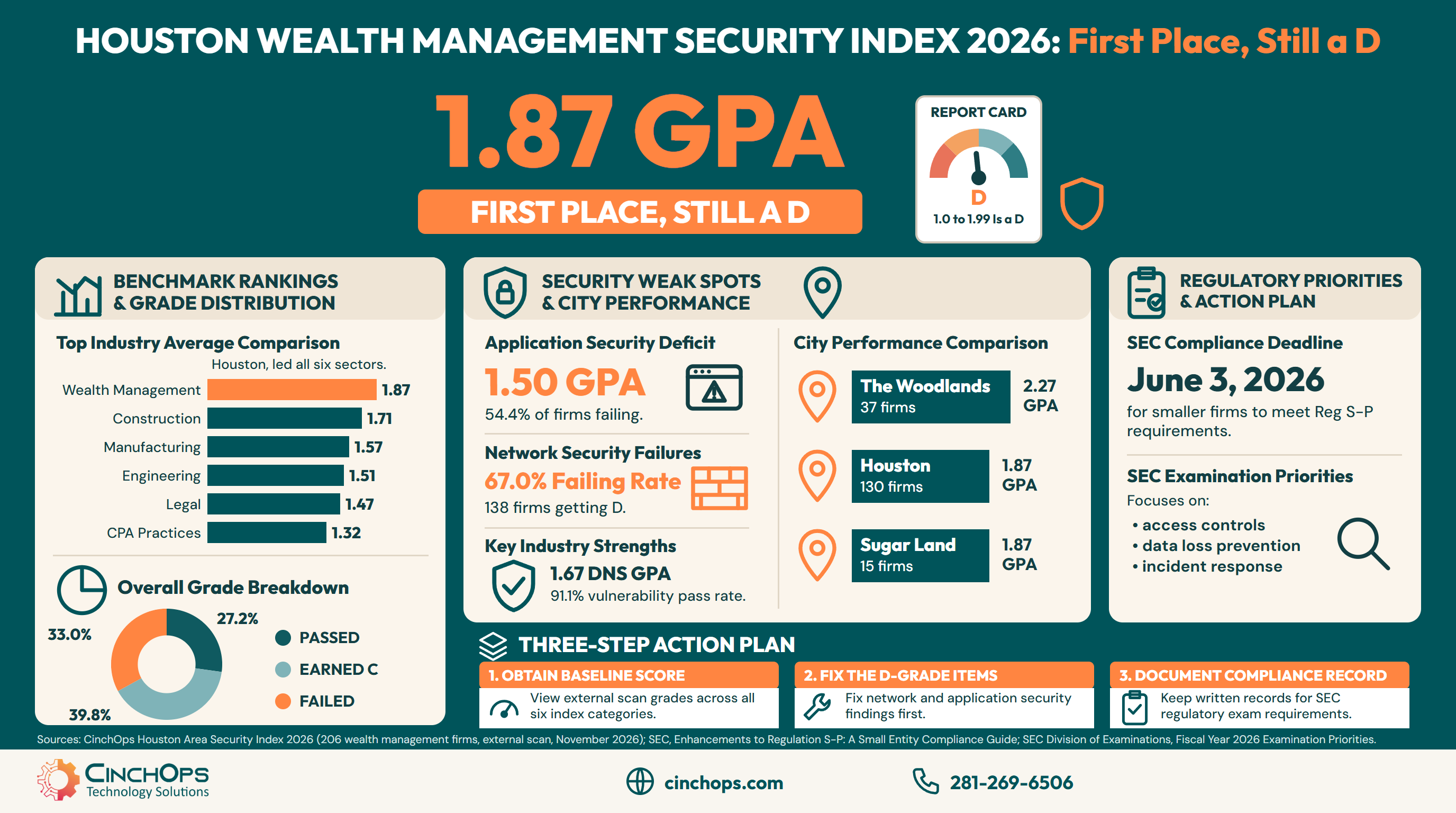
Houston wealth management firms average a 1.87 GPA on the 2026 Security Index, the highest of six industries, with 33.0% of firms failing (a D or F) against 48.8% across all 4,599 businesses in the index.
Commercial construction and trades had held first place since August at 1.71, with 41.7% failing. Manufacturing follows at 1.57, engineering at 1.51 and legal at 1.47, and CPA practices sit last at 1.32 with 55.5% failing. Adding 206 wealth managers moved the index-wide average from 1.51 to 1.53.
The gap between first and second place is wider than any other step in the table. Wealth managers sit 0.16 above construction, while the next four industries are separated by 0.14 or less from neighbor to neighbor. Their fail rate is also the only one in the index below 40%.
The matrix plots each industry by average GPA and by the share of firms failing. Wealth Management is the only industry in the upper-left corner by a clear margin: higher grades and fewer failures than the index average on both measures at once.
Leading the Index Still Means Averaging a D
What a 1.87 GPA means on the index's own grading scale.
A 1.87 GPA is a D on the Security Index scale, which grades 1.0 to 1.99 as a D and 2.0 to 2.99 as a C, so the best-performing industry in the Houston index is 0.13 points short of an average C.
Grade counts make the spread clearer. Of 206 firms, one earned an A, 55 earned a B, 82 a C, 53 a D and 15 an F. That puts 27.2% of Houston wealth managers in the passing range, 39.8% in the middle and 33.0% failing. The largest single group is the C firms, which is why the average sits close to the line without crossing it.
The position here is plain: first place in this index is a relative result. A wealth manager reading 1.87 as a pass is reading the rankings table and skipping the scale underneath it.
Application Security and Network Security Pull the Grade Down
Which of the six scored categories cost Houston wealth managers the most points.
Application security is the weakest category for Houston wealth management firms at a 1.50 GPA, with 54.4% failing and only 2.9% passing, and network security follows at 1.91 with 67.0% of firms failing.
The index scores six categories. Application Security covers common website and application vulnerabilities, and only 6 of 206 wealth managers earned an A or B there. Network Security covers insecure network configurations and settings, and it splits almost in two: 60 firms earned an A and 138 earned a D, with only 8 in between. A wealth manager is usually at one end of that split, and the external scan shows which.
The strengths are real too. Wealth managers beat the index average on DNS Health (1.67 against 1.26), and 91.1% pass Vulnerabilities, which covers exposures and risks detected on external assets, against 78.8% across the index. IP Reputation (3.96) and Social Engineering (3.00) are high for every industry and do little to separate firms.
Two of the three categories where wealth managers trail or match the index, application and network, are configuration work on the website and the firewall. DNS Health is still the category with the most outright failures, with 53 firms graded F, so the lead there is a better average rather than a finished job.
The Woodlands Wealth Managers Hold the Strongest Cell in the Index
How wealth management grades differ across Houston-area cities.
The Woodlands wealth management firms average a 2.27 GPA with 16.2% failing, the strongest region-and-industry cell in the 2026 Houston Area Security Index and the first to average above a C.
None of the 37 firms in The Woodlands earned an F, and 16 earned a B. Houston, with 130 firms, sits at 1.87 with 33.1% failing, and Sugar Land's 15 firms land at the same 1.87 with 33.3% failing. Katy has 9 wealth management firms in the cohort, one short of the 10 the index requires before a city-and-industry group is ranked, so Katy is reported but not ranked.
The Woodlands result is the local finding worth acting on. A Woodlands firm graded C sits in the middle of its own peer group, while the same C in Houston sits above the city average, so the comparison a firm should make is with its own city, not the metro. Missouri City, Tomball, Cypress and Fulshear add 15 firms between them, too few to rank on their own.
The Same Gaps Sit Close to What SEC Examiners Ask About
How the index's weakest categories line up with Regulation S-P and SEC exam priorities.
Regulation S-P now requires SEC-registered investment advisers to keep a written incident response program, and the compliance date for smaller firms passed on June 3, 2026, so the gaps an outside scan finds are gaps an exam can ask about.
The SEC adopted its Regulation S-P amendments on May 16, 2024. Larger entities had to comply by December 3, 2025, and smaller ones by June 3, 2026. The SEC's small entity compliance guide says service providers must notify the firm as soon as possible and no later than 72 hours after a breach, that customer notice goes out no later than 30 days, and that ultimate responsibility for that notice rests with the adviser.
The SEC Division of Examinations' fiscal year 2026 priorities name governance practices, data loss prevention, access controls, account management, and responses and recovery to cyber-related incidents. They also flag red flags during customer account takeovers and fraudulent transfers. The external scan does not grade a firm against those rules, but its three weakest wealth management categories map onto the same topics.
An external scan grades what anyone can see, which is a fair proxy for the first question an examiner or an insurer asks: what is exposed, and who is fixing it. A firm with a D in network security and no written plan to fix it has a harder conversation ahead than one with the same D and a dated remediation record.
A 1.87 leads the index and still grades as a D. Houston wealth managers did the email and domain work better than anyone else we measured. The points they are losing are on the website and the firewall, and those are fixes, not projects.
See Your Firm's Own Grade
The free CinchOps assessment uses the same external view as the Security Index, so a wealth manager can see its own six category grades next to the Houston averages. CinchOps cybersecurity then works the D-grade items first.
Explore CinchOps cybersecurity →How CinchOps Can Help Houston Wealth Management Firms
CinchOps is a managed IT services provider based in Katy, Texas, serving small and mid-sized businesses across the Houston metro area. CinchOps specializes in cybersecurity, network security, managed IT support, VoIP, and SD-WAN for businesses with 10 to 200 employees.
Firms searching for top managed IT for Houston wealth management firms usually start with the same three questions the index answers: how exposed the firm is, how it compares with peers, and what to fix first. CinchOps starts with the score and works in that order.
- Wealth management IT: the CinchOps wealth management practice covers RIAs and advisory firms, with help desk requests answered in under 15 minutes.
- Security: cybersecurity services with 24/7 threat monitoring, plus managed IT support for the firewall and website fixes the index flags.
- Compliance records: CTO and CIO services to keep the written plan and remediation history exam staff ask for.
- Local coverage: Houston, The Woodlands, Sugar Land and Katy.
Leading the index is a good place to start from, and a D average is still a D. A wealth manager that knows its own six grades can fix the network and application items before an examiner or a client asks about them, so talk to CinchOps about getting yours.
Frequently Asked Questions
How did Houston wealth management firms score on the 2026 Security Index?
The 206 Houston-area wealth management firms in the 2026 CinchOps Houston Area Security Index average a 1.87 GPA, the highest of the six industries measured. On the index scale that is a D. In total, 27.2% of firms earned an A or B, 39.8% a C, and 33.0% a D or F.
Which security categories do Houston wealth managers fail most often?
Network security has the most failures, with 67.0% of Houston wealth management firms graded D or F, and application security has the lowest average at 1.50 with only 2.9% passing. Both cover configuration of the firm's website and network, which an outside scan can see without any access to the firm.
Which Houston-area city has the strongest wealth management security grades?
The Woodlands. Its 37 wealth management firms average a 2.27 GPA with 16.2% failing and no F grades, the strongest city-and-industry group in the 2026 index. Houston's 130 firms and Sugar Land's 15 firms both average 1.87. Katy's 9 firms fall one short of the 10-firm ranking floor.
Does Regulation S-P apply to my Houston RIA?
Regulation S-P applies to investment advisers registered with the SEC. The 2024 amendments require a written incident response program, service provider breach notice within 72 hours and customer notice within 30 days. Larger firms had to comply by December 3, 2025, and smaller firms by June 3, 2026.
How can a wealth management firm see its own Security Index grade?
CinchOps offers a free external security assessment for Houston-area businesses that uses the same outside view as the Security Index. A wealth manager receives its own grade in all six categories, which it can compare with the Houston wealth management averages published on the CinchOps Security Index page.
What does cybersecurity cost for a Houston wealth management firm?
CinchOps prices managed IT and cybersecurity for Houston wealth management firms at a flat $100 to $250 per user per month, with the help desk included. Terms are Zero-Zero-Zero: no long-term contracts, no hidden fees and no cancellation penalties. The free assessment shows which fixes a firm needs before it commits.
Discover More
Resource
Sources
- CinchOps, Houston Area Security Index 2026 (wealth management cohort added November 23, 2026)
- U.S. Securities and Exchange Commission, Enhancements to Regulation S-P: A Small Entity Compliance Guide
- U.S. Securities and Exchange Commission, Division of Examinations, Fiscal Year 2026 Examination Priorities

