


Q3 2026 Ransomware Numbers: Which Houston Firms Should Act First?
Manufacturing And Professional Services Led Q3 2026 Postings – The Median Ransom Just Jumped 167% To $400,000
Which Houston Firms Should Act First?
Bridewell counted 2,889 leak-site victims. Coveware put the median ransom at $400,000. Here is the Houston read.
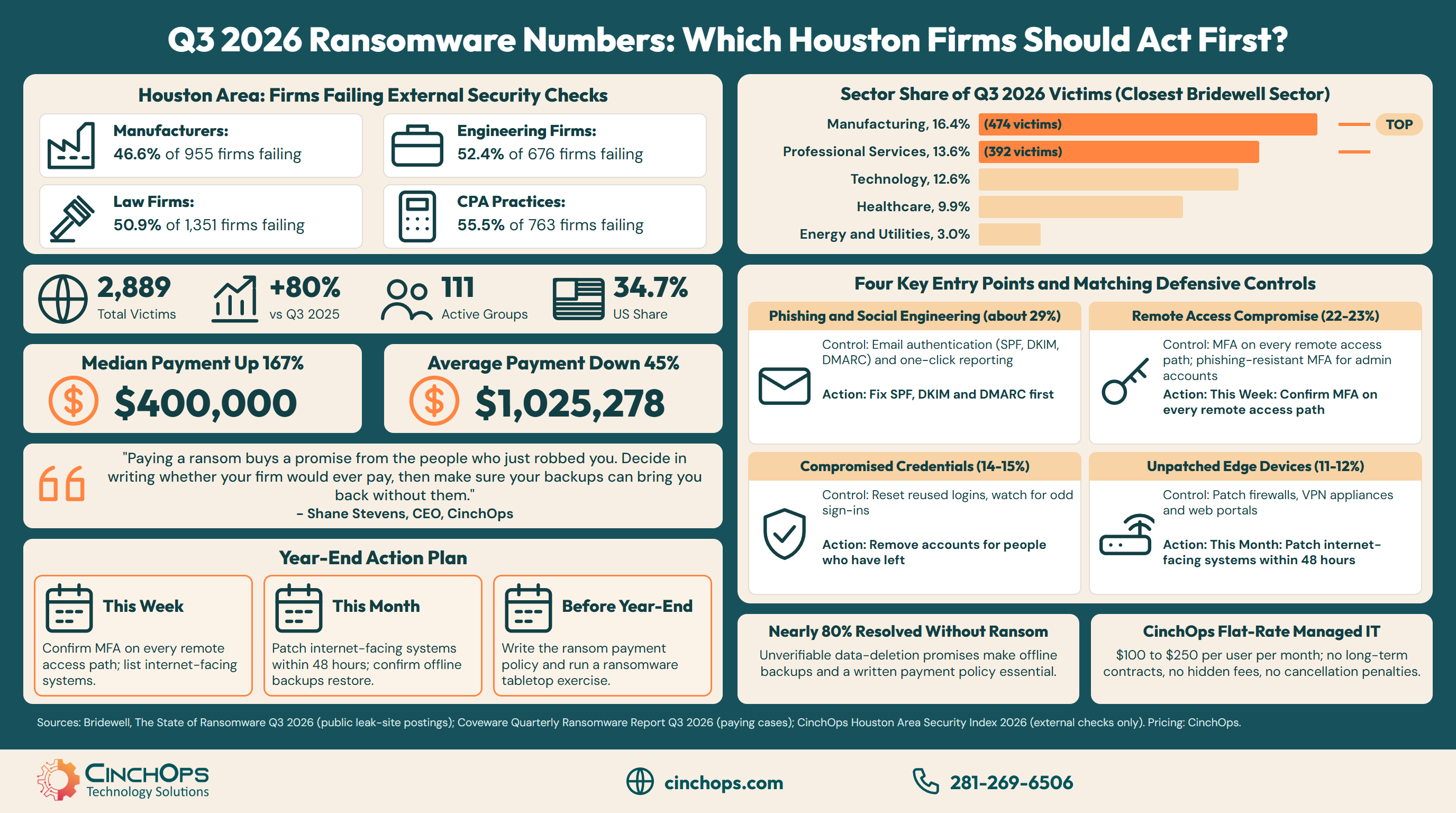
The Q3 2026 ransomware numbers from Bridewell put 2,889 victims on criminal leak sites between July and September, the highest quarter in its six-quarter window and 80% above Q3 2025. For a Houston manufacturer, engineering firm, law firm or CPA practice, the useful part is which industries were posted and how the attackers got in.
Bridewell's BCON Collective builds its count from Ransomware.live, which tracks the victims ransomware groups post on their data-leak sites. That means the figure covers public postings only and undercounts real attacks, because a victim that pays quietly is never posted. In Q3 2026, 111 groups posted victims, up from 86 a year earlier. The top 10 groups posted 48% of all victims, while 47 groups posted fewer than 10 each. Qilin (362 victims) and The Gentlemen (360) led the quarter, and the United States accounted for 1,002 postings, or 34.7% of the total.
CinchOps provides managed cybersecurity specifically for Houston manufacturers, engineering firms, law firms and CPA practices with 10 to 200 employees, with 24/7 threat monitoring and immutable offsite backups stored outside the Gulf Coast flood zone.
Which Houston Firms Fall Into the Sectors Q3 2026 Ransomware Hit Hardest?
Bridewell's Q3 sector counts set beside the CinchOps Houston Area Security Index scores for the matching local industries.
Manufacturing was the most posted sector in Q3 2026 ransomware leak-site data, with 474 victims (16.4%), followed by professional services with 392 (13.6%), according to Bridewell. Together the two sectors took 30% of all postings. Around Houston, the CinchOps Security Index finds 46.6% of 955 manufacturers failing external security checks, and more than half of engineering, legal and CPA firms.
The table below compares each Bridewell Q3 2026 sector share with the matching Houston cohort in the CinchOps Houston Area Security Index and the first control each kind of firm should check.
| Houston firm type | Closest Bridewell sector, Q3 2026 share | Houston cohort failing external checks (CinchOps Security Index) | First control to check |
|---|---|---|---|
| Manufacturers | Manufacturing, 16.4% (474 victims) | 46.6% of 955 manufacturers | Patch internet-facing systems within 48 hours, including any PLM server |
| Engineering firms | Professional Services, 13.6% (392) | 52.4% of 676 engineering firms | Patch file-sharing and PLM portals, then check who can reach them |
| Law firms | Professional Services, 13.6% (392) | 50.9% of 1,351 law firms | MFA on email and every remote access path |
| CPA practices | Professional Services, 13.6% (392) | 55.5% of 763 CPA practices | Phishing-resistant MFA for partner and admin accounts |
| Medical practices | Healthcare, 9.9% (285) | Not scored in the Security Index | Offline backups, with a restore you have watched work |
Below the top two, Bridewell counted 363 technology victims (12.6%), 285 in healthcare (9.9%) and 88 in energy and utilities (3.0%). Thirteen sectors were hit in all. The bars show how far ahead manufacturing and professional services sit.
Two caveats keep the comparison honest. Bridewell's count reflects public leak-site postings, so a firm that paid quietly or was never posted is missing from it. The Security Index measures only what anyone can see from outside, including DNS health, application security and exposed network signals, and it cannot see internal segmentation. Read together, the two sources point the same way: the sectors attackers posted most in Q3 2026 match the Houston cohorts with the weakest outside view, and that makes manufacturers and professional firms the place to start.
Should a Houston Business Plan to Pay a Ransom in 2026?
What Coveware's Q3 2026 case data says about ransom amounts, payment rates and data-deletion promises.
Coveware's Q3 2026 report puts the median ransom payment at $400,000, up 167% from Q2 2026, while the average fell 45% to $1,025,278. Coveware also reports that nearly 80% of incidents are resolved without a ransom payment. For a Houston business, the planning answer is a written payment policy decided now, backed by recovery that works without paying.
The Q2 2026 baseline was a $150,000 median and a $1,880,612 average, per the Coveware table Bridewell reproduces. The same Coveware report shows the median victim company growing 49% to 1,121 employees. That is far larger than a Houston firm with 10 to 200 staff, so a 40-person company should read the $400,000 as a figure drawn from bigger organizations.
Paying for silence is the weaker bet. Coveware's Q3 report is built around leaked Silent Ransom Group chats that identified victims who had paid to keep their incidents out of the public domain. Coveware states that threat actors' promises to delete stolen data cannot be verified, and it treats data-theft-only extortion mainly as a legal, governance and communications crisis. Bridewell's own advice is to define a ransom payment policy before an incident. A workable policy for a Houston firm answers four questions:
- Who has authority to approve or refuse a payment, and who is the backup when that person is unreachable.
- Whether the firm would ever pay for a decryption key, and whether it would ever pay for a deletion promise that cannot be verified.
- Who gets the first three calls: the cyber insurer, outside counsel and the IT provider, in that order or another the policy names.
- What recovery looks like without payment, starting from offline, immutable backups that someone has watched restore.
Writing those answers down in November costs an afternoon. Deciding them during an incident, with systems encrypted and a deadline posted, is how firms end up paying for promises nobody can check.
Does your firm have a written ransom payment policy?
CinchOps helps Houston owners write one, check the backups behind it and name who makes the call.
Talk to CinchOpsWhich Four Entry Points Should Houston Firms Close Before Year-End?
Coveware's Q3 2026 initial-access data and Bridewell's defensive list, turned into a short work order.
Coveware traced most Q3 2026 ransomware cases to four entry points: phishing and social engineering (about 29%), remote access compromise (22-23%), compromised credentials (14-15%) and unpatched software appliances and edge devices (11-12%). A Houston firm with 10 to 200 employees can check all four in a week, usually with tools it already owns.
- Phishing and social engineering. Email authentication is the outside layer attackers test first, and the CinchOps Security Index found 60.4% of 4,393 Houston-area businesses failing its DNS health checks. Fix SPF, DKIM and DMARC, then make reporting a suspicious email a one-click habit.
- Remote access compromise. Bridewell recommends MFA on all remote access and phishing-resistant MFA for privileged accounts. That covers VPN, remote desktop tools, vendor support portals and Microsoft 365 admin roles. See why phishing-resistant authentication matters for admins.
- Compromised credentials. Reset any password reused across work and personal accounts, remove accounts for people who have left, and watch for sign-ins from new countries or at odd hours. Bridewell lists monitoring for anomalous authentication among its core controls.
- Unpatched edge devices. Bridewell recommends patching internet-facing systems within 48 hours. Firewalls, VPN appliances, file-transfer servers and web portals all count.
The Cl0p campaign in Bridewell's report shows why the edge matters to Houston engineering and manufacturing firms. Cl0p exploited CVE-2026-12569, a critical remote code execution flaw in PTC Windchill and FlexPLM product lifecycle management software, and used JSP webshells to stage engineering data before extortion. NIST's National Vulnerability Database scores the flaw 9.8 out of 10, and CISA added it to its Known Exploited Vulnerabilities catalog on June 25, 2026. Any engineering firm or manufacturer running Windchill or FlexPLM should confirm the fix is installed and that the server is not reachable from the open internet.
Bridewell assesses, with moderate confidence, that elevated ransomware activity will continue into Q4 2026. It also recommends a ransomware tabletop exercise, especially for manufacturers. A one-hour tabletop with the owner, the office manager and the IT provider is the fastest way to find out whether the payment policy and the backups hold up.
Paying a ransom buys a promise from the people who just robbed you. Decide in writing whether your firm would ever pay, then make sure your backups can bring you back without them.
Is MFA on every remote access path at your firm?
Remote access compromise was behind 22-23% of Coveware's Q3 2026 cases. CinchOps cybersecurity for Houston businesses covers MFA rollout, patching of internet-facing systems and 24/7 threat monitoring.
See CinchOps cybersecurity →How CinchOps Can Help Houston Firms Act on the Q3 2026 Numbers
CinchOps is a managed IT services provider based in Katy, Texas, serving small and mid-sized businesses across the Houston metro area. CinchOps specializes in cybersecurity, network security, managed IT support, VoIP, and SD-WAN for businesses with 10 to 200 employees.
The work order splits into three stops: this week, this month and before year-end. Each stop uses controls Bridewell and Coveware both point to.
- Through cybersecurity services, CinchOps runs 24/7 threat monitoring, MFA rollout and patching of internet-facing systems.
- CinchOps business continuity and disaster recovery keeps immutable, verified backups stored outside the Gulf Coast flood zone, so recovery does not depend on paying.
- With managed IT support, help desk requests are answered in under 15 minutes, so a suspicious email gets a real answer before someone clicks it.
- Owners who want help writing the payment policy get it from vCIO services, which also run the tabletop exercise.
- CinchOps supports manufacturers, engineering firms, law firms and CPA practices across Houston and Katy, at a flat monthly rate per user with Zero-Zero-Zero terms: no long-term contracts, no hidden fees, no cancellation penalties.
The Q3 2026 numbers say attackers posted more victims from more groups than in any quarter Bridewell tracked, and manufacturing and professional services sat at the top. A Houston firm in those sectors should treat the four entry points and the payment policy as year-end work, not a 2027 project. If you want a second set of eyes on either, talk to CinchOps.
Frequently Asked Questions
How many ransomware attacks were there in Q3 2026?
Bridewell counted 2,889 ransomware victims posted on criminal leak sites in Q3 2026, up 80% from 1,609 in Q3 2025 and about 26% above the 2,299 posted in Q2 2026. Those are public postings only. Victims that paid quietly or were never posted are not in the count, so the real number is higher.
Which ransomware groups were most active in Q3 2026?
Qilin posted 362 victims and The Gentlemen posted 360, about 12.5% of the Q3 2026 total each, according to Bridewell. Two new groups, Storm (78 victims) and Direwolf (60), appeared during the quarter. The top 10 groups posted 48% of victims, and 47 of the 111 active groups posted fewer than 10 each.
What was the average ransom payment in Q3 2026?
Coveware reports an average Q3 2026 ransom payment of $1,025,278, down 45% from Q2 2026, and a median of $400,000, up 167%. Both figures count paying cases only. Coveware also reports that nearly 80% of incidents are resolved without a ransom payment, and that promises to delete stolen data cannot be verified.
Are small Houston businesses targets if Coveware's median victim has 1,121 employees?
Yes. Coveware's median comes from its own incident cases, which skew larger. Black Kite's 2026 manufacturing report found 70.2% of revenue-known 2026 manufacturing victims in the $10 million to $100 million revenue band, so mid-sized companies make up most of the known victims. The CinchOps Security Index also finds 46.6% of 955 Houston-area manufacturers failing external checks.
What does ransomware protection cost for a Houston business?
Most Houston businesses buy ransomware protection as part of managed IT and cybersecurity, priced per user each month. The published CinchOps rate is $100 to $250 per user per month, flat, with Zero-Zero-Zero terms: no long-term contracts, no hidden fees and no cancellation penalties. Ask any provider which security controls its per-user price covers before you compare quotes.
Discover More
Resource
Sources
- Bridewell (BCON Collective), The State of Ransomware Q3 2026
- Coveware, The Silent Ransom Group Leak Shows Why Paying for Silence Fails (Q3 2026 Quarterly Ransomware Report, October 28, 2026)
- NIST National Vulnerability Database, CVE-2026-12569 (PTC Windchill and FlexPLM)
- Black Kite Research Group, 2026 Manufacturing and Distribution Ransomware Report
- CinchOps, Houston Area Security Index 2026 (updated September 25, 2026)


