


Agentic AI Attacks Are Here. What Houston Businesses Check First
The Exploit Was Ready Before Most Offices Read The Patch Notes – Three Checks Every Houston Business Can Run This Week
What Houston Businesses Check First
Google says attackers now run AI agents through whole stages of an intrusion. Here is what that changes for a Houston office.
Agentic AI attacks are intrusions in which AI agents carry out stages of the attack, such as scanning for a flaw, writing the exploit and running it, with little or no typing by a person. Google Threat Intelligence Group (GTIG) says that activity has crossed a significant threshold. Its AI Threat Tracker, published November 16, 2026, describes attackers running multi-agent frameworks against live targets, and one framework that found, built and ran exploits with no human in the loop.
If you run a Houston business with 10 to 200 people, the news probably reached you as a headline about AI hackers. The report itself is more useful than the headline. Most of what it describes is familiar attack work done faster: finding a known flaw, using a stolen credential, fooling an employee. Google's assessment is that these frameworks can compress attack timelines to machine speed, and that for now they trade stealth for velocity. Fast and loud is something a monitored network can catch.
CinchOps provides managed cybersecurity specifically for Houston and Katy businesses with 10 to 200 employees, with 24/7 threat monitoring and help desk requests answered in under 15 minutes. This post ranks the five findings in Google's report by how directly they reach an office that size, and turns the top three into checks you can run this week.
AI Agents Now Turn a Published Patch Into an Attack Within Days
Exploits arrive faster, and the systems the internet can reach go first.
AI agents now shorten the gap between a published patch and a working attack to days. Google's November 2026 report says attackers use LLMs and agents to automate patch diffing, which means comparing fixed code with the old code to locate the flaw, and then build exploits for known vulnerabilities at scale. Internet-facing systems feel it first.
PaperCut print management servers are the example Google cites. In late August 2026, attackers chained two zero-days, CVE-2026-81578 and CVE-2026-82078, into unauthenticated remote code execution. Google's report says researchers and the security company Huntress used LLMs to build working exploits within a day of disclosure. GreyNoise then reported a campaign four days after disclosure against hundreds of organizations, in which the attacker went from an initial foothold to domain administrator within minutes.
Google also found a framework it calls exploit_agent on an exposed staging server. It ran continuous comparisons of popular web applications, drafted exploits and executed them without a person involved, the first fully automated discovery and exploitation pipeline GTIG says it has identified. One target it analyzed was a WordPress plugin, Spectra (Ultimate Addons for Gutenberg). If your company website runs on WordPress, its plugins sit in the same queue.
Houston businesses give these tools plenty to find. The CinchOps Houston Area Security Index scored 4,393 Houston-area businesses on what the internet can see, and 49.6% graded D or F. Application security, the category closest to websites and plugins, averaged a 1.53 GPA. DNS health averaged 1.24 and network security 1.94, against a metro GPA of 1.51. Automated scanners start from exactly that outside view, which is why the Houston Area Security Index is a sensible first look at your own exposure.
Not sure what your business exposes to the internet?
CinchOps can list every internet-facing system you run and the patch clock each one should be on.
Talk to CinchOps →Stolen AI Keys and AI Coding Tools Are a New Way In
LLMJacking runs up bills, and an AI tool's settings file can carry a backdoor.
LLMJacking is the theft of AI service credentials, such as API keys and cloud accounts, so an attacker can run or resell AI usage on the victim's bill. Google's report says Mandiant responded to several LLMJacking cases in 2026, with single-day fraudulent charges above $100,000 and cumulative abuse reaching $1 million in the most severe cases.
The way in is ordinary. Google lists credentials harvested from public GitHub repositories and session tokens captured through deceptive websites. In one case, a botnet generated millions of AI API calls in about 24 hours before the credentials were revoked. Stolen access often ends up in what the report calls LLM Mixers, storefronts on Russian- and Chinese-language markets that resell it for $0.10 to $25 per million tokens.
The exposure grows each quarter for Houston offices. A CinchOps analysis of Census Bureau survey data found that 20.6% of Houston-area businesses used AI across 2026, and 24.9% expect to within six months. A new AI tool usually brings an API key, a billing account or both, and those tend to sit outside the IT inventory. The Houston small business AI report has the full numbers.
AI coding tools are the second door. Google describes a North Korea-linked cluster it tracks as MIDNIGHT NEPTUNE that got inside an organization and edited .claude/settings.json files in internal code repositories, so that starting Claude Code downloaded a backdoor called SOMBERMEME. The same actor created GitHub access tokens named after Microsoft Copilot to blend in. A firm with staff who write scripts or code with an AI assistant, including engineering firms and oil and gas companies with in-house tools, now has settings files worth protecting.
- Put a spending cap and a billing alert on every AI and cloud account that has a payment method attached.
- Keep API keys out of code and shared folders, store them in a secrets vault, and rotate any key that ever sat in a repository.
- Treat AI coding assistant settings files as code: require a review for changes and alert on edits.
- Remove AI accounts and keys the day an employee or contractor leaves.
Do you know every AI account your staff signed up for?
CinchOps cybersecurity services include 24/7 threat monitoring and a review of the AI and cloud accounts that hold your keys and your billing.
See CinchOps cybersecurity →Five Findings in Google's Report, Ranked for a Houston Office
Three reach a 10 to 200 person business directly. Two reach it less often.
Three of the five findings in Google's November 2026 AI Threat Tracker reach a Houston business with 10 to 200 employees directly: faster exploitation of known flaws, stolen AI and cloud keys, and tampered AI coding tools. AI-built phishing kits reach the same office through email. AI-run influence operations mostly target public opinion and rarely touch a small office network.
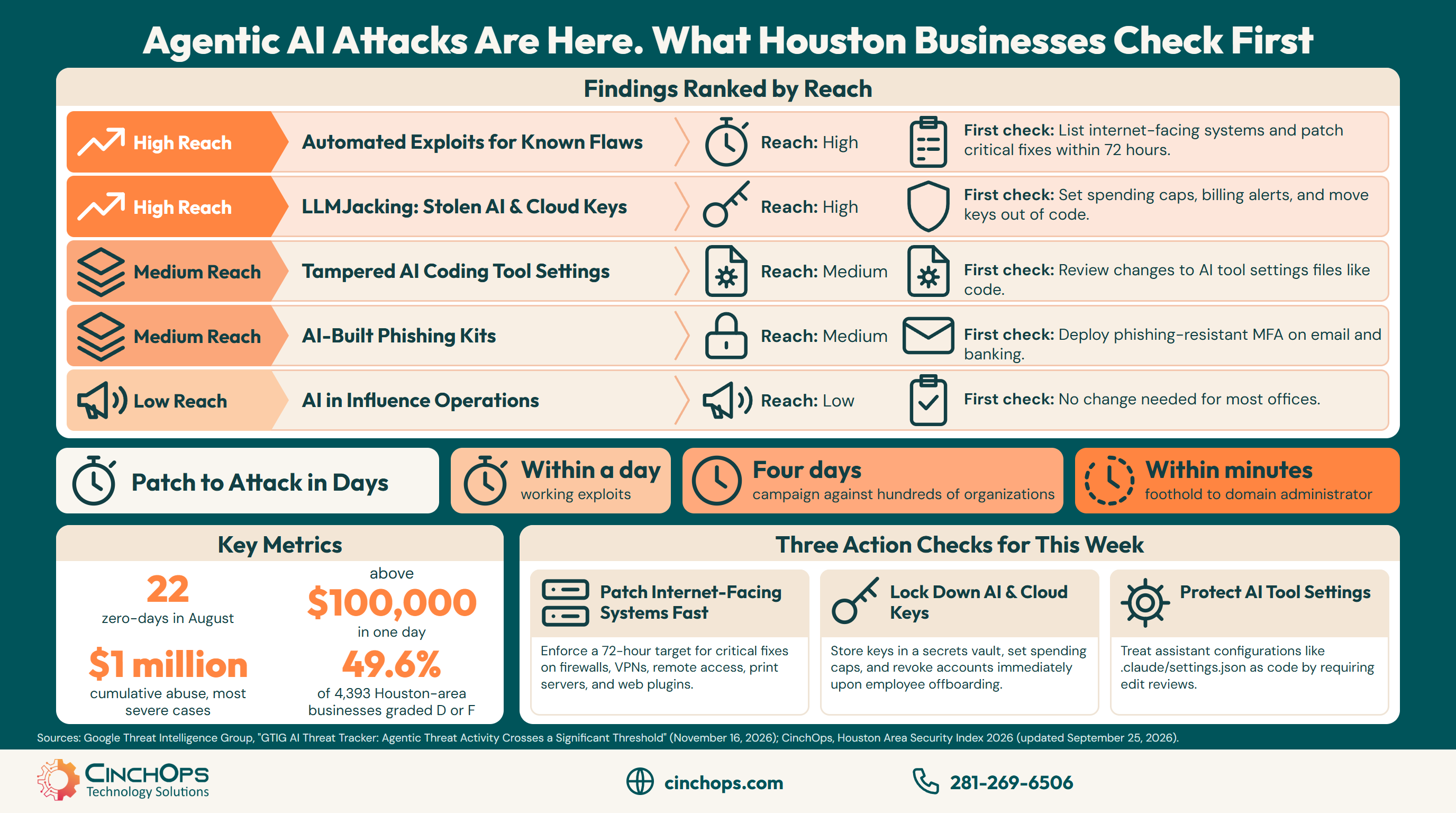
The table below ranks each finding from Google's report by how directly it reaches a Houston office of 10 to 200 people, and names the first check for each.
| Finding in Google's report | Reach for a 10 to 200 person office | First check this week |
|---|---|---|
| Automated exploits for known flaws (PaperCut, WordPress plugins) | High: anything the internet can reach | List internet-facing systems and patch critical fixes within 72 hours |
| LLMJacking: stolen AI and cloud keys | High, if anyone holds an AI or cloud account | Spending caps, billing alerts, keys out of code |
| Tampered AI coding tool settings (.claude/settings.json) | Medium: firms with staff who script or code | Review changes to AI tool settings files |
| AI-built phishing kits (Jieyou) | Medium: arrives by email | Phishing-resistant MFA on email and banking |
| AI in influence operations | Low: aimed at public opinion | No change for most offices |
The phishing finding is worth a closer look. Jieyou, a Chinese-language phishing-as-a-service platform first seen in March 2026, added an AI chatbot in a June 2026 update so its affiliates can configure phishing panels and edit templates in plain language. That lowers the skill needed to build a convincing fake login page.
Google's own assessment gives defenders something to work with. The report says these frameworks currently trade stealth for velocity: autonomous runs leave forensic traffic, recognizable identifiers and code-level traces. A fast attack is a loud attack, so an office with 24/7 monitoring on its firewall, email and endpoints has a real chance of catching one in progress. For the wider case on response speed, see why Houston businesses need faster defenses.
The AI part of these attacks is the speed. The way in is still an unpatched server, a key left where it should not be, or an employee who clicked. Close those three, and an AI agent has far less to work with.
How CinchOps Can Help Against Agentic AI Attacks
CinchOps is a managed IT services provider based in Katy, Texas, serving small and mid-sized businesses across the Houston metro area. CinchOps specializes in cybersecurity, network security, managed IT support, VoIP, and SD-WAN for businesses with 10-200 employees.
Google's report describes four problems a Houston office can act on, and each one has a matching piece of CinchOps work. If you are weighing AI tools for the business itself, the agentic AI for Houston businesses page covers the other side of the same technology.
- Through managed IT support, CinchOps keeps a list of your internet-facing systems and patches those first, and help desk requests are answered in under 15 minutes.
- CinchOps cybersecurity services include 24/7 threat monitoring, which is how a fast, noisy attack gets caught while it runs.
- With vCIO services, CinchOps reviews the AI and cloud accounts your staff use, with billing alerts and key reviews on each, and treats AI tool settings changes like code.
- CinchOps supports offices across Houston, Katy and Cypress, including CPA firms, engineering firms and oil and gas companies.
Google's report will not be the last one with a frightening headline. The practical response is short: know what the internet can see, patch that first, and keep AI keys and settings under the same control as passwords. If you want that list written for your office, talk to CinchOps.
Frequently Asked Questions
What are agentic AI attacks?
Agentic AI attacks are intrusions in which AI agents carry out stages of an attack, such as reconnaissance, writing an exploit and running it, with little human input. Google's November 2026 AI Threat Tracker reports attackers using open-source agent frameworks such as CAIRN and PentAGI against live targets, plus one pipeline that ran with no human in the loop.
Did Google say AI agents are hacking businesses on their own?
Partly. Google says it found one framework, exploit_agent, that discovered, built and ran exploits against web applications without human involvement, the first it has identified. Most of the frameworks it describes automate separate phases of an intrusion that a person still directs. Google also says they currently trade stealth for speed, which makes them easier to detect.
How fast are attackers exploiting new vulnerabilities in 2026?
Very fast for internet-facing systems. In the PaperCut case from late August 2026, Google's report says working exploits existed within a day of disclosure, a campaign against hundreds of organizations followed four days later, and one attacker went from a foothold to domain administrator within minutes. Critical fixes on exposed systems need a target measured in days.
What is LLMJacking and how much can it cost?
LLMJacking is the theft of AI API keys or cloud accounts to run or resell AI usage on someone else's bill. Google's report says Mandiant saw single-day fraudulent charges above $100,000 in 2026, and cumulative abuse reaching $1 million in the worst cases. Spending caps, billing alerts and keeping keys out of code repositories are the first defenses.
Should a Houston business stop using AI coding tools after this report?
No. The risk in the report is tampering with the tool's settings after an attacker is already inside, such as an edited .claude/settings.json that downloaded a backdoor when Claude Code started. Keep using the tools, but review changes to their settings files the same way you review code, and remove access when people leave.
What does protection against agentic AI attacks cost in Houston?
Managed IT and security for Houston small businesses commonly runs $100 to $250 per user per month. The published CinchOps rate is $100 to $250 per user per month, flat and month-to-month, with help desk requests answered in under 15 minutes and no long-term contracts, no hidden fees and no cancellation penalties.
Discover More
Resource
Sources
- Google Threat Intelligence Group, "GTIG AI Threat Tracker: Agentic Threat Activity Crosses a Significant Threshold" (November 16, 2026)
- CinchOps, Houston Area Security Index 2026 (updated September 25, 2026)
- CinchOps, "Houston Small Business AI Adoption: The 2026 Census Report" (June 23, 2026)
- U.S. Census Bureau, Business Trends and Outlook Survey data

