


Best IT for Houston Manufacturers: The 9 Uptime Tests (2026)
Manufacturing IT In Houston: Evidence, Costs And The Questions That Matter – How Houston Manufacturers Should Compare Managed IT Providers
9 uptime tests for Houston manufacturers, evidenced against 6,555 public Google reviews of 217 Houston-area IT providers and 954 graded Houston-area manufacturing plants.
The best IT for Houston manufacturers is judged on one number nobody publishes: how long the line stayed down. These 9 uptime tests separate a provider that has carried a plant through a bad night from one that has only ever carried an office, and every test can be run before you sign anything.
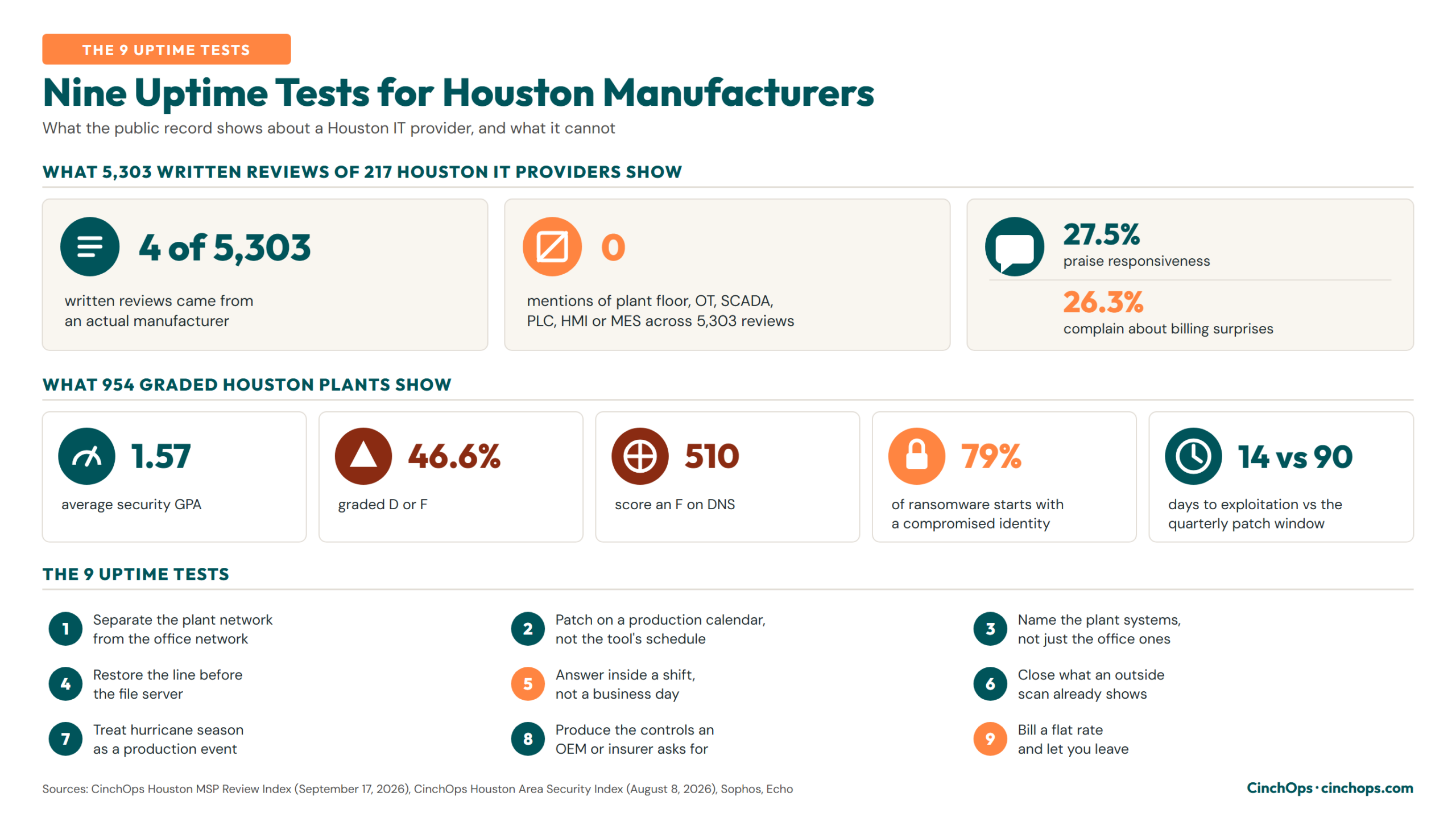
If you are a plant manager or an owner shopping for managed IT for a Houston manufacturing company, the public record is thinner than it looks. CinchOps read all 5,303 written Google reviews behind the September 17, 2026 snapshot of the Houston MSP Review Index, which covers 217 Houston-area IT providers and 6,555 reviews. Four of those reviews were written by a manufacturer. Plant floor, OT, SCADA, PLC, HMI and MES appear zero times in any of them.
People searching for cybersecurity providers for Houston manufacturing get handed the same ranked lists of company names, usually written by a company that put itself at the top. So this guide ranks no companies. It ranks the 9 things a provider has to get right to keep a plant running, shows where the evidence for each one comes from, and gives you the question that tests it. No provider is named anywhere in it. CinchOps is not in the ranking, and the only place CinchOps measures itself is a labeled box at the end.
How This List of 9 Uptime Tests Was Built
A ranked list is only as honest as its method. This one fits in five bullets.
This list was built by searching 5,303 written Google reviews of 217 Houston-area IT providers for the language of plant work, then filling the gaps the reviews leave with the 954 Houston-area manufacturers graded in the CinchOps Houston Area Security Index and four named third-party reports. Every one of the 9 tests is something a well-run provider can pass.
- Review sample: the September 17, 2026 snapshot behind the Houston MSP Review Index, 6,555 Google reviews across 217 Houston-area providers, of which 5,303 carry written text. Every count in this post is a count over those 5,303 texts unless it says otherwise.
- Plant vocabulary search: manufacturing, plant, plant floor, shop floor, factory, production line, OT, SCADA, PLC, HMI, ICS, MES, ERP, SAP, Epicor, SYSPRO, CNC, machine shop, uptime and downtime. Every match was read by hand. Of 14 raw matches on the word manufacturing, 4 came from a real manufacturer, spread across 4 providers, all five stars. The other 10 were a laptop or printer manufacturer's warranty, or a graphics-card shortage.
- Why every match was read by hand: all 12 hits on ICS belong to a Houston IT provider whose company name is ICS. Not one refers to an industrial control system. A keyword count on its own would have reported a plant-security signal that does not exist.
- What reviews cannot measure: network segmentation, patch discipline, restore order and external security posture. Those tests are evidenced from the 954 Houston-area manufacturers graded in the CinchOps Houston Area Security Index, updated August 8, 2026, plus the Verizon 2026 DBIR, the Sophos State of Ransomware 2026, the Picus Blue Report 2026 and NOAA hurricane climatology.
- Order: the 9 tests follow the order a bad week tests a provider, starting at the boundary between the plant and the office and ending at the invoice.
One finding from that search deserves to stand alone. Public reviews of Houston IT providers almost never describe production work: across 5,303 written reviews, plant floor, shop floor, OT, SCADA, PLC, HMI, MES, SAP, Epicor, SYSPRO, CNC and machine shop appear zero times, and downtime appears 54 times without a single one of those mentions sitting in a critical review. The closest the whole corpus gets to a plant is one five-star review praising a provider for answering a 5:30am call to keep a shop working and for scheduling downtime on weekends. A review can tell you a provider is pleasant. It cannot tell you whether that provider has ever been the reason a shift started on time.
What Separates a Good IT Provider for a Houston Plant From a Failing One?
The same 9 tests from both ends, with how much the public record can tell you about each.
A good IT provider for a Houston manufacturer draws a boundary between the plant network and the office network, patches on a production calendar, knows the ERP by name, restores production before email, answers inside a shift, closes what an outside scan can see, plans for hurricane season, produces the controls an OEM customer asks for, and bills a flat rate you can leave. A failing one does the opposite, and the reviews almost never reveal which is which.
The table below compares each of the 9 uptime tests by what a good provider does for a Houston plant, what a failing provider does, and what the public record can tell you about that test at all. The last column is the point: the emptier it is, the more the test has to happen in the meeting.
| Uptime test | What a good provider does for a Houston plant | What a failing provider does | What the public record shows |
|---|---|---|---|
| 1. Separate the plant network from the office | Draws the boundary, documents what crosses it, and keeps office traffic off the production segment | One flat network, and a printer share on the same segment as the machines | Segmentation of a plant network: 0 of 5,303 reviews |
| 2. Patch on a production calendar | Publishes 12 months of windows that fit the shift pattern and the shutdown schedule | Pushes updates whenever the tool schedules them, and reboots mid-run | Exploitation now runs ahead of quarterly windows; see the Echo and Verizon figures below |
| 3. Know the plant systems by name | Names the ERP and MES it has cut over and who it calls at the vendor | "We support all software" | SAP, Epicor, SYSPRO, MES: 0 mentions. ERP: 6 |
| 4. Restore the line before the file server | Agrees a restore order in writing and can give the date of the last test | "The backups run every night" | Backup: 81 mentions, restore order: none |
| 5. Answer inside a shift | States a first-response time and staffs the hours the plant actually runs | Answers fast at 10am and goes to voicemail at 5:30am | Responsiveness is the top praise theme at 27.5% of 5,189 positive reviews |
| 6. Close what an outside scan can see | Scans your domain before signing and shows the 90-day fix list | Never looks at the plant from outside | 954 graded Houston-area manufacturers average a 1.57 GPA; 46.6% grade D or F |
| 7. Treat hurricane season as a production event | Keeps backup copies out of the Gulf Coast flood zone and plans a multi-day outage | Treats bad weather as an office-closure problem | Hurricane, storm or flood: 8 mentions in 5,303 reviews |
| 8. Produce the controls an OEM or insurer asks for | Shows an MFA exception report and maps to a recognized framework | MFA on staff, exempted for the people who sign things | Not a review subject; Sophos puts 79% of ransomware on compromised identities |
| 9. Bill flat and let you leave | One per-user rate, short or no term, and seats that move with headcount | Line items, a long term and a cancellation fee | Billing surprises are the #1 complaint theme at 26.3% of 114 critical reviews |
Only rows 5 and 9 carry enough review evidence to judge a provider from its Google profile. Rows 1 through 4 and 6 through 8 decide whether a plant gets through a bad night, and those are exactly the rows the public record is silent on.
The 9 Uptime Tests for IT Providers Serving Houston Manufacturers
Each test opens with the number behind it and closes with the question that settles it.
The 9 uptime tests are network separation, patch scheduling, plant system knowledge, restore order, response speed inside a shift, external security posture, hurricane planning, provable controls, and flat billing you can walk away from. Run all 9 on every provider, including the one you already have.
1. They separate the plant network from the office network
Segmenting control-system and field networks from the office network is the one control that stops a phishing click in accounting from reaching a Houston plant floor, and 602 of the 954 Houston-area manufacturers graded in the CinchOps Houston Area Security Index score a D on network posture. That category carries a 1.57 GPA overall for manufacturing, the second-weakest of the four industries in the Index.
Segmentation is also the test the public record is blindest to. Across 5,303 written reviews of Houston IT providers, no client describes a provider separating a production network from a corporate one. The work leaves no trace a reviewer would think to mention, which is exactly why it has to be asked about directly. A provider that has done it can draw the boundary on a whiteboard in under a minute and tell you which three things are allowed to cross it and why.
Ask: draw the line between our office network and our production network, then tell us every protocol that crosses it and who approved each one.
2. They patch on your production calendar, not their own
Echo's Mythos Readiness Report puts the trimmed mean time from vulnerability disclosure to exploitation at 14 days for 2026 so far, down from 55 days in 2025, while most plants still hold patching to a quarterly shutdown window of about 90 days. The Verizon 2026 Data Breach Investigations Report found 31% of breaches now start with a software vulnerability, ahead of stolen passwords.
Those two numbers together are the whole argument for asking about patch scheduling before you sign. A quarterly window is not wrong for the machines, but it cannot be the answer for everything in the building. A provider that understands a plant patches the office estate continuously, patches the boundary equipment on a short cycle, and treats the production segment as a separate change process with its own approval and its own rollback plan. A provider that does not understand a plant pushes an update at 2pm on a Tuesday because that is when the tool ran.
Ask: show us the next 12 months of patch windows against our shift pattern and our shutdown schedule, and tell us what you do about a critical vulnerability that lands in week 3 of a quarter.
3. They can name the plant systems, not just the office ones
SAP, Epicor, SYSPRO and MES appear zero times across 5,303 written Google reviews of 217 Houston-area IT providers, and ERP appears 6 times, so a manufacturer cannot learn from the public record whether any provider has ever touched the system the plant schedules on. Two of the 4 reviews written by an actual manufacturer mention an ERP implementation, which is the strongest platform signal the whole corpus offers.
In 35+ years doing this, the tell is always specificity. A provider that has supported a plant will name the ERP, name the version, and tell you what broke during the last upgrade. A provider that has not will say it supports all software, which is true in the same sense that a general practitioner supports all organs. Ask for a reference running your platform, not a reference who likes them.
Ask: which ERP or MES platforms have you carried through an upgrade in the last 24 months, and can we call the plant manager who lived through it.
4. They restore the line before they restore the file server
The Sophos State of Ransomware 2026 found that only 34% of organizations with 100 to 250 employees stopped an attack before encryption or extortion, against 46% at 3,001 to 5,000 employees, and put the average recovery cost at $1.7M. For a manufacturer, the order of recovery decides how much of that cost is production and how much is IT.
Backup appears in 81 of 5,303 written reviews, always as a thing that exists rather than a thing that was tested. No review in the corpus describes a restore order. That is the gap to close in the meeting: a provider serving a Houston plant should be able to hand you a written sequence showing what comes back first, second and third, with the ERP and the scheduling system ahead of the shared drive, and a dated record of the last time somebody proved it.
Ask: give us the restore order in writing and the date, duration and file list of the last restore you actually performed for a manufacturer.
5. They answer inside a shift, not inside a business day
Responsiveness is the most common reason Houston businesses praise an IT provider, appearing in 27.5% of 5,189 positive reviews in the Houston MSP Review Index, and slow or no response drives 14.0% of the 114 critical ones. All 4 reviews written by a manufacturer praise response speed, and one of them describes a provider driving across Houston so a plant would have no down time.
For an office, a 3-hour wait costs an afternoon. For a plant running two shifts, the same wait can cost a production run and the changeover behind it. The one review in the corpus that describes a shop floor makes the point better than any statistic: the provider earned it by answering a 5:30am phone call. Ask about the hours your plant actually runs, not the hours on the website.
Ask: what is your first-response time at 5:30am on a Saturday during a changeover, who specifically picks up, and is that a person or a monitoring alert.
6. They close the gaps an outside scan already shows
CinchOps graded 954 Houston-area manufacturers on externally visible security signals and found an average GPA of 1.57, with 46.6% grading D or F and only 3 plants in the whole set earning an A. DNS is the weakest category by a distance: 510 of those 954 manufacturers score an F on DNS configuration, against 127 scoring an A.
None of that requires access to a single plant. It is what anyone with a browser can see from outside, which means it is also what an attacker shopping for a target sees first, and what a customer running a supplier risk check sees. A provider that has never looked at your plant from outside is guessing about the part of your security posture that is already public. The full industry ranking and the move from a D to a B is covered in the Houston manufacturing security grades.
Ask: scan our domain before we sign anything, show us what grades out, and tell us which findings you would close in the first 90 days.
7. They treat hurricane season as a production event
The Atlantic hurricane season runs from June 1 to November 30 and peaks on September 10 according to NOAA's National Hurricane Center, and for a Gulf Coast plant that is a 6-month window in which a backup copy stored 20 miles away is a backup copy in the same weather. Hurricane, storm and flood together appear in 8 of 5,303 written reviews of Houston IT providers.
An office can work from home for a week. A plant cannot. The questions that matter are about sequence and distance: where the backup copies physically sit, how long the plant can run on paper, what comes back first when power returns, and who is authorized to make the call to fail over at 11pm on a Sunday. A provider that has only ever recovered offices will answer in terms of laptops and email.
Ask: walk us through a 5-day outage at this address in September, starting with where our backup copies physically are and ending with the first product off the line.
8. They can produce the controls an OEM customer or an insurer asks for
The Sophos State of Ransomware 2026 attributes 79% of ransomware attacks to compromised identities, which is why the multi-factor authentication question now arrives from your customers and your insurer rather than from your IT provider. In Travelers Property Casualty Co. of America v. International Control Services, the insurer alleged that an Illinois electronics manufacturing services company had signed an MFA self-attestation while protecting only its firewall, and the parties stipulated in August 2022 that the policy be declared void from inception.
Controls that exist on paper and controls that fire are also different things. Picus Labs tested 338 million simulated attacks inside customer production environments for the Blue Report 2026 and found prevention effectiveness in manufacturing and engineering fell from 81% to 72% year over year. A provider that only reports on whether a control is deployed is reporting on the easier half.
Texas gives a manufacturer a reason to put the program in writing. Under Texas SB 2610, effective September 1, 2025, a business with fewer than 250 employees that maintained a conforming cybersecurity program is shielded from exemplary damages, with the required program scaling by headcount: password policies and training under 20 employees, CIS Controls Implementation Group 1 at 20 to 99, and a recognized framework such as NIST or the ISO/IEC 27000 series at 100 to 249. A provider that cannot tell you which tier your plant sits in has not read it.
Ask: show us a redacted MFA exception report from another client, then tell us which Texas SB 2610 tier our headcount puts us in and what is missing today.
9. They bill a flat rate and let you leave
Billing surprises and hidden fees are the number one complaint theme in the Houston MSP Review Index at 26.3% of 114 critical reviews, ahead of failed projects at 18.4%, and contract lock-in follows at 15.8%. Pricing earns praise in only 3.3% of 5,189 positive reviews, the second-rarest of the 12 praise themes in the market.
Read that pair together and the buying advice writes itself. Almost nobody praises an IT provider for its price, and the people who leave overwhelmingly leave over the invoice and the term. For a manufacturer the risk sits in how seats are counted, because a plant that runs seasonal or contract labor gets billed for headcount it does not have unless the contract says how seats move. Price the exit before the entry.
Ask: what is the notice period, what does it cost to leave in month 7, and what happens to the bill when we add 12 people for a build season and remove them in October.
Want to see how your plant grades from outside?
A free security assessment grades your Houston plant on the same external signals as the Security Index, before your next customer audit asks.
Talk to CinchOps"Your machines get patched at the quarterly shutdown. Attackers are exploiting new vulnerabilities within about two weeks. The gap between those two numbers is the whole argument for keeping the office network away from the plant network."
How to Choose Cybersecurity Providers for Houston Manufacturing
An 18-point card, 4 steps and one afternoon of evidence.
To choose cybersecurity providers for Houston manufacturing, score each candidate 0, 1 or 2 on the 9 uptime tests for an 18-point card, look up how manufacturers in your city graded on the Security Index, ask for the segmentation drawing, the patch calendar and the restore record in writing, and call a reference running your ERP. Providers that cannot produce the evidence in a week rarely produce it later.
- Step 1 - Score what is already public. Tests 5 and 9 can be scored from a Google profile: do reviews describe speed, and do the critical reviews mention billing or contracts? Then look up how manufacturers in your city graded on the Security Index, so you know what a provider is walking into. Sugar Land manufacturing grades worst in the metro, with 13 of its 20 graded plants at D or F.
- Step 2 - Ask for the drawing, not the promise. Tests 1, 2 and 4 each end in a document: a network boundary diagram, a 12-month patch calendar mapped to your shifts, and a dated restore record with a restore order. A provider that supports Houston plants should show a redacted example of each from another client within a week.
- Step 3 - Test the platform and the hours. Ask which ERP or MES the provider has carried through an upgrade, then call that reference and ask what broke. Ask test 5 in its hardest form, naming the earliest shift start you actually run. Tests 3 and 5 are where general-purpose providers most often come apart.
- Step 4 - Price the exit before the entry. Read the termination clause, ask how seasonal headcount is billed, and agree to a trial period that starts before hurricane season rather than during it.
A provider scoring 14 or more of 18 is worth a second meeting. Below 9, the conversation is usually over. For what the same discipline looks like applied to a whole market rather than one vertical, see what the best Houston managed IT providers have in common. For a worked example of a plant move that held uptime, see how a Houston manufacturer moved plants without downtime.
What Does Managed IT Cost for a Houston Manufacturer in 2026?
Value is how many of the 9 tests a provider passes at a price that does not move.
Managed IT for a Houston manufacturer is commonly priced as a flat monthly rate per user, and in 2026 CinchOps' published range runs from $100 to $250 per user per month depending on how much security, backup and after-hours coverage is bundled in. For a plant, a rate that excludes after-hours response is a rate for a different business.
The cheapest quote and the best value are rarely the same quote, because a manufacturer buys coverage in the hours an office does not use. Three things move the number:
- Whether the plant-side work is in the base rate. Network segmentation, boundary equipment patching, restore testing and after-hours response are tests 1, 2, 4 and 5. A lower rate that prices each one as a project usually costs more across a year, and it costs the most in the week you need all four at once.
- How production headcount is counted. Per-user billing only works for a plant if the contract says what a user is. Shared floor terminals, badge stations and seasonal labor all need a stated treatment before you compare two quotes, or you are comparing different things.
- Term and exit. A cheaper monthly number tied to a long term and a cancellation fee is not a cheaper price. Contract lock-in is the third most common complaint in the Houston market at 15.8% of critical reviews. Price the exit, then compare.
CinchOps publishes its own model as three tiers: Launch at $100 to $125, Mission at $125 to $175 and Explorer at $175 to $225 or more per user per month, with no long-term contract, no hidden fees and no cancellation penalty, plus a 30-day satisfaction guarantee. Backup and recovery sit in the top tier rather than in every plan, which is the kind of detail worth confirming with any provider you price.
Take the 9 Uptime Tests Into Your Next Provider Meeting
Every test above works on any provider, before any contract. If you want to see how a Houston provider answers them for a plant, start with how CinchOps approaches managed IT for manufacturers and cybersecurity.
See CinchOps IT for Houston manufacturers →How Can CinchOps Help a Houston Manufacturer Compare IT Providers?
CinchOps is a managed IT services provider based in Katy, Texas, serving small and mid-sized businesses across the Houston metro area. CinchOps specializes in cybersecurity, network security, managed IT support, VoIP, and SD-WAN for businesses with 10 to 200 employees.
For plants, CinchOps provides managed IT and cybersecurity specifically for manufacturers in the Houston metro area, with the production network segmented from the office network at the boundary and a help desk that answers in under 15 minutes.
- Through IT services for manufacturers, oil and gas and energy and utilities, CinchOps supports the industrial side of the Houston economy.
- Through managed IT support and cybersecurity services, help desk, patching, monitoring and security run under one flat per-user rate.
- Business continuity and disaster recovery keeps backup copies immutable and geo-redundant outside the Gulf Coast flood zone, and SD-WAN keeps a second site or a remote yard on the same managed network.
- CinchOps serves manufacturers through local teams for IT support in Houston, Katy, Sugar Land and Cypress.
How CinchOps measures against these criteria - judge for yourself:
- Test 1 - Plant and office separation. CinchOps segments IT and OT or SCADA networks at the boundary between the shop floor and the corporate network. Ask us to draw yours in the first meeting and judge how fast the pen moves.
- Test 2 - Patch calendar. No published number to quote here. Ask for a sample 12-month window plan built against a two-shift pattern, and ask what we did the last time a critical vulnerability landed mid-quarter.
- Test 3 - Plant systems. Ask which of SAP, Oracle, Epicor and SYSPRO we have supported, and ask for a reference on the one you run.
- Test 4 - Restore order. Backup copies are immutable, verified and kept outside the Gulf Coast flood zone. Ask for the date of the last restore test and the order we would bring a plant back in.
- Test 5 - Response inside a shift. The CinchOps help desk answers in under 15 minutes, threat monitoring runs 24/7, and the staffed office and help desk hours are Monday to Friday, 8 to 6. Ask exactly what happens on a 5:30am Saturday call and hold us to the answer.
- Test 6 - The outside view. CinchOps publishes the Houston Area Security Index that test 6 is built on. Ask us to scan your own domain and show you the findings before you sign anything.
- Test 7 - Hurricane season. Backups are geo-redundant outside the Gulf Coast flood zone. Ask where the second copy physically sits and what our failover call looks like on a Sunday night.
- Test 8 - Provable controls. No number to quote. Ask us for a redacted MFA exception report and to walk through which Texas SB 2610 tier your headcount triggers.
- Test 9 - Billing and exit. A flat monthly rate of $100 to $250 per user, Zero-Zero-Zero terms of no long-term contracts, no hidden fees and no cancellation penalties, and a 30-day satisfaction guarantee.
CinchOps is about 2 years old and holds a 5.0 rating across 22 Google reviews, the newest of them posted in February 2026, which is a small and slow-moving sample you should weigh accordingly. Read our Google profile and the market figures in the Houston MSP Review Index, read the critical reviews on every provider you consider, then hold all of them, CinchOps included, to the same 9 tests.
A plant's IT provider gets judged at 5:30am and in September, not in the sales meeting, so run the tests while you still have time to act on the answers. Ask every provider on your shortlist this month for the segmentation drawing, the patch calendar and the last restore date. If you want CinchOps to be one of the providers you test, bring the hard questions and talk to CinchOps.
Frequently Asked Questions
Who are the best cybersecurity providers for Houston manufacturing?
No independent, audited ranking of cybersecurity providers for Houston manufacturing exists, and most published lists are written by a provider that ranks itself first. Score candidates on the 9 uptime tests in this guide instead: network separation, patch scheduling, plant systems, restore order, shift-hours response, external posture, hurricane planning, provable controls and flat billing.
What is the best IT support for a Houston manufacturer?
The best IT support for a Houston manufacturer is the provider that can show, in writing, a network boundary between the plant and the office, a patch calendar built on your shift pattern, a dated restore test and a response time that covers the hours your line runs. Reviews rarely show this: plant floor, OT, SCADA, PLC, HMI and MES appear zero times across 5,303 written Houston IT reviews.
What does managed IT cost for a manufacturer in Houston?
Managed IT for a Houston manufacturer is commonly billed as a flat monthly rate per user, and CinchOps publishes a range of $100 to $250 per user per month in 2026, with no long-term contracts, no hidden fees and no cancellation penalties. Confirm how shared floor terminals and seasonal labor are counted before comparing quotes.
How secure are Houston manufacturers today?
CinchOps graded 954 Houston-area manufacturers on externally visible security signals and found an average GPA of 1.57, with 46.6% grading D or F and only 3 plants earning an A. DNS configuration is the weakest category, with 510 of the 954 plants scoring an F, and network posture is next, with 602 scoring a D.
Does an IT provider need to understand OT and SCADA to support a plant?
It needs to understand the boundary, at minimum. Segmenting control-system and field networks from the office network is what stops an office compromise from reaching production, and it is the single control that separates a provider who has supported a plant from one who has supported offices. Ask the provider to draw the boundary and name every protocol that crosses it.
How fast should an IT provider respond to a Houston plant?
Fast enough for a shift rather than a business day. Responsiveness is the top praise theme in the Houston market at 27.5% of 5,189 positive reviews, and all 4 reviews written by a manufacturer praise response speed. Ask for the first-response time at your earliest shift start, on a weekend, and ask whether a person or an alert answers.
What does Texas SB 2610 require of a Houston manufacturer?
Texas SB 2610, effective September 1, 2025, shields a business with fewer than 250 employees from exemplary damages if it maintained a conforming cybersecurity program. The required program scales with headcount: password policies and training under 20 employees, CIS Controls Implementation Group 1 at 20 to 99, and a recognized framework such as NIST or ISO/IEC 27000 at 100 to 249. Compensatory damages and regulatory enforcement are not affected.
Discover More
Resource
Sources
- CinchOps Houston MSP Review Index - 217 Houston-area IT providers, 6,555 public Google reviews, September 17, 2026 snapshot; plant-vocabulary search over the 5,303 written reviews run September 19, 2026
- CinchOps Houston Area Security Index 2026 - 3,690 Houston-area businesses including 955 manufacturers, published June 15, 2026, updated August 8, 2026
- Verizon 2026 Data Breach Investigations Report - 31% of breaches start with a software vulnerability
- Sophos, State of Ransomware 2026 - 79% of attacks originate from compromised identities; 34% of 100 to 250 employee organizations stopped the attack before encryption; $1.7M average recovery cost
- Echo, Mythos Readiness Report (September 3, 2026) - trimmed mean days from disclosure to exploitation, 84 in 2024, 55 in 2025, 14 in 2026 so far (provisional)
- NOAA National Hurricane Center, Tropical Cyclone Climatology - Atlantic season June 1 to November 30, peak September 10
- Texas SB 2610 (89R), enrolled text - cybersecurity safe harbor for businesses with fewer than 250 employees, effective September 1, 2025
- Insurance Journal, "Travelers, Policyholder Agree Cyber Policy Is Void" (August 30, 2022) - Travelers v. International Control Services, policy declared void from inception after an MFA self-attestation dispute
- Picus Labs, The Blue Report 2026 - manufacturing and engineering prevention effectiveness fell from 81% to 72%

