


How Large Is a Typical Data Breach in Texas? 652 Reports, Counted
How Large Is A Typical Data Breach Reported In Texas – Texas Data Breach Reports By Size, Data Type And Location
What the Texas Attorney General's public breach listing shows about size, exposed data and Houston-area filers.
A typical data breach in Texas is small, and Texas data breach reports are public record. An organization that loses the sensitive personal information of at least 250 Texans has 30 days to tell the Texas Attorney General, and the Attorney General posts each report online. CinchOps read all 652 reports listed on October 3, 2026 and counted what they show.
A Houston business owner who sees a breach of several million records in the news tends to file it under big-company problems. The Attorney General's own listing points the other way. Half of the 652 reports cover fewer than 1,668 Texans, and 82.5% involve Social Security numbers, the same data that sits in every employer's payroll and HR files.
The figures on this page come from the Texas Breach Notice Index, the fourth CinchOps index beside the Houston Area Security Index, the Houston Area Patch Index and the Houston MSP Review Index. The index is refreshed monthly and publishes totals and shares only. No listed organization is named or ranked.
What Do 652 Texas Data Breach Reports Show?
The headline figures from the Texas Attorney General's breach report listing, as it stood on October 3, 2026.
The table below compares the 8 headline measures from the Texas Attorney General's public breach report listing on October 3, 2026, with the figure for each and what it means for a Houston-area business.
| Measure | Figure on October 3, 2026 | What it means for a Houston business |
|---|---|---|
| Reports listed | 652 | Listing dates run April 1, 2025 to October 2, 2026. The listing keeps about 12 months of reports. |
| Reports per month | 54.5 on average | Across 11 full calendar months, from 29 (January 2026) to 81 (September 2026). |
| Median Texans affected per report | 1,668 | Half of all reports cover fewer than 1,668 Texans. |
| Share of reports under 1,000 Texans | 39.3% (256) | A count that size is one client list, one payroll file or one patient roster. |
| Share listing Social Security numbers | 82.5% (538) | The most common sensitive data type on the list. |
| Consumers not yet notified at listing | 4.4% (29) | Notice status is shown as of the listing and can change afterward. |
| Filers with a Texas address | 41.6% (271) | The other 58.4% are out-of-state organizations holding Texans' data. |
| Filers with a Houston-area address | 81 | 29.9% of Texas-based filers, by ZIP prefix 770 to 775. |
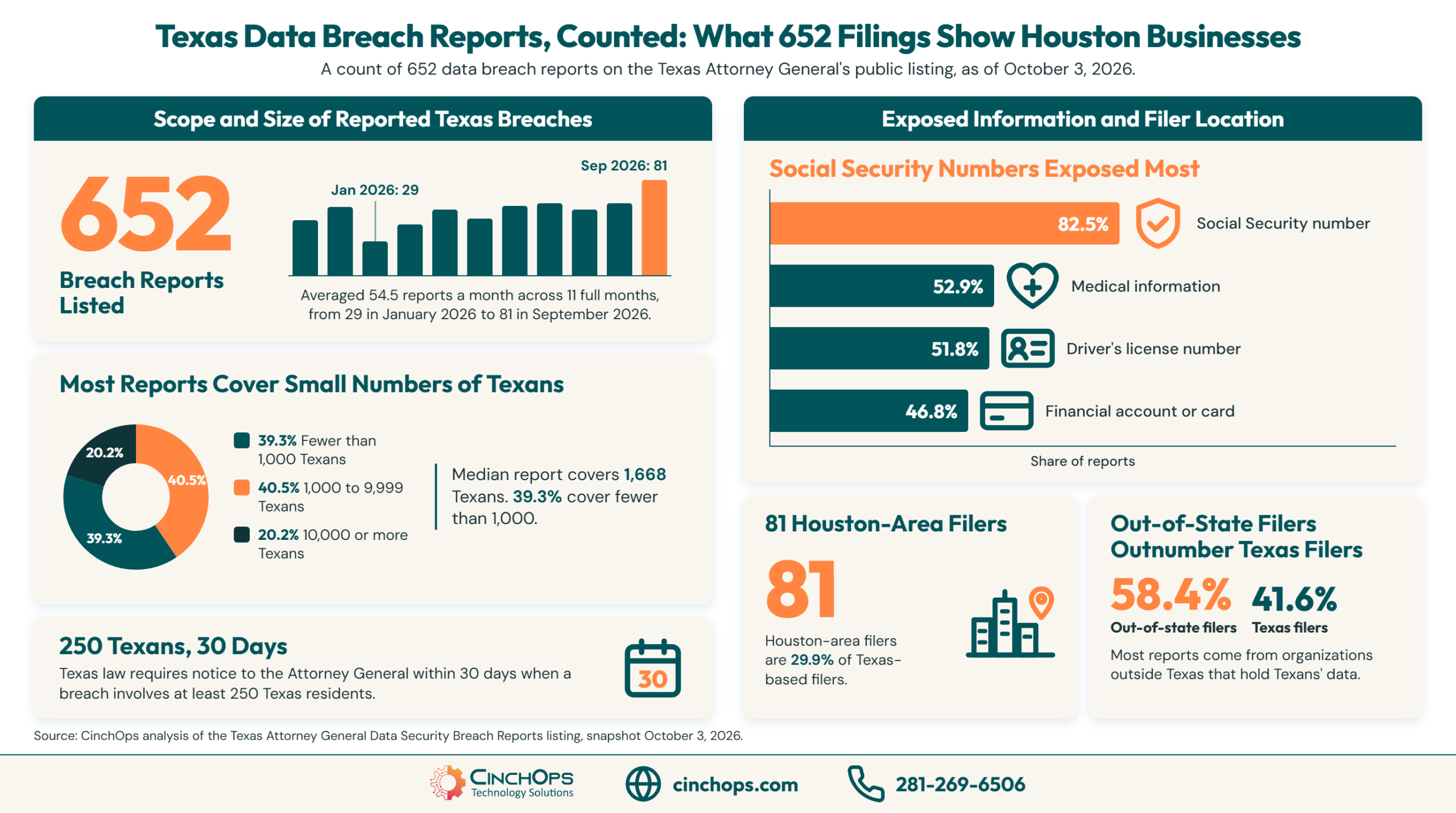
The Texas Attorney General listed 652 data breach reports on October 3, 2026, about 54.5 a month. The median report covers 1,668 Texans, 82.5% list Social Security numbers, and 58.4% were filed by organizations outside Texas that hold Texans' data.
Monthly volume moved between 29 reports in January 2026 and 81 in September 2026. September 2026 is the highest full month in the listing. One snapshot cannot say whether that is a trend, because the Attorney General's site keeps no history and older reports are removed.
How Big Is a Typical Data Breach Reported in Texas?
Breach size on the Texas Attorney General's listing, measured by the number of Texans each report says were affected.
The typical data breach reported to the Texas Attorney General is small. The median report on the October 3, 2026 listing covers 1,668 Texans. 39.3% of the 652 reports cover fewer than 1,000 Texans, 40.5% cover 1,000 to 9,999, and only 20.2% cover 10,000 or more.
The total tells a different story from the median. The 652 reports add up to 52,366,726 Texans affected, and the 2 largest reports account for 46.1% of that sum. The 10 largest account for 79.2%. A handful of very large filings produce the headlines, while 79.8% of reports stay under 10,000 people.
That total counts notices, and one person can appear in several reports. It should be read as the number of times a Texan's information was reported exposed during the listing period.
CinchOps reports the median because the average, 80,317 Texans per report, is pulled far upward by 8 reports of 1,000,000 or more. A Houston law firm, CPA practice or construction company that pictures its own exposure should look at the 1,668 figure, which is roughly the size of a client database or a few years of employee records.
What Personal Information Do Texas Data Breaches Expose?
Each report to the Texas Attorney General lists the types of information affected. A report can list more than one.
Social Security numbers are the most commonly exposed sensitive data in Texas breach reports, listed in 82.5% of the 652 reports on the October 3, 2026 listing. Medical or health insurance information appears in 58%, driver's license numbers in 51.8%, and financial account or card information in 46.8%.
The median report lists 5 types of information, so a single incident usually exposes a full identity record and seldom just one field. 43.3% of reports list a Social Security number and financial information together.
CinchOps sees the same pattern in onboarding audits across the Houston area. Social Security numbers sit in HR shares, scanned new-hire packets and old tax forms that nobody has opened in years, and every mailbox with an attached W-2 holds one too. A business does not need to be a hospital or a bank to hold the data type that shows up in 82.5% of Texas breach reports.
How Many Houston-Area Organizations Reported a Breach?
Where the organizations that filed Texas breach reports are located, by the address shown on each report.
81 of the 652 breach reports on the Texas Attorney General's October 3, 2026 listing came from filers with a Houston-area address, meaning a Texas ZIP code that starts with 770 through 775. Houston-area filers make up 29.9% of the 271 Texas-based filers and 12.4% of all reports.
49 of the 81 Houston-area reports carry a 770 ZIP code, which covers the city of Houston itself. The median Houston-area report covered 2,123 Texans, and 31 of the 81 (38.3%) covered fewer than 1,000. Social Security numbers were listed in 86.4% of Houston-area reports.
Most filers are not in Texas at all. 381 reports (58.4%) came from organizations in 44 other states and the District of Columbia. The Texas rule follows the residents, so an out-of-state payroll processor or software vendor that loses Texans' data reports to Austin. For a business in Katy, Sugar Land or The Woodlands, that makes vendor selection part of breach prevention.

The reports that should get an owner's attention are the ones with 800 or 1,500 people on them. Nobody writes a headline about those, and that is the size of a client list or a payroll file at the companies I sit down with in Katy and Houston every week.
How Was the Texas Breach Notice Index Built, and What Are Its Limits?
Source, snapshot date, row count, calculations and known limitations for the October 2026 edition.
The Texas Breach Notice Index is built from one source: the Texas Attorney General's public Data Security Breach Reports listing. CinchOps saved all 652 listed reports on October 3, 2026, confirmed the count against the number the listing displays, and calculated every figure on this page from that saved copy.
- Source. The Texas Attorney General's Data Security Breach Reports listing, which shows 10 fields per report: name, address, city, state, ZIP code, types of information affected, number of Texans affected, whether notice was provided to consumers, the methods of notice, and the date published.
- Date of data. Snapshot taken October 3, 2026. Published dates on the listing run from April 1, 2025 to October 2, 2026.
- Row count. 652 reports, equal to the count the listing displayed. The saved copy has 0 duplicate rows, and the number of Texans affected is a whole number on all 652 rows.
- Who is on the list. Texas Business and Commerce Code Section 521.053(i) requires notice to the Attorney General when a breach involves at least 250 Texas residents, no later than 30 days after the breach is determined. Section 521.053(j) requires the Attorney General to post the listing, update it within 30 days of each new notice, and remove a report by its first anniversary if the filer has reported no further breach.
- Entries can change. The listing states that details "may change after a report is listed here," including the number of Texans affected and whether notice was provided. Every figure on this page is the listing as it stood on October 3, 2026.
- Calculations. Breach size uses the median and 3 size bands. Information types are counted once per report, so their shares add to more than 100%. Texas and out-of-state shares use the state on each report. Houston area means a Texas address with a ZIP code starting 770, 771, 772, 773, 774 or 775.
- Monthly averages. Averages use the 11 full calendar months from November 2025 through September 2026. 3 reports dated before October 2025 remain on the listing and are included in every other figure.
Known limitations. The index covers only breaches reported to the Texas Attorney General. A breach affecting fewer than 250 Texans is not required to be reported there, so the true number of Texas breaches is higher. 20 listed reports show fewer than 250 Texans, including 2 that show 0, and the index counts them as listed. The number affected is the filer's figure at the time of its notice. The address is the filer's address, which says nothing about where the affected Texans live. The listing has no field for industry, company size or cause, so the index cannot say which sectors or attack types drive the reports. Because reports are removed after about a year, one snapshot is a 12-month window and cannot show a multi-year trend.
Revisions. 2026-10-03: first edition. Later editions will be dated snapshots, and any correction to a published figure will be named here with its prior value.
If a Breach Has Already Happened
Texas gives an organization 30 days to notify the Attorney General and 60 days to notify the people affected. CinchOps runs breach response for Houston businesses, from containment through the evidence an attorney and a cyber insurer will ask for.
See how CinchOps handles breach response →How Can CinchOps Help a Houston Business Stay Off the Texas Breach List?
CinchOps is a managed IT services provider based in Katy, Texas, serving small and mid-sized businesses across the Houston metro area. CinchOps specializes in cybersecurity, network security, managed IT support, VoIP, and SD-WAN for businesses with 10 to 200 employees.
- Through cybersecurity services, CinchOps runs 24/7 threat monitoring on the accounts and devices that hold Social Security numbers, medical records and financial data.
- With managed IT support, help desk requests are answered in under 15 minutes, so a suspicious email gets a real answer before someone clicks it.
- In a breach response engagement, CinchOps works the technical side of an incident while the owner, the attorney and the insurer handle the notices.
- Through business continuity and disaster recovery, backup copies are immutable and stored offsite, which keeps a ransomware incident from also becoming a data-loss incident.
- CinchOps serves Houston, Katy, Sugar Land and The Woodlands, with industry programs for law firms, CPA firms and construction companies.
The Texas breach list is mostly ordinary organizations holding ordinary records, and 81 of them have a Houston-area address. CinchOps prices the work that keeps a business off that list at a flat $100 to $250 per user per month, on Zero-Zero-Zero terms: no long-term contracts, no hidden fees and no cancellation penalties. An owner who wants to know where the company's Social Security numbers and client records actually sit can talk to CinchOps.
Frequently Asked Questions
What is the Texas Breach Notice Index?
The Texas Breach Notice Index is a CinchOps count of every data breach report the Texas Attorney General lists publicly. The October 2026 edition covers 652 reports and shows how large the breaches were, what personal information was exposed, whether consumers were notified, and how many filers are in the Houston area.
Who has to report a data breach to the Texas Attorney General?
Texas Business and Commerce Code Section 521.053(i) requires anyone who must notify individuals of a breach to also notify the Texas Attorney General when the breach involves at least 250 Texas residents. The notice is due as soon as practicable and no later than 30 days after the breach is determined.
How many data breaches were reported in Texas in the past year?
The Texas Attorney General listed 652 data breach reports on October 3, 2026, dated April 1, 2025 to October 2, 2026. Across the 11 full calendar months in the listing, that averages 54.5 reports a month, from a low of 29 in January 2026 to a high of 81 in September 2026.
What information is exposed most often in Texas data breaches?
Social Security numbers appear in 82.5% of the 652 Texas breach reports listed on October 3, 2026. Medical information appears in 52.9%, driver's license numbers in 51.8%, and financial account or card information in 46.8%. The median report lists 5 types of information.
How many Houston-area organizations reported a data breach to the Texas Attorney General?
81 of the 652 reports listed on October 3, 2026 came from filers with a Houston-area address, defined as a Texas ZIP code starting with 770 through 775. That is 29.9% of all Texas-based filers. The median Houston-area report covered 2,123 Texans.
What does cybersecurity to prevent a data breach cost in Houston?
CinchOps prices managed IT and cybersecurity for Houston-area businesses at a flat $100 to $250 per user per month, with 24/7 threat monitoring. The CinchOps model is Zero-Zero-Zero: no long-term contracts, no hidden fees and no cancellation penalties. A 25-person office would pay between $2,500 and $6,250 a month.
Does the Texas breach list show every data breach in Texas?
No. The Texas Attorney General's listing covers only breaches reported under Section 521.053(i), which applies at 250 or more Texas residents. Smaller breaches still require notice to the affected people but are not reported to the Attorney General. The statute also has reports removed from the listing after about one year.
Discover More
Resource
Sources
- CinchOps Texas Breach Notice Index - the standing index page, refreshed monthly
- Office of the Texas Attorney General, Data Security Breach Reports - public listing, 652 reports, snapshot taken October 3, 2026
- Texas Business and Commerce Code, Chapter 521, Section 521.053(i) and (j) - reporting threshold, deadline and public listing rules
- Office of the Texas Attorney General, Data Breach Reporting - reporting form and instructions


