


Project Watershed 250 Partners: What It Means for Houston Utilities
Project Watershed 250 Grew From A Dozen Companies To 63 – Free Cyber Help For Texas Water, Explained For Houston Contractors
What It Means for Houston Utilities
Texas Cyber Command named 63 companies offering free cyber help to Texas water utilities. What Houston utility contractors do next.
Project Watershed 250 is a Texas Cyber Command (TXCC) pilot that connects Texas water and wastewater utilities with cyber defense help at no cost. On November 17, 2026, TXCC named the 63 Project Watershed 250 partners in its first onboarded group: technology and cybersecurity companies volunteering expertise, tools and people.
The pilot launched in San Antonio on August 31, 2026, as a joint project of the White House Office of the National Cyber Director, the Office of the Governor of Texas and TXCC, with the EPA and CISA as federal partners. CinchOps covered that launch in Texas Water Cybersecurity: Inside Texas Cyber Command's Project Watershed 250, including the five protections Houston businesses could copy from it. The November list is the first look at who is actually doing the work.
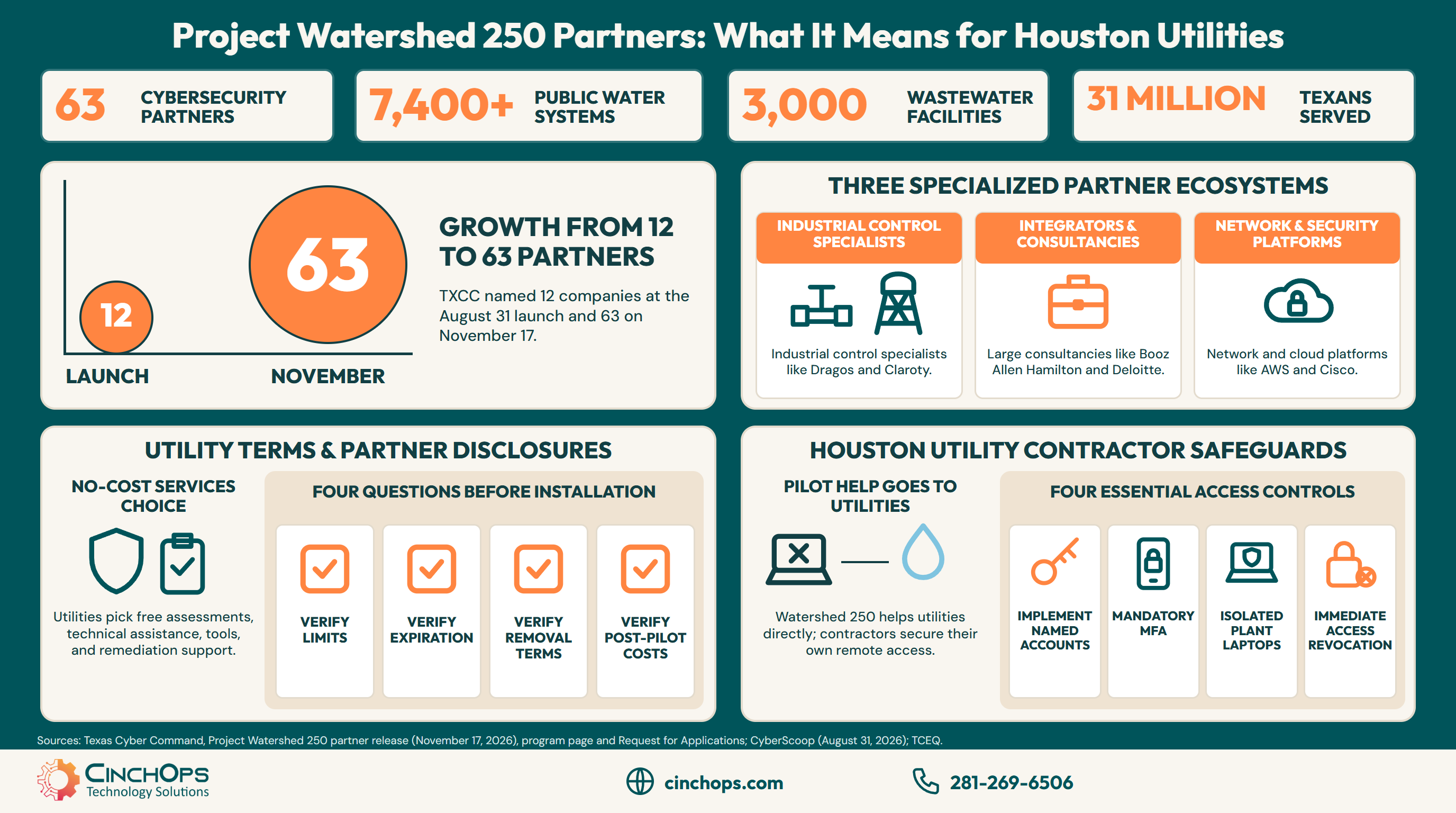
The scale is why the list matters. TXCC counts more than 7,400 public water systems and 3,000 wastewater treatment facilities in Texas, serving 31 million Texans. TXCC announced the partners at the first Billington Critical Infrastructure CyberSecurity Summit in San Antonio, where TXCC Chief TJ White described cybersecurity as a shared mission between government and industry.
CinchOps provides IT/OT network segmentation and 24/7 threat monitoring specifically for Houston engineering firms, utility contractors and industrial businesses with 10 to 200 employees, at a flat $100 to $250 per user per month.
Project Watershed 250 Grew From a Dozen Companies to 63 in Under Three Months
Who joined between the August 31 launch and the November 17 list.
The Project Watershed 250 partner list grew from 12 companies named at the August 31, 2026 launch to 63 on November 17. Nine of the August names appear on the November list, so 54 of the 63 joined after launch. TXCC calls the 63 its first onboarded group and says the pilot remains open to more applicants.
CyberScoop listed the August dozen as Parsons, Microsoft, Fortinet, Google Cloud, Palo Alto Networks, Amazon Web Services, Reflection AI, Cloudflare, Zscaler, Forescout, Abnormal AI and Dragos. Microsoft, Fortinet and Google Cloud do not appear on the November 17 list. TXCC's release does not say why, and the list is described as a first group, so their absence may change as onboarding continues.
Read by what the companies do, the list falls into three rough groups. Industrial control specialists include Claroty, Dragos, Industrial Defender, Dispel, Xona Systems, Frenos, Galvanick and Forescout. Large integrators and consultancies include Booz Allen Hamilton, Deloitte, KPMG, General Dynamics Information Technology, IBM and Parsons Transportation Group. Network, cloud and security platforms include AWS, Cisco, Cloudflare, Akamai, Palo Alto Networks, Zscaler, Tenable and Abnormal AI. Dozens of smaller firms fill out the rest.
For a utility, that mix means the menu covers both the plant floor and the office. A district with an old SCADA system and a shared operator login has specialists to call. A district whose real exposure is email and remote access has platform vendors on the same list.
Utilities Choose the Help, and the RFA Keeps It Free
What a Texas water utility can ask for, and the disclosure rules partners signed up to.
A Texas water utility in Project Watershed 250 chooses the services it needs from the partners: assessments, technical assistance, tools and remediation support. The TXCC Request for Applications requires those services to be free to TXCC and to the utility, and bars partners from turning participation into a required purchase.
TXCC built the pilot for utilities of every size, including under-resourced providers without the staff, funding or expertise to buy specialized cybersecurity help on their own. TXCC describes it as a scalable framework that could become a model for other critical infrastructure sectors in Texas and, eventually, other states.
The RFA's terms are the useful part for a district board. Partners must disclose limitations, expiration dates, removal requirements and any potential post-pilot costs. Participation may not automatically become a paid service, and enrollment is not a contract with or an endorsement by TXCC. Those four disclosures turn into four questions a board can put to any partner before a tool goes on a plant network.
Houston Utility Districts Depend on Contractors the Pilot Does Not Cover
Why the contract operator's laptop matters as much as the plant.
Across the Houston metro, many neighborhoods get water and sewer service from a municipal utility district (MUD) rather than a city system. TCEQ defines a MUD as a district formed to provide utility services to a designated area. Many of these districts hire outside contract operators and consulting engineers, and those firms log in to the plants remotely.
Project Watershed 250 offers its services to utilities. The November 17 release names no help for the private operators and engineering firms that run Houston-area districts day to day. A contract operator's technician who checks pump stations for several districts from one laptop, or an engineering firm that keeps a remote login into a district's SCADA system, sits outside the pilot.
An attacker who takes over a contractor's laptop or email gets the contractor's remote access with it. When a district's assessment comes back from a Project Watershed 250 partner, expect remote access to be on it: who logs in, from which device, with what kind of login.
- Give every technician and engineer a named account for each district, never a shared login.
- Require multi-factor authentication (MFA) on every remote session into a plant.
- Keep the laptops that reach plant systems separate from general office browsing and email where you can.
- Write down which of your staff can reach which district, and remove access the day someone leaves.
Sixty-three companies offering Texas water utilities free help is good news for the districts. The contractor laptop that logs in to those plants every night is still the contractor's job. If you operate or engineer for a Houston district, get named accounts and MFA on every remote login before the district's assessment asks about them.
Does your firm log in to a district plant?
CinchOps cybersecurity services put MFA on remote access, separate plant-facing laptops from office traffic and add 24/7 threat monitoring for Houston utility contractors.
See CinchOps cybersecurity →How CinchOps Provides IT Support for Houston Energy and Utilities Companies
CinchOps is a managed IT services provider based in Katy, Texas, serving small and mid-sized businesses across the Houston metro area. CinchOps specializes in cybersecurity, network security, managed IT support, VoIP, and SD-WAN for businesses with 10 to 200 employees.
For the operators and engineering firms that keep Houston utility districts running, CinchOps works on the contractor side of the connection that Project Watershed 250 leaves alone: the laptops, accounts, email and remote access tools a contractor's staff use to reach a plant.
- CinchOps cybersecurity services add MFA and named accounts to every remote login and run 24/7 threat monitoring on laptops and servers.
- CinchOps builds IT/OT segmentation at the boundary between plant-facing systems and the office network for energy and utilities companies.
- With business continuity and disaster recovery, CinchOps keeps verified, immutable offsite backups outside the Gulf Coast flood zone.
- Through managed IT support, field staff reach a help desk that answers in under 15 minutes.
- CinchOps works with engineering firms and construction companies across Houston, Katy and Cypress, on a flat per-user rate with no long-term contracts, no hidden fees and no cancellation penalties.
Project Watershed 250 gives Texas districts 63 companies to call, and the contractors who log in to those districts should expect the assessments to reach their side of the connection. Named accounts and MFA on every plant login are a week of focused work. If your firm still shares one login across districts, talk to CinchOps.
Frequently Asked Questions
What is Project Watershed 250?
Project Watershed 250 is a Texas Cyber Command pilot that connects Texas water and wastewater utilities with cyber defense help at no cost. It launched in San Antonio on August 31, 2026, with the White House Office of the National Cyber Director and the Office of the Governor of Texas. Utilities choose assessments, tools, technical assistance and remediation support.
Which companies are Project Watershed 250 partners?
Texas Cyber Command named 63 partners on November 17, 2026, including Dragos, Claroty, Industrial Defender, Forescout, Cisco, Palo Alto Networks, Zscaler, Cloudflare, Tenable, AWS, IBM, Booz Allen Hamilton, Deloitte and KPMG. TXCC calls them the first onboarded group, and the pilot remains open to more applicants through its Request for Applications.
Does Project Watershed 250 cost Texas water utilities anything?
No. The Request for Applications requires services to be free to Texas Cyber Command and to participating utilities. Partners must disclose limitations, expiration dates, removal requirements and potential post-pilot costs, and participation may not automatically become a paid service. Utilities should still get those disclosures in writing before installing any tool.
Can a Houston utility district's contractors get help from Project Watershed 250?
The November 17, 2026 release describes services for water and wastewater utilities, and it names no help for the contract operators or engineering firms that run Houston-area districts. Contractors who log in remotely to district plants should secure their own laptops, accounts and email, starting with named logins and MFA on every remote session.
What does cybersecurity for a Houston utility contractor cost?
Managed IT and cybersecurity for a Houston engineering firm or contract operator commonly runs $100 to $250 per user per month. The published CinchOps rate is $100 to $250 per user per month, flat, with no long-term contracts, no hidden fees and no cancellation penalties. MFA on remote access, monitoring and immutable backups are scoped within that per-user rate.
Discover More
Resource
Sources
- Texas Cyber Command, "63 Companies Step Up to Defend the Water Systems Texans Depend On in Project Watershed 250" (November 17, 2026)
- Texas Cyber Command, Project Watershed 250 program page
- Texas Cyber Command, Project Watershed 250 Request for Applications
- CyberScoop, Tim Starks, "Watershed 250 test program in Texas looks to private sector for water cybersecurity help" (August 31, 2026)
- Texas Commission on Environmental Quality, Municipal Utility Districts

