


AI-Generated Code in Houston Small Businesses: Who Checks It First?
Explore, Delegate, Release: Who May Use AI Code – Who Reviews AI Code When Nobody On Staff Writes Code
Who Checks It First?
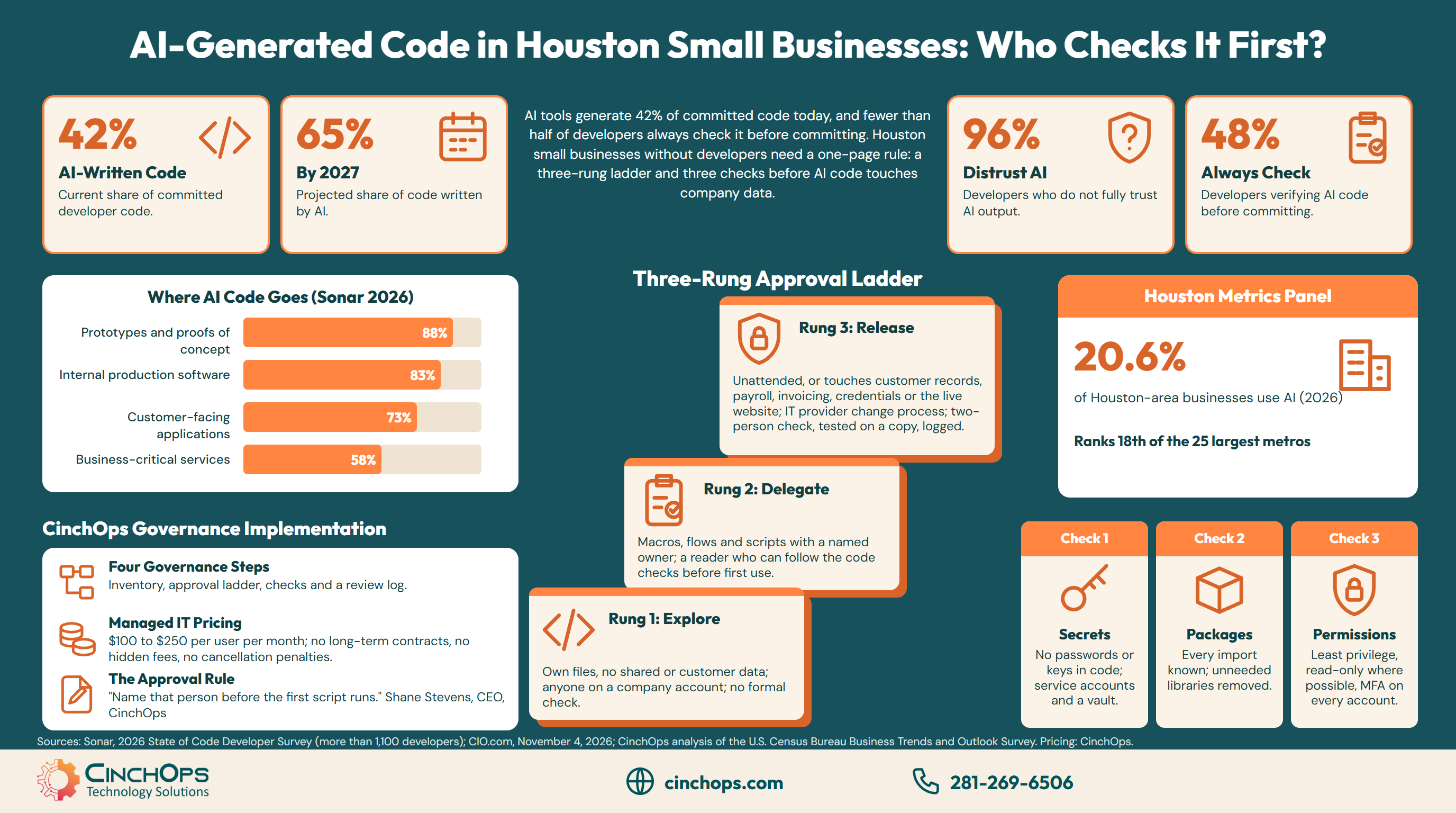
Sonar's 2026 survey puts AI at 42% of committed code. A Houston business with no developer still needs a rule for who reads it.
AI-generated code is already running inside Houston small businesses, and most of it was never read by anyone who could check it. Sonar's 2026 State of Code survey of more than 1,100 professional developers found that AI now accounts for 42% of committed code, that 96% of developers do not fully trust it, and that only 48% always check it before committing.
That survey describes companies with developers. A CIO.com article published November 4, 2026 asked how technology leaders at Chase, Snowflake, Boomi, Thomson Reuters and Sanofi keep control as AI writes more of their code. A 10 to 200 person Houston business has no CIO and usually no developer, which makes the question sharper there. The Excel macro, the Power Automate flow and the website script that ChatGPT or Copilot wrote last month have no review step at all unless the owner creates one.
CinchOps writes AI-use policies specifically for Houston-area businesses with 10 to 200 employees through its AI policy and governance service, alongside managed IT priced at a flat $100 to $250 per user per month.
AI Writes 42% of Committed Code and Only Half of It Gets Checked
What Sonar's 2026 developer survey and the CIO.com interviews say about volume, trust and review.
The volume of AI-written code is rising faster than the habit of checking it. Developers in Sonar's 2026 survey expect AI's share of committed code to reach 65% by 2027, yet 38% of them say reviewing AI code takes more effort than reviewing a colleague's work, and 35% reach the tools through personal accounts their employer cannot see.
The code is not staying in test environments. Sonar found 88% of developers use AI for prototypes, 83% for internal production software, 73% for customer-facing applications and 58% for business-critical services. Boomi CEO Steve Lucas told CIO.com that Boomi writes 10 times the code it did two years ago, and he cited research putting Claude Code at 4% of public GitHub commits, with a projection of 20% of daily commits by the end of 2026.
Houston's numbers make the problem quieter, not smaller. CinchOps' analysis of the U.S. Census Bureau's Business Trends and Outlook Survey put Houston-area business AI use at 20.6% across 2026, 18th of the 25 largest metros. In a city where one business in five uses AI at all, the AI-written code inside a Katy engineering firm or a Houston distributor tends to arrive through one or two early adopters, often on a personal account, long before anyone writes a rule for it.
Three Rungs Decide Who May Use AI Code and Who Checks It
TF1's explore, delegate, release model, sized for a company with no development team.
An AI code policy for a small business is a one-page rule that says, for each use, whether staff may explore it, delegate work to it or release it into production, and who checks the result at each rung. François-Xavier Pierrel, group chief data and ad tech officer at the French broadcaster TF1, described that three-way split to CIO.com as the way TF1 keeps humans in the loop in a defined way.
Gill Haus, CIO of Chase, added the other half of the rule. Chase does not release production services that fail its quality and security bar, however the code was written. A 30-person Houston construction firm can hold the same line with one sentence in its policy.
The table maps the three rungs to the AI-written code a 10 to 200 person business actually produces, with the person who approves each one.
| Rung | What it covers in a small business | Who may do it | Who checks before it is used |
|---|---|---|---|
| 1. Explore | Drafts and experiments on your own files: a formula, a one-off script on a copy of a spreadsheet, a prototype that touches no shared or customer data | Anyone, on a company account | Nobody formally; the output stays with the person who made it |
| 2. Delegate | Work AI writes and a person owns: Excel macros on shared workbooks, Power Automate flows, reporting scripts, website edits in a staging copy | Staff with a named owner for the result | A designated reader who can follow the code, or the IT provider, before first use |
| 3. Release | Anything that runs unattended or touches customer records, payroll, invoicing, credentials or the live website | Only through the IT provider's change process | Two-person check, tested on a copy first, logged with the date and the reviewer |
Texas's AI law, HB 149, took effect January 1, 2026 and places no registration, filing or audit duty on a private business outside its voluntary sandbox. The policy that governs AI-written code in a Houston company is the one that company writes for itself, which is why the ladder above has to fit on one page. The CinchOps TRAIGA checklist covers what the law does ask.
Pierrel documents TF1's agent processes in Confluence. A small business can do the same on a SharePoint page: the rung, the owner, the reviewer and the date. Without that record and a policy behind it, he told CIO.com, AI becomes disruptive once the number of agents grows.
Three Checks Happen Before AI Code Touches Company Data
Secrets, packages and permissions, plus a reader who can follow the code.
Before AI-written code touches company data, three checks run: no secrets inside it, every package it pulls in is known, and it holds only the permissions the task needs. Tal Carmi, CIO of WalkMe, told CIO.com that his engineers check credentials and potentially problematic packages in what non-developers build, and that in-house engineering work is shifting from building to testing.
- Secrets. AI tools will paste a password or API key straight into a script, and a prompt that contains one has already leaked it. Service accounts and a password manager replace pasted credentials.
- Packages. Generated code imports libraries and connectors nobody chose, and each one is a supply-chain door. Campaigns such as GlassWorm spread through exactly those code repositories. The reviewer lists every import and removes the ones the task does not need.
- Permissions. A flow that only needs to read a list should not be able to delete it. Least privilege, read-only connections where possible and multifactor authentication on every account the code uses.
- A reader. Sonar found 53% of developers see AI produce code that looks correct but is not reliable. Someone who can follow the code runs it on a copy and compares the result to what was asked.
The CIO.com interviews agree on the staffing consequence. Lucas expects Boomi to need more engineers to keep quality up as output grows. Kirsty Roth, COO of Thomson Reuters, said the time AI saves raises the question of which roles a firm needs next. For a Houston business the reader is usually the managed IT provider, because nobody else in a 40-person firm reads code.
Emmanuel Frenehard, chief digital officer at Sanofi, told CIO.com he worries that professionals who do not use AI for coding may lose their jobs within five years, so Sanofi is coaching and training staff rather than restricting them. The small-business version is the same. The ladder and the three checks exist so staff can use the tools, with a named person reading what comes out.
If nobody in the building can read the code, nobody in the building can approve it. Name that person before the first script runs.
A one-page AI code policy for your business
The CinchOps AI policy and governance service writes the approval ladder, names the reviewer and sets the secrets, package and permission checks for Houston businesses that use AI to write code without a development team.
See AI policy and governanceHow CinchOps Can Help Houston Businesses Keep AI-Written Code in Check
CinchOps is a managed IT services provider based in Katy, Texas, serving small and mid-sized businesses across the Houston metro area. CinchOps specializes in cybersecurity, network security, managed IT support, VoIP, and SD-WAN for businesses with 10 to 200 employees.
AI policy and governance turns the three-rung ladder into a written policy with named reviewers. Fractional CTO/CIO services decide which rung each use sits on and review what reaches the release rung. Cybersecurity services cover the secrets, package and permission checks, with 24/7 threat monitoring on the accounts the code uses. Managed IT is priced at a flat $100 to $250 per user per month under Zero-Zero-Zero terms: no long-term contracts, no hidden fees and no cancellation penalties. CinchOps works with businesses in Houston and Katy, including engineering firms, construction companies and oil and gas operators whose technical staff write scripts as part of the job.
AI is going to write a growing share of the code inside your business whether or not anyone decides it should. The decision left to make is who reads it first. If that person does not exist yet in your Houston company, talk to CinchOps.
Frequently Asked Questions
What counts as AI-generated code in a small business?
AI-generated code in a small business is any macro, formula, script, automation flow or website change that ChatGPT, Copilot, Claude or a similar tool wrote or largely wrote. It includes Excel VBA, Power Automate flows, reporting scripts and WordPress edits, whether or not the person who requested it can read the result.
Should a small business ban AI coding tools?
No. Sonar's 2026 survey found 35% of developers already reach AI coding tools through personal accounts, so a ban moves the work out of sight. A three-rung policy works better: anyone may explore on their own files, delegated work gets a named owner and a reader, and anything released to production goes through the IT provider's change process.
Who should review AI-generated code when a company has no developers?
A named person who can follow the code, which in a 10 to 200 person Houston business is usually the managed IT provider. The reviewer runs the code on a copy of the data, compares the result with what was asked, checks for pasted secrets and unknown packages, and records the review date before live use.
What should be checked before AI-written code is used?
Three things, before it touches company data: no passwords or API keys inside the code; every library or connector it imports is known and needed; and it holds only the permissions the task requires, with multifactor authentication on each account it uses. Sonar found 53% of developers see AI code that looks correct but is not reliable.
What does an AI code policy cost in Houston?
The policy is one page and costs staff time more than money. The review work is the real cost, usually carried by the managed IT provider. The published CinchOps managed IT rate is $100 to $250 per user per month, with no long-term contracts, no hidden fees and no cancellation penalties; policy work is scoped through its fractional CTO/CIO service.
Discover More
Resource
Sources
- Mark Samuels, CIO.com, "How CIOs can retain control as AI writes more code," November 4, 2026
- Sonar, press release, "Sonar Data Reveals Critical Verification Gap in AI Coding," January 8, 2026 (2026 State of Code Developer Survey)
- Sonar, "State of Code Developer Survey report: The current reality of AI coding," January 8, 2026
- CinchOps, "Houston Small Business AI Adoption: The 2026 Census Report" (analysis of the U.S. Census Bureau Business Trends and Outlook Survey)
- Texas Legislature, HB 149 (89R), Texas Responsible Artificial Intelligence Governance Act, enrolled text


