


Third-Party Vendor Risk in Houston: Your Vendors Have Vendors Too
Four Myths About Vendor Risk For Small Businesses – A Workaround For Every Critical Vendor
Your Vendors Have Vendors Too
Part 4 of Building the Resilient Business, a CinchOps series on IT resilience for small and mid-sized Houston companies.
Third-party vendor risk is the chance that a software, cloud or service provider your business depends on fails, gets breached or shuts down, and takes your operations down with it. For a 10-200 person Houston business the risk runs a layer deeper than most owners look, because every vendor has vendors of its own.
NIST calls the discipline cybersecurity supply chain risk management and defines it as "a systematic process for managing exposure to cybersecurity risks throughout the supply chain" and developing the responses to match. Large companies staff whole teams for it. A small business needs a shorter version: know who you depend on, and know what you will do when one of them stops.
This post is Part 4 of Building the Resilient Business, a CinchOps series on IT resilience. Part 1, What Is IT Resilience? named vendors as one of the six parts. Each later post goes deep on one part, and this one takes on four common beliefs about vendors that leave small businesses exposed.
CinchOps manages IT and vendor reviews specifically for Houston-area businesses with 10 to 200 employees, with 24/7 threat monitoring and a help desk that answers in under 15 minutes.
Is a Big-Name Vendor a Safe Vendor?
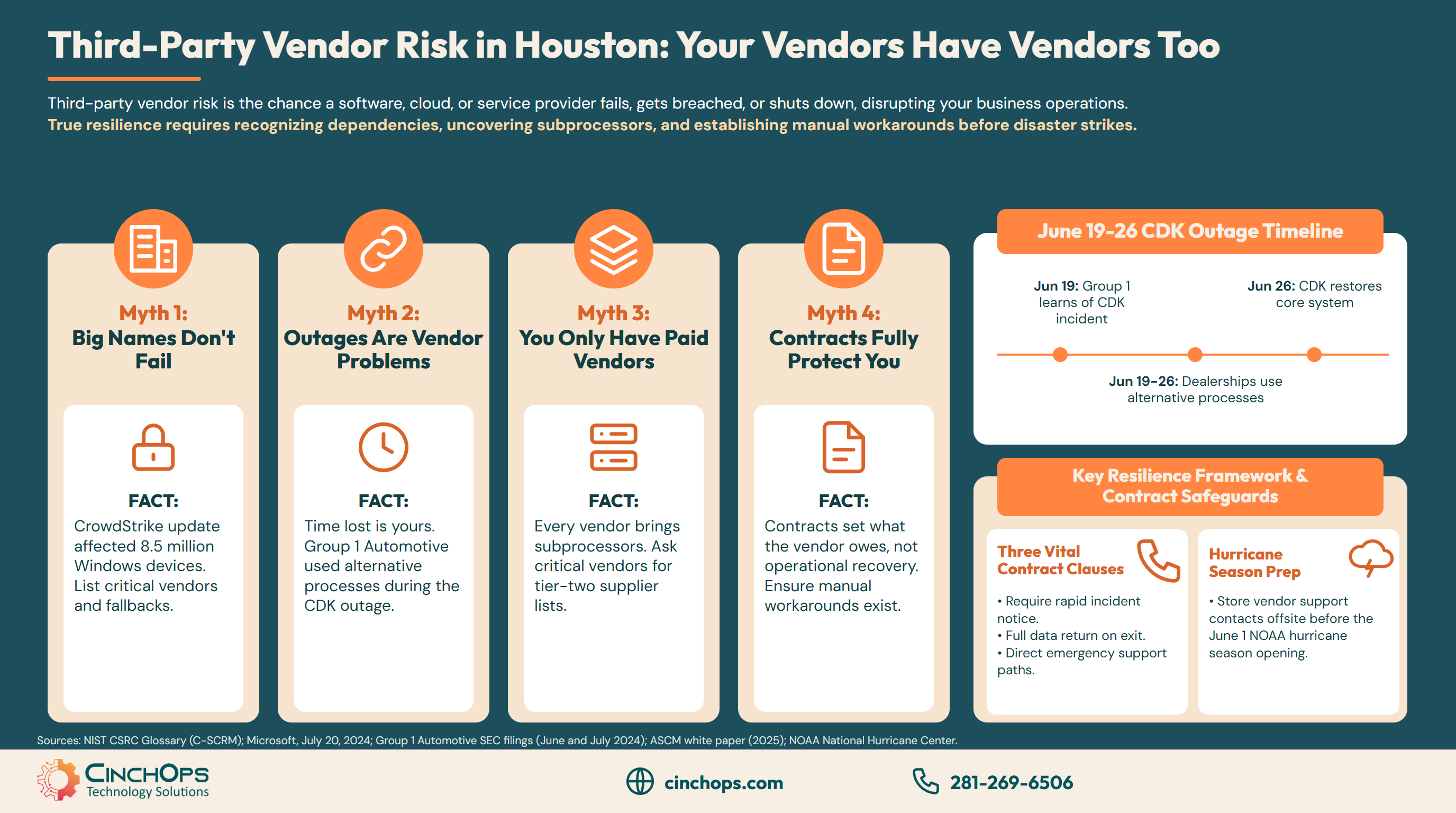
Myth: a large, well-known provider will not fail. Fact: scale changes the odds, not the outcome.
A big-name vendor is not a safe vendor, only a well-resourced one. Large providers may fail less often, but when they fail, thousands of businesses go down at once and none of them can fix it. The useful question is not whether a vendor will fail but what the office does when it does.
On July 19, 2024, a faulty CrowdStrike update knocked Windows computers offline around the world, and Microsoft said it affected 8.5 million Windows devices. CrowdStrike is a security vendor businesses buy specifically to reduce risk. The businesses hit did nothing wrong, and their recovery depended on how quickly someone could reach each affected machine.
The fix is a short list: the vendors whose failure would stop work within a day. For each one, write down who to call, how long the business can run without it, and the manual fallback.
Is a Vendor Outage Only the Vendor's Problem?
Myth: when the vendor is down, there is nothing to do but wait. Fact: a written workaround keeps the doors open.
A vendor outage becomes your problem the minute your staff cannot do their jobs. The vendor owns the repair, but the business owns the time in between, and a written workaround decides whether that time is lost or just slower than usual.
Houston has a public example. Group 1 Automotive, headquartered on Gessner in Houston, reported to the SEC that it learned on June 19, 2024 of a cybersecurity incident at CDK Global, the company behind the dealer management system its U.S. stores used. The filing said all Group 1 U.S. dealerships continued to conduct business using alternative processes until CDK's systems were available, and Group 1 later reported that CDK restored the core system on June 26, 2024.
That week is the whole lesson in miniature. The vendor's repair took days, and the business kept selling because it had a way to work without the system. A 30-person office needs the same thing on a smaller scale: how to invoice, schedule or take payments when the main app is down.
Do You Know Who Your Vendors Depend On?
Myth: a business only has the vendors it pays. Fact: each vendor brings its own suppliers.
A small business can usually name the vendors it pays, but the companies those vendors depend on rarely appear on any list: hosting providers, payment processors, support contractors and software suppliers. A failure two layers down reaches the office just as fast as a failure at the vendor itself.
Manufacturers face the same blind spot. The Association for Supply Chain Management's 2025 white paper found industrial manufacturers significantly less likely than other sectors to report completely accurate identification of their tier-two and tier-three suppliers, and it calls visibility beyond tier-one suppliers a significant challenge. That study covers manufacturers, but the pattern holds for software too: each layer down is harder to see.
The fix takes about a week. Ask each critical vendor for its list of subprocessors or key suppliers, note where your data is hosted, and add one line to the vendor list: what else has to work for this vendor to work.
Does a Vendor Contract Protect You From an Outage?
Myth: the contract covers it. Fact: a contract sets what the vendor owes, not how you keep working.
A vendor contract protects the business on paper, not in practice. It defines what the vendor owes after a failure, but it cannot restore your files, reopen your schedule or answer your customers. Three clauses matter most to a small business: incident notice, data return on exit and the support path during an outage.
Read each critical contract for those three things. How quickly must the vendor tell you about a breach or outage? Can you get all your data back, in a usable format, if you leave? Who do you call at 7 a.m. when the service is down, and is that number written somewhere other than the vendor's own website?
Review contracts at renewal rather than in a crisis, because renewal is where a small business has the most bargaining power. Houston businesses should also store vendor support contacts outside the office before hurricane season opens on June 1, according to the National Hurricane Center's season dates, so the list is reachable when the building is not.
You can't stop a vendor from failing. Put your effort into what you can control: the workaround, the contact list and the plan that keep your business online and operational while they fix it.
Know which vendors could stop your business
A CinchOps vendor audit grades each technology vendor keep, renegotiate or cut, flags auto-renewal dates, and finds vendors with system access that never went through a security review.
See the vendor auditHow CinchOps Helps Houston Businesses Manage Vendor Risk
CinchOps is a managed IT services provider based in Katy, Texas, serving small and mid-sized businesses across the Houston metro area. CinchOps specializes in cybersecurity, network security, managed IT support, VoIP, and SD-WAN for businesses with 10 to 200 employees.
- Vendors: a vendor audit grades each technology vendor, and CTO/CIO services cover vendor and contract reviews at renewal.
- Operations: SD-WAN runs across redundant service providers, such as 5G data and Starlink, so one internet vendor is not a single point of failure.
- Data: backup and disaster recovery keeps immutable, offsite copies of Microsoft 365 and Google Workspace data outside the Gulf Coast flood zone.
- Security: cybersecurity services add 24/7 threat monitoring across email and admin accounts.
- Local coverage: CinchOps works with businesses in Houston, Katy and The Woodlands, including construction companies, CPA firms and wealth management firms.
Third-party vendor risk never reaches zero, and it does not need to. List the vendors that could stop work in a day, write a workaround for each, and talk to CinchOps if you want help checking the vendors behind your vendors.
Frequently Asked Questions
What is third-party vendor risk?
Third-party vendor risk is the chance that an outside provider, such as a software, cloud, payment or IT services company, fails, is breached or shuts down and disrupts your business. For a 10-200 person Houston company it includes the vendors' own suppliers, which rarely appear on any vendor list.
How does a small business manage vendor risk?
A small business manages vendor risk with a short list and a few habits: name the vendors that would stop work within a day, write a workaround and support contact for each, ask critical vendors for their subprocessor lists, and review contracts at renewal for incident notice and data return.
What happened in the June 2024 CDK Global outage?
In June 2024 a cybersecurity incident at CDK Global took down dealer management systems used by car dealerships. Houston-based Group 1 Automotive reported that its U.S. dealerships kept doing business with alternative processes, and that CDK restored the core system on June 26, 2024.
What does a vendor risk review cost in Houston?
A first vendor list costs little beyond staff time. Ongoing vendor and contract reviews usually sit inside managed IT, which CinchOps prices at a flat $100 to $250 per user per month under Zero-Zero-Zero terms: no long-term contracts, no hidden fees and no cancellation penalties.
How often should a small business review its vendors?
Review the critical vendor list at least once a year and at every contract renewal, plus whenever a vendor reports a breach or a major outage. Houston businesses should also confirm each spring, before hurricane season opens on June 1, that vendor support contacts are stored outside the office.
Discover More
Resource
Sources
- NIST Computer Security Resource Center, Glossary: cybersecurity supply chain risk management
- Microsoft, David Weston, "Helping our customers through the CrowdStrike outage," July 20, 2024
- Group 1 Automotive, Form 8-K, June 19, 2024
- Group 1 Automotive, second quarter 2024 results (Form 8-K, Exhibit 99.1)
- ASCM, "Adapting to Uncertainty: Visibility and Traceability Strategies to Build Resilience," 2025
- NOAA National Hurricane Center, Tropical Cyclone Climatology

