


Business Resilience vs Business Continuity: The Difference (2026)
Business Resilience For Small And Mid-Sized Businesses In Houston – What Business Continuity Covers And What Resilience Adds
Four beliefs Houston owners hold about resilience, checked against the NIST definitions and what Hurricane Beryl did in July 2024.
Business resilience vs business continuity comes down to one difference: continuity is the plan you wrote for the disruption you expected, and resilience is how well the business keeps working when the disruption is bigger than the plan.
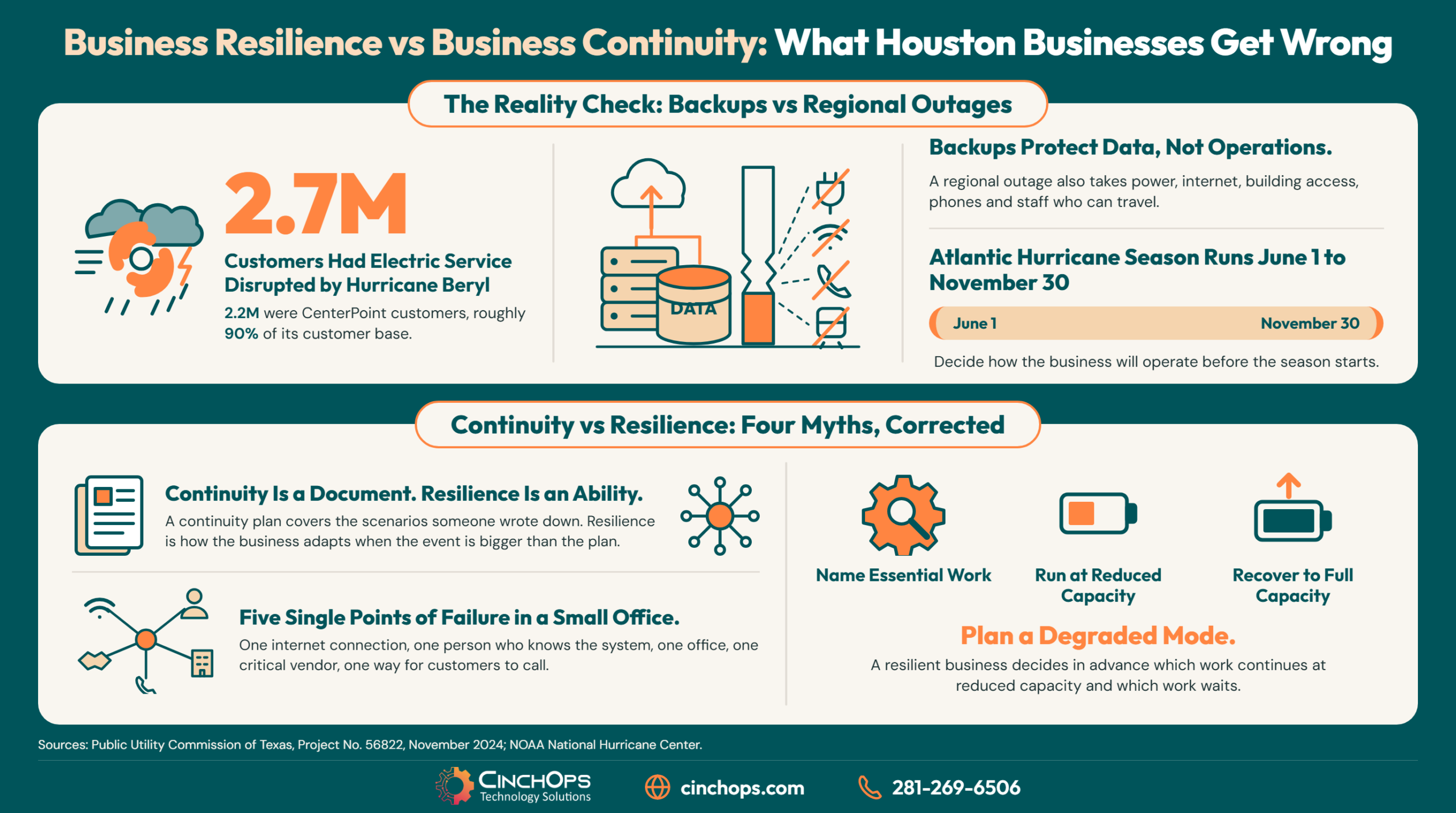
Most Houston owners who ask about this already have backups, and many have a continuity binder on a shelf. Then a storm takes power from most of the metro for days, and the servers were never the problem. When Hurricane Beryl came ashore on July 8, 2024, it disrupted electric service for 2.7M customers, including 2.2M CenterPoint customers, roughly 90% of the utility's customer base, according to the Public Utility Commission of Texas.
CinchOps provides managed IT support and business continuity planning specifically for small and mid-sized businesses in the Houston metro, with backups stored outside the Gulf Coast flood zone. The four myths below are the ones that come up most in that work.
Is Business Resilience Just Another Name for Business Continuity?
Myth: the two terms mean the same thing, so having one covers the other.
No. Business continuity is a documented plan for sustaining critical business processes during and after a significant disruption. Business resilience is the broader ability to prepare for and adapt to changing conditions and to withstand and recover rapidly from disruptions. Continuity is one of the things a resilient business has.
The definitions come from NIST. NIST SP 800-34 Rev. 1 defines a business continuity plan as "the documentation of a predetermined set of instructions or procedures that describe how an organization's mission/business processes will be sustained during and after a significant disruption." NIST SP 800-37 Rev. 2 defines resilience as "the ability to prepare for and adapt to changing conditions and withstand and recover rapidly from disruptions."
One is a document and the other is an ability. A continuity plan is written in advance for scenarios someone thought of. Resilience is tested by the scenario nobody wrote down: the outage that lasts 6 days when the plan assumed 1, or the vendor that goes dark the same week the office floods. Disaster recovery sits inside both and covers one job, which is restoring IT systems and data.
For the continuity side in detail, CinchOps has a separate guide on what business continuity is and why Houston businesses need it.
If Our Backups Work, Are We Resilient?
Myth: a good backup means the business is covered.
No. A backup protects data. A backup does not restore power, internet service, a reachable office, working phones or staff who can get to work, and those are what a regional event along the Gulf Coast takes away first.
Hurricane Beryl is the local proof. Four days after landfall, the Supreme Court of Texas issued an emergency order citing "difficulties with access, electricity, internet, travel, and communication by lawyers, parties, and others" in Harris, Fort Bend, Galveston, Matagorda and Montgomery counties. Every law firm named in that sentence could have had a perfect backup and still been unable to work.
The exposure repeats every year. The Atlantic hurricane season runs from June 1 to November 30 and peaks on September 10, according to the National Hurricane Center. We see the same gap in onboarding reviews across the Houston area: the backup job is green, and nobody has decided where people work or who answers the phones when the building is dark.
Backups still matter, and they have to be the right kind. CinchOps keeps backup copies immutable and offsite, stored outside the Gulf Coast flood zone, so a storm that closes a Katy or Sugar Land office does not also take the data. Whether a backup can be restored is a separate question, covered in backup testing for Houston businesses.
Is Business Resilience Only for Large Enterprises?
Myth: resilience needs a risk department and a budget to match.
No. ISO 22316:2017, the international guidance on organizational resilience, states that it applies to any size or type of organization. For a 20-person Houston firm, resilience is a short list of single points of failure with a decision written next to each one.
A single point of failure is anything the business has only one of and cannot work without. Large companies hire people to find them. A small office can find its own in an hour, because there are usually five.
In 35+ years doing this, the single point of failure I find most often is a person. One office manager holds the admin passwords, knows how payroll runs and is the only one the software vendor will talk to. That works until the week that person is evacuated to Austin with no signal.
None of the five answers requires enterprise spending. A second internet path, calls that reroute to mobile phones and a documented login process are ordinary managed IT work. The free CinchOps business continuity scorecard walks through the same questions in a few minutes.
Does Being Resilient Mean Never Going Down?
Myth: a resilient business has no downtime.
No. NIST SP 800-39 describes resilience as the ability to keep operating under adverse conditions or stress, "even if in a degraded or debilitated state, while maintaining essential operational capabilities," and then to recover. A resilient business decides in advance which work continues at reduced capacity and which work waits.
Degraded mode is the part most continuity plans leave out. The plan says systems will be restored within a set time. It does not say what the business does in the hours or days before that, and that gap is where customers are lost.
Writing a degraded mode takes three decisions. Name the essential functions, such as taking orders, answering customers and running payroll. Decide how each one works without the usual system: orders on paper, calls on mobile phones, invoices sent later. Then set how long the business can run that way before the damage is serious.
The way to find out whether those decisions hold is to rehearse them. A tabletop exercise puts the people who would make the calls in one room and walks them through a bad day before a real one arrives.
A backup tells me your data will survive. It tells me nothing about whether your people can work on Tuesday. Resilience is the list of things you decided before the lights went out.
Find Your Single Points of Failure Before a Storm Does
CinchOps reviews backups, internet paths, phones and access for Houston businesses, then builds the gaps into a business continuity and disaster recovery plan that has been tested.
See CinchOps business continuity services →How CinchOps Can Help Houston Businesses Build Resilience
CinchOps is a managed IT services provider based in Katy, Texas, serving small and mid-sized businesses across the Houston metro area. CinchOps specializes in cybersecurity, network security, managed IT support, VoIP, and SD-WAN for businesses with 10 to 200 employees.
- Through business continuity and disaster recovery, CinchOps keeps immutable, offsite backup copies outside the Gulf Coast flood zone and verifies them.
- With VoIP and SD-WAN, calls and traffic have a second path when the office or its main circuit is down.
- Under managed IT support, help desk requests are answered in under 15 minutes by an engineer who knows the network.
- CinchOps supports businesses across the Houston area, including law firms, construction companies and CPA firms.
A continuity plan and a backup are where resilience starts, and most Houston businesses stop there. The work that pays off in hurricane season is the short list of single points of failure and the decisions written beside them. If nobody at your company can say where people work when the building is dark, talk to CinchOps before June 1.
Frequently Asked Questions
What is the difference between business resilience and business continuity?
Business continuity is a documented plan for keeping critical business processes running during and after a disruption. Business resilience is the broader ability to adapt to changing conditions and recover quickly, including from events the plan did not cover. A continuity plan is one part of a resilient business.
What is business continuity in IT?
Business continuity in IT is the set of documented procedures that keep critical systems and processes available during a disruption, such as a power outage, a ransomware attack or a hurricane. It covers which systems come first, how long each can be down and who is responsible for each step.
Is disaster recovery the same as business resilience?
No. Disaster recovery is the narrowest of the three terms and covers restoring IT systems and data after an outage. Business continuity keeps critical processes running while that happens. Business resilience is the wider ability to adapt when the event is larger or different than planned.
How do we know if our Houston business is resilient?
List everything the business has only one of: one internet connection, one person who knows the system, one office, one critical vendor and one way for customers to call. A resilient business has a written decision beside each item and has tested those decisions at least once.
What does business continuity and resilience support cost in Houston?
CinchOps prices managed IT and security at a flat monthly rate of $100 to $250 per user per month, with no long-term contracts, no hidden fees and no cancellation penalties. Backup and recovery are included in the top-tier plan, so continuity work is part of the service.
How often should a small business test its continuity plan?
Test a continuity plan at least once a year and again after any major change, such as a new office, a new core system or a new key vendor. Along the Gulf Coast, the practical deadline is before June 1, when the Atlantic hurricane season begins.
Discover More
Resource
Sources
- NIST Computer Security Resource Center, Glossary: resilience (NIST SP 800-37 Rev. 2, NIST SP 800-39)
- NIST Computer Security Resource Center, Glossary: business continuity plan (NIST SP 800-34 Rev. 1)
- ISO 22316:2017, Security and resilience - Organizational resilience - Principles and attributes
- Public Utility Commission of Texas, Investigation of Emergency Preparedness and Response by Utilities in Houston and Surrounding Communities, Project No. 56822, November 2024
- Supreme Court of Texas, Misc. Docket No. 24-9042, Emergency Order, July 12, 2024
- NOAA National Hurricane Center, Tropical Cyclone Climatology

