


Fastest-Growing High-Risk Counties in Texas (2026): Montgomery #2, Fort Bend #9 in the U.S.
Four Texas Counties On The 2026 Fastest-Growing High-Risk List – How Growth And FEMA Risk Overlap In The Houston Area
Four Texas counties made the RealtyHomes top 25. Two of them, Montgomery and Fort Bend, are Houston-area counties.
The fastest-growing high-risk counties in Texas are Montgomery, Collin, Fort Bend and Denton, according to a September 15, 2026 study by RealtyHomes Research that joined U.S. Census Bureau Vintage 2025 population estimates with FEMA National Risk Index v1.20 hazard ratings. Montgomery County ranked #2 in the United States. Fort Bend County ranked #9.
If your company sits in The Woodlands, Conroe, Sugar Land, Katy or Richmond, the study is describing your address. Montgomery County added 155,825 residents between July 2020 and July 2025 and Fort Bend County added 144,844, and RealtyHomes lists lightning, not hurricane, as FEMA's top-rated hazard for both. That detail shapes the order of work once the backups are safe, and this post is built around it.
CinchOps provides managed IT and backup and disaster recovery specifically for 10 to 200 employee businesses in Fort Bend and Montgomery counties, with backup copies stored outside the Gulf Coast flood zone and a help desk that answers in under 15 minutes. The county data below comes from the RealtyHomes study and from the Census Bureau's own county file, which CinchOps re-ran to check every Texas number in this post.
Which Texas Counties Are on the 2026 Fastest-Growing High-Risk List?
What RealtyHomes measured, which four Texas counties made the cut, and how the top 25 breaks down by state and hazard.
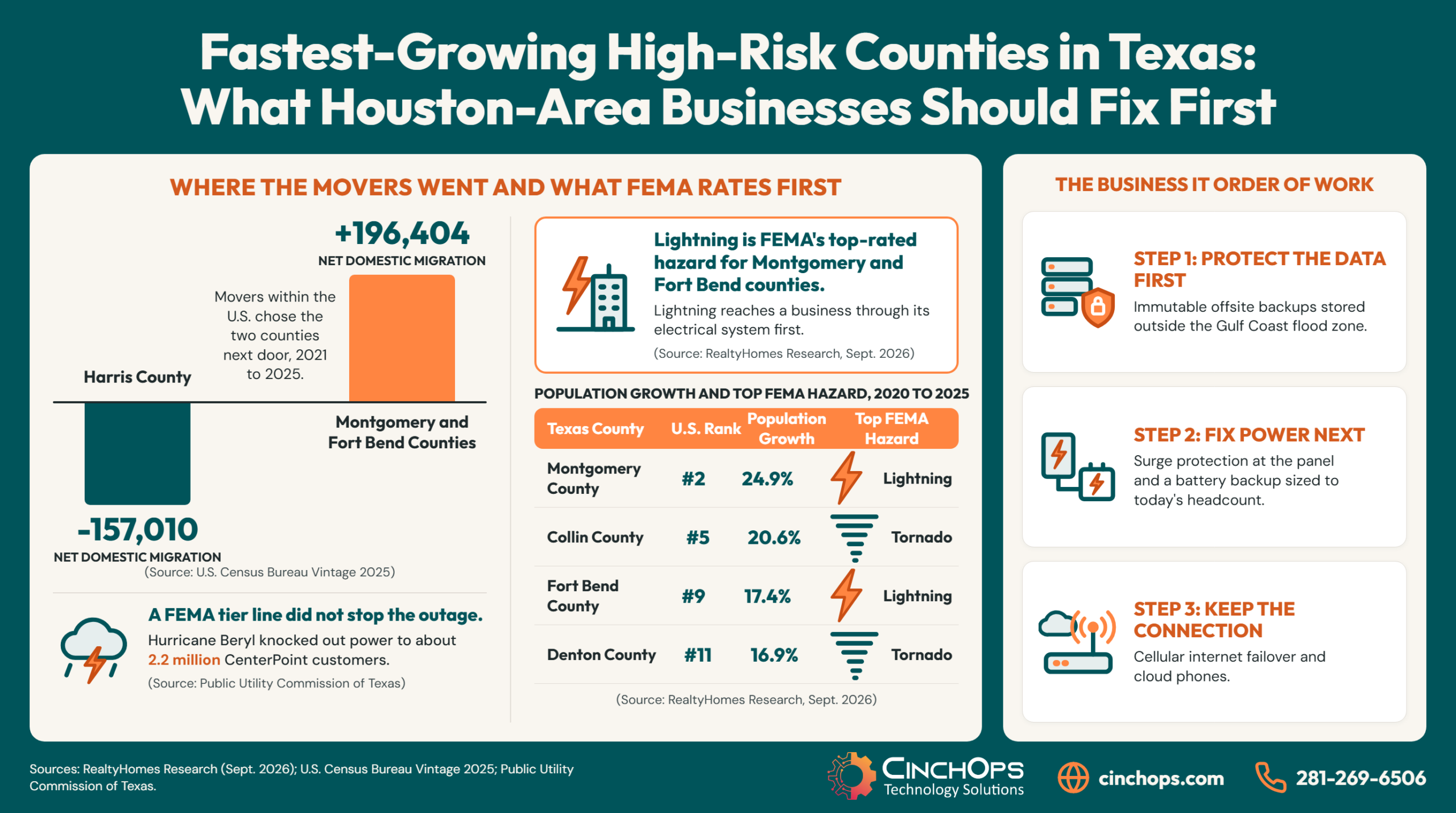
The RealtyHomes list ranks U.S. counties with at least 100,000 residents that FEMA's National Risk Index rates Relatively High or Very High for natural hazards, ordered by percentage population growth from July 2020 to July 2025. Texas placed four counties: Montgomery (#2, 24.9%), Collin (#5, 20.6%), Fort Bend (#9, 17.4%) and Denton (#11, 16.9%).
The 25 counties added about 2.07 million residents and 983,381 housing units in five years. Their median housing-stock growth was 16.8%, against 4.6% for other large counties. Florida placed 12 counties, Texas 4, North Carolina 3 and South Carolina 3, so four states account for 22 of the 25.
The hazard column is where the list gets useful for a Houston business. Of the 25 counties, 23 are rated Relatively High or Very High for lightning, 19 for hurricane, 16 for strong wind, 16 for tornado and 15 for inland flooding. Both Houston-area counties carry lightning as the top-rated hazard. Both Dallas-area counties carry tornado.
The table below compares the four Texas counties on the RealtyHomes list with Harris County, which sits in FEMA's highest risk tier and did not make the list, and adds one column RealtyHomes did not publish: net domestic migration for 2021 through 2025, which CinchOps computed from the Census Bureau's Vintage 2025 county file.
| Texas county | RealtyHomes U.S. rank | Metro area | Population, July 2025 | Growth, July 2020 to July 2025 | Residents added | Top FEMA hazard (per RealtyHomes) | Net domestic migration, 2021-2025 (Census, CinchOps calc.) |
|---|---|---|---|---|---|---|---|
| Montgomery | #2 | Houston | 781,194 | 24.9% | 155,825 | Lightning | +116,575 |
| Collin | #5 | Dallas-Fort Worth | 1,297,179 | 20.6% | 221,667 | Tornado | +125,343 |
| Fort Bend | #9 | Houston | 975,191 | 17.4% | 144,844 | Lightning | +79,829 |
| Denton | #11 | Dallas-Fort Worth | 1,069,346 | 16.9% | 154,829 | Tornado | +93,432 |
| Harris (not on the list) | Not ranked; FEMA highest tier | Houston | 5,045,026 | 6.6% | 310,966 | Not stated in the study | -157,010 |
One basis note so the numbers can be checked. RealtyHomes measured growth from the July 1, 2020 population estimate, which is why Montgomery shows 155,825 residents added here and 160,643 on the CinchOps Houston Growth Index, which starts from the April 1, 2020 Census count. Both are correct. They start the clock at different points.
Houston's Growth Landed One Risk Tier Below Harris County
The study's central finding, read against the Census migration data for the three Houston-area counties that matter most to a local business.
RealtyHomes' own summary of the pattern is that "the strongest post-2020 growth is concentrated not in FEMA's absolute highest-risk counties, but in the next tier." In the Houston area that sentence has names. Harris County, in FEMA's highest tier, grew 6.6%. Montgomery County grew 24.9% and Fort Bend County grew 17.4%, directly across the county line.
The Census Bureau's county file shows how that happened. From 2021 through 2025, Harris County recorded net domestic migration of -157,010 people. Over the same five years Montgomery gained 116,575 net domestic movers and Fort Bend gained 79,829, a combined 196,404. Harris still grew, on international migration and births, but the households moving within the United States chose the two counties one tier out. Together, Montgomery and Fort Bend added 300,669 residents.
The tier line on FEMA's map did not hold in the last real test. Hurricane Beryl made landfall on July 8, 2024 as a Category 1 storm and, according to the Public Utility Commission of Texas investigation, knocked out service to about 2.2 million CenterPoint customers, roughly 90% of the utility's customer base. The IRS disaster relief that followed named 67 Texas counties, Harris, Fort Bend and Montgomery among them. The Supreme Court of Texas let justice courts in Fort Bend, Galveston, Harris, Matagorda and Montgomery counties extend civil deadlines, citing "difficulties with access, electricity, internet, travel, and communication."
For a 40-person engineering firm in Sugar Land or a CPA practice in The Woodlands, the practical reading is simple. Your county's growth outran the county FEMA worries about most, and your last outage was the same outage Harris had.
A national list named your county. The backups should not live in the building that list describes.
CinchOps builds business continuity and disaster recovery for Houston-area businesses with immutable, offsite backup copies stored outside the Gulf Coast flood zone and verified backups that cover servers, laptops, Microsoft 365 and Google Workspace. The lightning strike and the hurricane get the same answer: the data is already somewhere else.
See how CinchOps handles backup and recovery →What Fails First in a Fast-Growing Lightning County?
How each hazard on the RealtyHomes list reaches a small business through its IT, and why growth makes every one of them worse.
Lightning is the top-rated FEMA hazard for both Montgomery and Fort Bend counties in the RealtyHomes data, and lightning reaches a business through its electrical system: a surge or a brownout that hits the network switch, the server and the phone system long before any water does. In a county growing 17% to 25% in five years, the equipment taking that hit is usually sized for the company it used to be.
The pattern CinchOps sees most often on onboarding audits in Katy, Sugar Land and The Woodlands is a company that grew from 12 people to 50 without ever revisiting the closet. The battery backup bought for the 12-person era now carries twice the load and buys minutes rather than a clean shutdown. Surge protection stops at the power strip. The backup still runs to a drive on the shelf next to the server, in the same room, on the same circuit. Nothing failed yet, so nothing was changed.
Each hazard on the list has a different first failure. Lightning and strong wind trip power and cook electronics. A hurricane takes power and internet away for days across a wide area, which is what Beryl did to about 90% of CenterPoint's customers. Inland flooding takes the ground-floor rack and the backup drive sitting beside it. A tornado makes the building unreachable even when the gear inside survived. Growth does not change the list. It multiplies the blast radius, because every new hire is one more endpoint on the undersized battery and one more mailbox in a backup set nobody has restored from.
What fails first and what to protect first are different questions. Power fails first, but data is the one thing on the list a business cannot buy back, so the order of work starts there: immutable backup copies offsite and outside the Gulf Coast flood zone, verified rather than assumed. A cooked switch is replaced in a day. A lost client file is not. Then power: surge protection at the panel, a battery backup sized to the current headcount with automatic shutdown, and a generator plan if the business cannot close for a week. Then connectivity: a cellular failover path through SD-WAN and cloud phones that ring wherever staff end up. A business that does those three things in that order has handled lightning, Beryl and the flood in one pass.
Do not let FEMA's risk tier set your priorities. The rating compares your county to the rest of the country; it says nothing about what you cannot replace. Get the data offsite before anything else, because a backup is the one thing you cannot buy after the fact. Then, since lightning is the top hazard in Fort Bend and Montgomery, put the next dollar into surge protection at the panel and a battery backup sized for the people you have today, not the twelve you had when you bought it.
How CinchOps Can Help a Business in Fort Bend or Montgomery County
CinchOps is a managed IT services provider based in Katy, Texas, serving small and mid-sized businesses across the Houston metro area. CinchOps specializes in cybersecurity, network security, managed IT support, VoIP, and SD-WAN for businesses with 10 to 200 employees.
Katy itself straddles Harris, Fort Bend and Waller counties, so the two Houston-area counties on the RealtyHomes list are the ground CinchOps works on every day. In 35+ years doing this, Shane Stevens has watched the same closet-sized problems scale up with every growth cycle in the Houston area, and the fix has not changed much: get the data, the power and the connection each onto a footing that does not depend on the building.
- Through business continuity and disaster recovery, backup copies are immutable, offsite and outside the Gulf Coast flood zone, and they cover servers, laptops, Microsoft 365 and Google Workspace.
- With managed IT support, battery backup sizing, surge protection and shutdown automation get reviewed as headcount changes instead of after the first outage, and the help desk answers in under 15 minutes.
- SD-WAN and VoIP mean the office keeps a cellular path to the internet and phones keep ringing on laptops and mobiles when the building goes dark.
- Cybersecurity with 24/7 threat monitoring means the days after a hurricane, when staff work from anywhere on whatever connection they can find, are covered as carefully as a normal Tuesday.
- CinchOps serves Katy, Sugar Land, Richmond, Fulshear and Missouri City in Fort Bend County, The Woodlands in Montgomery County, and Houston across Harris County.
- The industries that fill these counties, construction, engineering and CPA firms, each get a plan built around their own software and deadlines.
Montgomery and Fort Bend did not slow down for FEMA's map, and the businesses moving in with those 300,669 new residents will not either. The ones that stay open after the next Beryl will be the ones that treated a national high-risk ranking as a work order rather than a headline. If your closet still looks like the company you were five years ago, talk to CinchOps before the next lightning season does the audit for you.
Frequently Asked Questions
Which Texas counties are on the 2026 fastest-growing high-risk county list?
Four Texas counties made the RealtyHomes Research top 25, published September 15, 2026: Montgomery County (#2 nationally, 24.9% growth), Collin County (#5, 20.6%), Fort Bend County (#9, 17.4%) and Denton County (#11, 16.9%). Montgomery and Fort Bend are in the Houston area; Collin and Denton are in Dallas-Fort Worth. All four are rated Relatively High or Very High on FEMA's National Risk Index.
Did Harris County make the fastest-growing high-risk county list?
No. Harris County sits in FEMA's highest risk tier but grew only 6.6% from July 2020 to July 2025, well under the 8.8% that the #25 county recorded. Census Bureau data shows Harris lost a net 157,010 residents to domestic migration from 2021 through 2025, while neighboring Montgomery and Fort Bend counties gained a combined 196,404 net domestic movers over the same years.
What does FEMA's "Relatively High" risk rating actually mean for a Houston-area business?
FEMA's National Risk Index rates every U.S. county on 18 natural hazards using expected annual loss, social vulnerability and community resilience, then ranks each county relative to the rest of the country. A Relatively High rating is a comparison, not a forecast. RealtyHomes lists lightning as the top-rated hazard for both Montgomery and Fort Bend counties, so the most likely IT loss is a power surge, not a flooded office.
What does managed IT with disaster recovery cost in Houston?
Managed IT in Houston generally runs $100 to $250 per user per month. CinchOps prices managed IT at that same flat monthly rate per user, $100 to $250 per user per month, with no long-term contracts, no hidden fees and no cancellation penalties. Backup and disaster recovery are included in the top-tier plan rather than in every plan, so a business planning around the exposure in this post should price the top tier.
What should a growing business in Fort Bend or Montgomery County fix first?
Protect the data first: move backups to immutable offsite copies stored outside the Gulf Coast flood zone and verify they restore. Then fix power, because lightning is the top-rated FEMA hazard in both counties. Confirm the battery backup is sized for today's headcount and add surge protection at the electrical panel. Then add a cellular internet failover and cloud phones.
How did Hurricane Beryl affect Fort Bend and Montgomery counties?
Hurricane Beryl made landfall on July 8, 2024 at Category 1 strength. The Public Utility Commission of Texas found it knocked out about 2.2 million CenterPoint customers, roughly 90% of the utility's base. The IRS named 67 Texas counties for disaster relief, including Harris, Fort Bend and Montgomery, and the Supreme Court of Texas allowed justice courts in Fort Bend, Montgomery and Harris counties to extend civil deadlines.
Discover More
Resource
Sources
- RealtyHomes Research, "Fastest-Growing U.S. Counties With High Natural Disaster Risk (2026)," September 15, 2026 - the top 25 ranking, state and hazard counts, housing figures and methodology.
- U.S. Census Bureau, County Population Totals and Components of Change: 2020-2025 (Vintage 2025), co-est2025-alldata.csv - population, growth and net domestic migration for Montgomery, Fort Bend, Harris, Collin and Denton counties, recomputed by CinchOps on October 6, 2026.
- FEMA, Resilience Analysis and Planning Tool - National Risk Index v1.20 dataset - the hazard index RealtyHomes used; FEMA now publishes the NRI through RAPT.
- Public Utility Commission of Texas, Investigation of Emergency Preparedness and Response by Utilities in Houston and Surrounding Communities, Project No. 56822, November 2024 - Hurricane Beryl outage figures.
- IRS news release IR-2024-191, July 22, 2024 - the 67 Texas counties, including Harris, Fort Bend and Montgomery, granted Beryl relief.
- Supreme Court of Texas, Misc. Docket No. 24-9042, Emergency Order, July 12, 2024 - justice-court deadline relief for Fort Bend, Galveston, Harris, Matagorda and Montgomery counties.

