


SASE for Small Business: A 2026 Houston Guide Before You Sign
What Is SASE? A Plain-Language Guide For Houston Small Businesses – How Many Security Logins Does Your Office Pay For And Never Open?
SASE (said "sassy") is Secure Access Service Edge: your office network and its security, delivered together as one cloud service.
SASE, pronounced "sassy", stands for Secure Access Service Edge. In plain terms, SASE is one cloud service that does the jobs of an office firewall, a remote-access VPN and a web filter, so staff get the same protection in the office, at home or on a job site.
SASE for small business usually arrives as a line on a renewal quote. The firewall and VPN contract is ending, and the replacement on offer is a bundle with an acronym nobody in the office asked for. A Houston firm with 10 to 200 employees can decide whether that bundle fits by working through 5 steps, and the first step is a count.
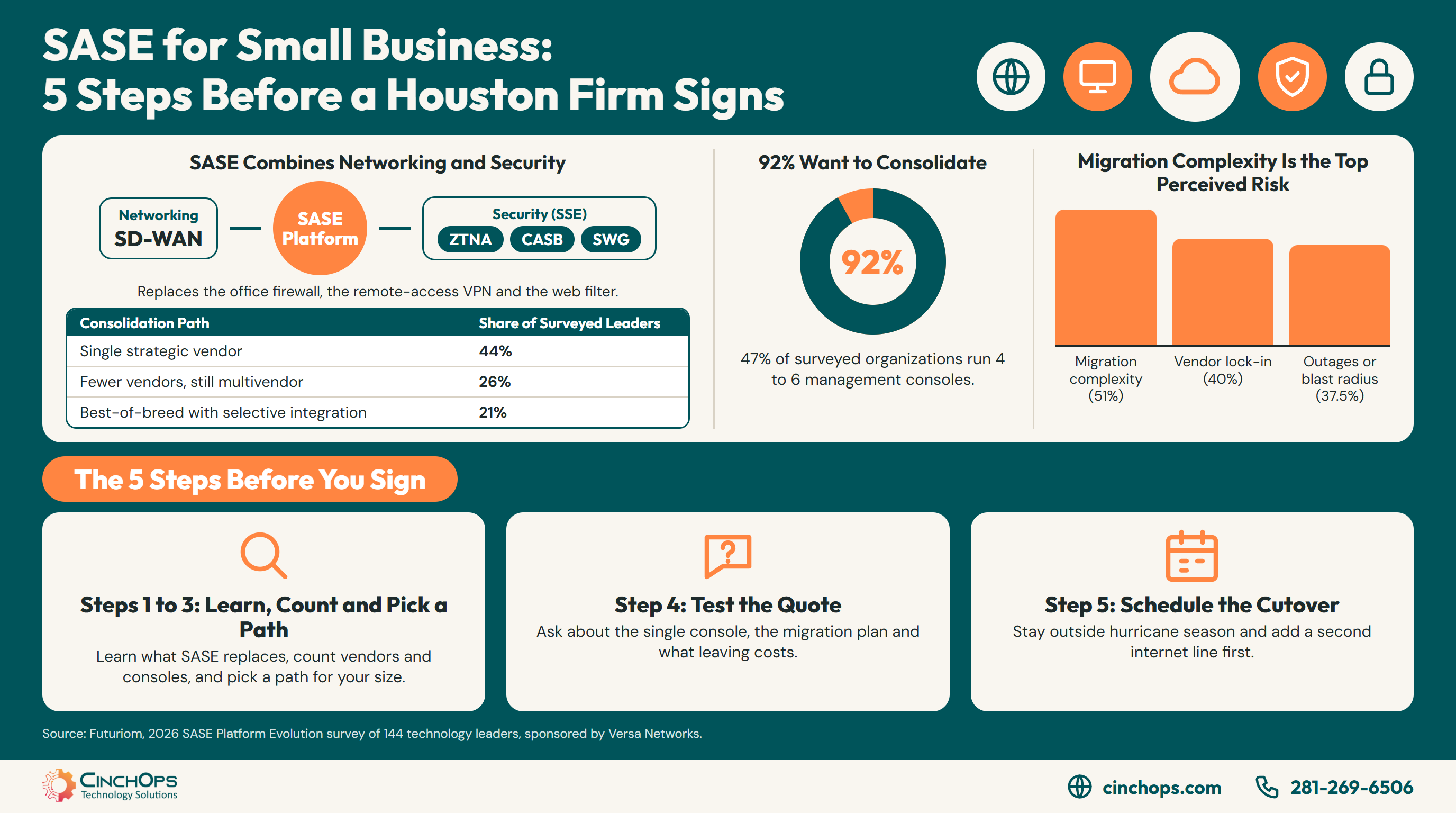
Salespeople now quote a survey to support that offer. Futuriom's 2026 SASE Platform Evolution report, published in September 2026, surveyed 144 director-level and executive technology leaders, and 92% said their organization wants to consolidate cybersecurity functions through a single-vendor or platform SASE strategy. Versa Networks, a SASE vendor, sponsored the research, and Futuriom states that Versa gave input into the survey questions and approach.
That survey describes large IT departments. Its pressure still reaches a 40-person engineering firm in Katy or a law office in Sugar Land, because the same vendors sell to both and the same acronym lands on both quotes. CinchOps designs and manages SD-WAN and network security specifically for multi-site businesses with 10 to 200 employees in the Houston area, at a published flat rate of $100 to $250 per user per month. The steps below turn the enterprise findings into decisions a small firm can make before the renewal meeting.
Learn What SASE Replaces Before a Vendor Explains It
Step 1 is vocabulary, because a quote is easier to judge when every acronym on it maps to a box already in the office.
SASE, or Secure Access Service Edge, is a single platform that joins a network service called SD-WAN with a set of cloud-delivered security services called SSE. For a small business, SASE replaces the branch firewall, the remote-access VPN and the web filter with one vendor, one policy and one console.
The network half is SD-WAN, which routes traffic across every internet line a site has. The security half is Security Service Edge, and it carries three services a small firm will see named on a quote. Zero trust network access (ZTNA) replaces the VPN by connecting a user to one application at a time. A cloud access security broker (CASB) watches how staff use cloud apps. A secure web gateway (SWG) filters web traffic wherever the laptop happens to be.
Futuriom traces the category to SD-WAN and notes that Gartner named it SASE in 2019. The same report says the product is unfinished: "It's a work in progress." In the survey, 50% of respondents ranked SSE among their most important capabilities, 45% chose ZTNA and 39% chose SD-WAN. A small firm rarely needs every piece on the first day. Most need to know which piece the quote is really selling.
Count Your Security Vendors and Consoles First
Step 2 produces the only number in the decision that belongs to the business and not to a vendor.
A console count is a list of every separate login someone at the business uses to manage network and security tools. Futuriom found 47% of surveyed organizations run 4 to 6 such consoles, and 92% rated reducing them as important or critical. A Houston small business should write its own count down before any SASE conversation.
The survey's fragmentation numbers explain why consolidation sells. Managing multiple consoles was the most reported operational problem at 44%, followed by performance troubleshooting complexity at 42% and inconsistent policies across tools at 38%. On the vendor side, 44% of respondents use 4 to 6 network security vendors, and 66% operate with at least 4.
Those are enterprise figures. A 30-person office reaches the same range faster than its owner expects, because small-business tools are bought singly over years. Walk the list and mark each item that has its own login and its own renewal date:
- The firewall, and the VPN if it is licensed separately
- Endpoint protection on laptops and servers
- Email filtering and the Microsoft 365 or Google Workspace admin center
- Web or DNS filtering
- Wi-Fi management
- Multi-factor authentication or single sign-on
- Backup
Staffing is the part of the survey that transfers best to small firms. Skills shortages were a major or moderate driver of consolidation for 87.5% of respondents, and those are organizations with security teams. A business whose office manager also handles IT has that constraint by default, and every unwatched console is a control nobody is operating.
Pick the Consolidation Path That Fits Your Headcount
Step 3 matches the count from step 2 to one of the three strategies the surveyed enterprises are already following.
Futuriom's respondents split into three consolidation paths: 44% are moving to a single strategic vendor, 26% are reducing vendors while staying multivendor, and 21% are keeping best-of-breed tools with selective integration. A small business should choose among the same three by site count, remote share and regulated data, and ignore company size on the brochure.
The mapping below is CinchOps' reading of how those enterprise paths scale down. It is a working rule for firms of 10 to 200 people, and it does not come from the survey data.
- One office, staff mostly on site, 3 or fewer consoles. Keep the firewall and tighten what is already owned. SASE is not the next purchase for this firm, whatever the renewal quote says.
- Two or more sites, or a third of staff working remotely. The access and SD-WAN pieces earn their place here. Buy those two from one vendor and leave endpoint and email tools where they are. A Houston construction company with job-site trailers usually sits in this group.
- Regulated data, 4 or more consoles, and no full-time security person. A single platform run by a managed provider is the honest fit. CPA practices, law firms and wealth managers in The Woodlands and Sugar Land often land here once the count is done.
The survey also shows that full consolidation is rarer than the headline suggests. Half of respondents already run a single-vendor SASE product, 34% run two vendors and 14% run several. Even so, 82% said multivendor visibility remains a key part of their strategy. Large IT teams that picked a single vendor still expect to watch other vendors' products, and a small firm should expect the same.
Hold Every SASE Quote to the Single-Console Test
Step 4 turns Futuriom's definition of a unified platform into questions a salesperson has to answer in writing.
A unified SASE platform, as Futuriom defines it, should not require separate management tools. The report lists 7 characteristics, and each one works as a yes-or-no question on a quote. A Houston small business that gets a "not yet" on the console question is being sold several products under one invoice.
Futuriom says plainly that the largest vendors have not finished the job. The report describes Cisco and Palo Alto Networks as having SASE functionality "fragmented across a portfolio which may require separate management consoles and operating systems." It tracks 10 vendors in all, including Cato Networks, Cloudflare, Fortinet, Netskope, Zscaler and the report's sponsor, Versa Networks, whose architecture the report praises. Read that praise knowing who paid for the research.
Savings claims deserve the same treatment. Futuriom's own earlier research, repeated in the 2026 report, estimates potential total savings of 20 to 50% from a unified platform, with product licensing down 15 to 25%. Those are potential figures from a sponsored report about enterprises. Among the surveyed leaders, improved security effectiveness was the leading goal at 62.5%, and lower operational cost trailed at 40%. Buy for fewer unwatched consoles first, and treat any savings as a result to measure after the first year.
Schedule the Cutover Outside Hurricane Season
Step 5 is timing, and on the Gulf Coast the calendar matters as much as the contract date.
A SASE cutover moves a business's internet path and remote access onto a new platform, so the riskiest weeks of the project should not overlap the riskiest weeks of the year. Houston-area firms should plan the migration for a quiet stretch and confirm that every site has a second internet line before the old firewall is retired.
The local evidence is recent. Hurricane Beryl made landfall on July 8, 2024, and the Public Utility Commission of Texas later reported that Beryl disrupted service for 2.7 million customers, including 2.2 million CenterPoint customers. An office without power has no firewall and no VPN. Staff working from wherever the lights are on still need access to files and applications, and with cloud-delivered security their protection does not depend on a box in a dark building.
Put three dates on one page before signing: the current contract's end, the proposed cutover week and the date the second internet line is live at each site. If the cutover falls in hurricane season, ask the vendor for a short extension on the old contract. A buyer holds most of the bargaining power before the signature.
Have a SASE Quote on Your Desk?
Bring the quote and your console count. CinchOps will walk a Houston-area business through the 5 steps against its own network.
Talk to CinchOpsBefore you sign anything that says SASE, count the consoles you already pay for and name who logs into each one. If nobody does, a new platform will not fix that by itself.
How CinchOps Can Help You Decide on SASE
CinchOps is a managed IT services provider based in Katy, Texas, serving small and mid-sized businesses across the Houston metro area. CinchOps specializes in cybersecurity, network security, managed IT support, VoIP, and SD-WAN for businesses with 10 to 200 employees.
CinchOps prices managed IT and security at a flat monthly rate of $100 to $250 per user, on Zero-Zero-Zero terms: no long-term contracts, no hidden fees and no cancellation penalties. A firm that asks its vendors about lock-in should get a clean answer from its IT provider as well.
- Through SD-WAN network services, CinchOps connects offices and job sites across redundant providers and manages the policy in one place.
- CinchOps managed firewall services keep the firewall a business already owns running while the SASE decision is still open.
- The cybersecurity services team provides 24/7 threat monitoring, and the help desk answers requests in under 15 minutes during business hours.
- With managed IT support, every vendor, console and renewal date is inventoried, so the count in step 2 exists on paper.
- CinchOps serves businesses in Houston, Katy, Sugar Land and The Woodlands.
- Multi-site industries get specific designs: construction, engineering firms and law firms.
A renewal quote that says SASE is a sales document, and a survey of 144 enterprise leaders is context for it. The decision belongs to the count, the path and the written answers. If the quote is already on the desk and the renewal date is close, talk to CinchOps before signing.
Frequently Asked Questions
What is SASE in plain terms?
SASE, or Secure Access Service Edge, is one platform that combines SD-WAN networking with cloud-delivered security services such as zero trust network access, a secure web gateway and a cloud access security broker. For a small business, SASE replaces the branch firewall, the remote-access VPN and the web filter with one vendor and one console.
Does a small business with one office need SASE?
Usually not yet. A business with one office, staff mostly on site and 3 or fewer security consoles gets more from tuning the firewall it already owns. SASE starts to earn its cost when a firm adds a second site, when a third of staff work remotely, or when nobody watches the existing tools.
Is single-vendor SASE safer than keeping separate tools?
Single-vendor SASE reduces the unwatched consoles and inconsistent policies that Futuriom's 2026 survey ranked among the top operational problems. It also concentrates risk: 37.5% of surveyed leaders named outages or a larger blast radius as a concern. A second internet path and a written exit plan offset that concentration.
What does SASE cost in Houston?
SASE platform licensing is quoted per user by each vendor and varies with the functions turned on, so no single market price applies. CinchOps publishes a flat managed IT and security rate of $100 to $250 per user per month and scopes any SASE platform licensing after reviewing the network, never before.
What is the biggest risk in moving to SASE?
Migration. In Futuriom's 2026 survey of 144 technology leaders, 51% named migration complexity as the top perceived downside of SASE consolidation, ahead of transition cost at 44% and vendor lock-in at 40%. A Houston business should get the migration plan, the cutover week and the exit terms in writing before it signs.
Discover More
Resource
Sources
- Futuriom, 2026 SASE Platform Evolution report and survey results (September 2026), sponsored by Versa Networks
- Versa Networks, press release on the Futuriom 2026 SASE survey (October 5, 2026)
- Public Utility Commission of Texas, Investigation of Emergency Preparedness and Response by Utilities in Houston and Surrounding Communities, Project No. 56822 (November 2024)


