


Star Trek at 60: Six Starfleet Lessons for Houston Managed IT
Star Trek at 60: Six Lessons for Houston Business Owners – How to Judge a Managed IT Provider, According to Starfleet
Six lessons from six decades of Star Trek for Houston business owners, timed for the September 8, 2026 anniversary.
I am a Trekker. Not a Trekkie. We are not going to discuss that difference here, because that discussion is long enough to fill an entire blog series on its own. That being said, it is time to celebrate the Star Trek 60th anniversary and what the adventures of six decades of Starfleet captains and crews have to say about managed IT for Houston area businesses.
A managed IT provider is a company that runs a business's technology for a flat monthly fee, and the closest thing television has ever shown to a good one is the bridge of a Federation starship or space station.
Star Trek premiered on NBC on September 8, 1966. NBC cancelled it after three seasons. Sixty years later it has outlasted that cancellation, three generations of viewers, and most of the technology it imagined. The communicator Kirk flipped open in the first season does less than the phone in your pocket.
Houston has always had a strong connection to Star Trek over those six decades. In 1977 NASA brought in Nichelle Nichols, Uhura herself, to recruit women and people of color for the Space Shuttle program. She came to Johnson Space Center that March, toured the center with Apollo 12 astronaut Alan Bean, and filmed her recruiting appeal in Mission Control. Star Trek did not just imagine a better future at NASA. It helped build one in Houston.
Take 35+ years of IT experience and 60 years of Star Trek, and somewhere along the way they came together like two merged transporter buffers. Kirk, Scotty, Data, Worf, Quark, the Kobayashi Maru, the red shirts: every one of them is a lesson about how a managed IT provider should behave, and how it should not. CinchOps provides managed IT support specifically for law firms, CPA practices, and construction companies in Houston with an under-15-minute help desk response and a flat $100 to $250 per user per month. That sentence is the whole business. The rest of this post is why Kirk, Picard, Sisko, Janeway, and Pike would all say: engage.
What Does a Managed IT Provider Actually Do Day to Day?
The bridge crew is an org chart. Six decades of crews map onto the people who keep a Houston office running.
A managed IT provider monitors, patches, secures, backs up, and supports every device and user in a business on a fixed schedule, so problems get caught before the owner ever hears about them.
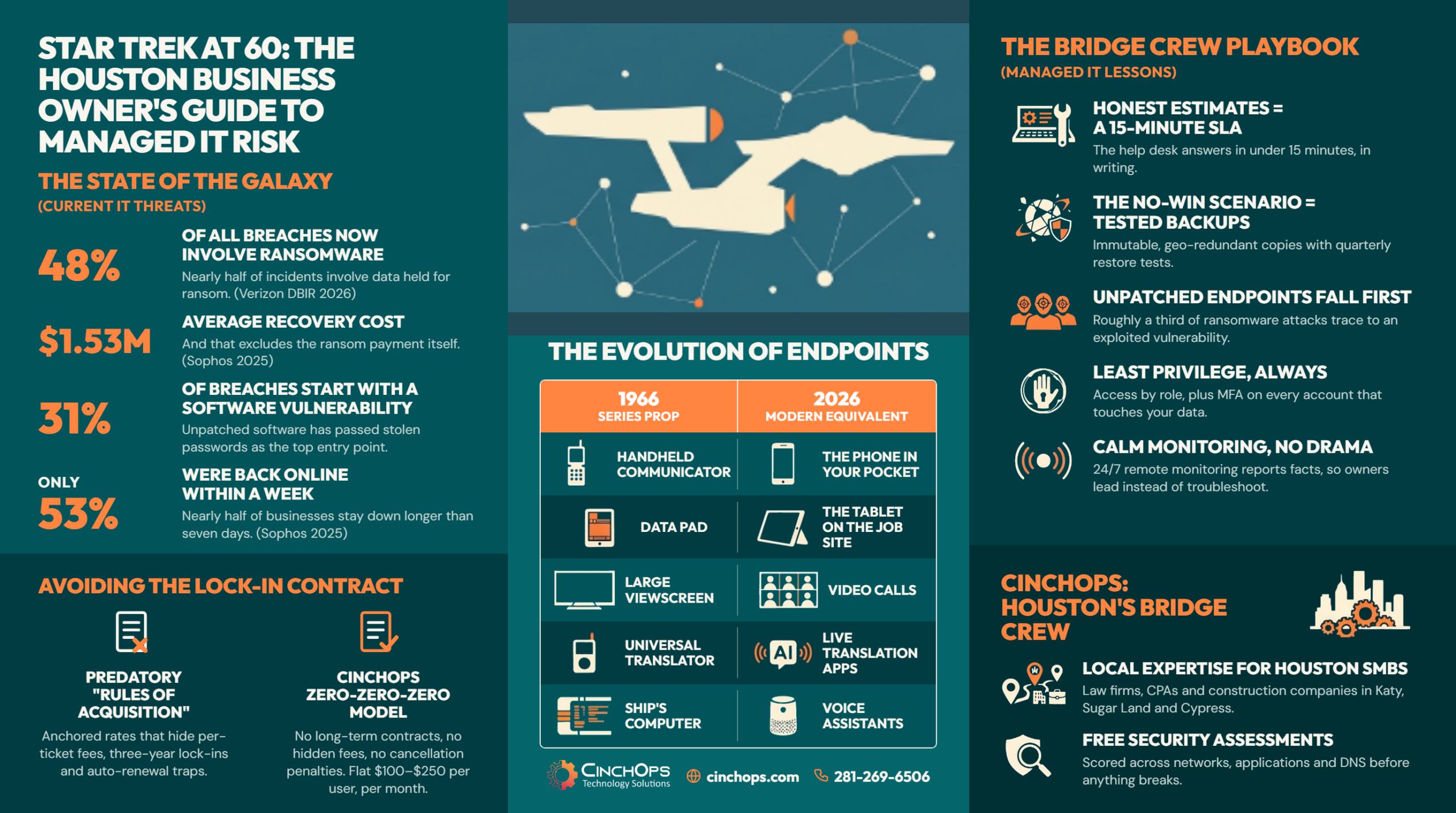
On every Star Trek series, every member of the bridge crew knows their station, responsibilities and duties. Spock and Data gather and synthesize information faster than anyone. Uhura runs the comms. Scotty keeps the engines inside tolerance (most of the time). Miles O'Brien keeps a whole space station running on hardware the previous occupants left behind. The captain makes decisions with the information the crew provides. That is a managed IT department.
| Bridge role | What they do on the ship | The managed IT equivalent |
|---|---|---|
| Spock, Data, T'Pol (science) | Read the sensors, report facts without drama | 24/7 remote monitoring and alerting on every server, workstation, and firewall |
| Uhura, Hoshi Sato (communications) | Keep every channel open, hail first | VoIP, email security, and a help desk that answers in under 15 minutes |
| Scotty, Geordi, B'Elanna Torres, Trip Tucker (engineering) | Keep the ship inside tolerance, give repair estimates | Patch management, hardware lifecycle, and a service level agreement with real numbers in it |
| Miles O'Brien (operations, Deep Space Nine) | Keeps a station of inherited Cardassian hardware alive with no budget | The provider that takes over the network the last company left behind: inventory, documentation, stabilization |
| McCoy, Crusher, the Doctor, Phlox (medical) | Diagnose, quarantine, treat | Endpoint detection and response, incident containment |
| Sulu, Worf, Odo, Tuvok (helm and security) | Shields up, verify who is really who, keep the ship out of the line of fire | Firewall, MFA, least-privilege access, security awareness training |
| Boimler and Mariner (Lower Decks) | Do the actual work nobody on the bridge sees | The help desk technicians closing tickets, running patch cycles, and testing restores |
| Kirk, Picard, Sisko, Janeway, Archer, Pike (the captains) | Decide with the crew's data | The business owner, handed a monthly report and a vCIO who can explain it |
The lesson is not that you need a bridge crew. It is that the owner should never be the one reading the sensors. If you are the person who notices the server is slow, then you are not captaining your business crew. You are the de facto IT leader instead.
Scotty's Repair Estimates Are a Service Level Agreement
The most honest engineering conversation in the franchise happens in Star Trek III. The second most honest one happens 25 years later, and Scotty is in that one too.
A service level agreement is the written promise of how fast a managed IT provider responds and resolves, and Scotty understood the value of one before the term existed.
In The Search for Spock, Kirk asks how long the refit will take. Scotty says eight weeks, then offers to do it in two. Kirk asks whether he always multiplies his estimates by four. Scotty answers that it is how he keeps his reputation as a miracle worker. Everybody laughs. Every business owner in Houston who has waited three days for a callback does not.
The franchise came back to the joke in The Next Generation. In the episode Relics, Scotty is pulled out of a transporter buffer after 75 years and put to work next to Geordi La Forge. Geordi tells Picard a repair will take an hour. Scotty, amused, asks whether he told the captain how long it would really take. Two engineers, two eras, and both of them delivered every time it counted, which is why neither captain ever worried about an estimate.
That trust is the one thing a business owner cannot borrow. A captain can walk down to engineering and see the work for himself. The owner of a Houston law firm cannot see the engine room, so trust has to be replaced with a number and a commitment. At CinchOps the help desk answers in under 15 minutes. There is a 30-day satisfaction guarantee. Those are not miracles. They are commitments you can measure against, which is the only kind worth paying for.
- Ask for the response number. Not "fast." Minutes. If the provider will not put it in writing, you have your answer.
- Ask what happens when they miss it. A service level agreement with no consequence attached is a wish.
- Ask for the monthly report. Geordi told Picard the truth about the repair. Your provider should tell you the truth about your network, in writing, every month.
In 35+ years doing this, the best providers I have worked alongside all did the same simple thing. They put a number in writing, then beat it often enough that nobody had to check.
Every great crew on that show is a handful of specialists who trust each other enough to say the hard thing out loud. That is what you are actually buying when you hire an IT provider. Not software. People who will tell you the truth before it becomes an emergency.
The Kobayashi Maru Is Ransomware Without a Tested Backup
Kirk had the no-win scenario. Picard had the Borg. A Houston business gets hit by both on a late Friday afternoon.
The Kobayashi Maru is a Starfleet Academy simulation designed to be unwinnable, and ransomware hitting a business with no tested backup is the same test with a real invoice at the end.
In The Wrath of Khan, Kirk admits he beat the no-win scenario by reprogramming the simulator. He changed the conditions of the test. That is the entire ransomware strategy, in one sentence, from a 1982 movie.
Here is the test as it exists today. The 2026 Verizon Data Breach Investigations Report found that 48% of all breaches now involve ransomware. Sophos' State of Ransomware 2025 survey found 49% of victims paid, the average recovery cost excluding the ransom was $1.53 million, and only 53% were back within a week. A Houston law firm with 30 people that gets encrypted on a Monday with no restorable backup has two options: pay, or lose the files. Both lose. That is the no-win scenario.
Every crew that ever beat the Borg did it by cutting the connection. Segment the network, keep a backup copy where the collective cannot reach it, and the assimilation stops at the first drone. Voyager's Year of Hell ends with the whole timeline reset to a clean state. That is a restore. Janeway would have preferred one that took less than a year.
You change the conditions before the test starts. A backup that is geo-redundant and stored outside the Gulf Coast flood zone. A restore that has actually been run, on a schedule, with a stopwatch. An incident response plan short enough to read while the phones are ringing. Do those three things and an encrypted server becomes an inconvenience instead of an extinction event.
- Immutable, off-site copies. Attackers go after the backups first. A copy the collective cannot reach or alter is the one that saves you.
- Quarterly restore tests. A backup you have never restored is a theory. CinchOps published the six-step restore test we run.
- A one-page plan. Who calls whom, in what order, with which phone numbers. Kirk did not improvise the Kobayashi Maru. He prepared for it.
Starfleet Academy makes cadets take the test because how you behave in the no-win scenario matters. A tabletop exercise is your Kobayashi Maru. Run it before the real one.
When Did You Last Watch a Backup Restore?
If the answer is "never" or "I think the last guy did it," that is the no-win scenario waiting to happen. CinchOps will run the restore test with you.
Talk to CinchOpsThe Red Shirts Are Your Unpatched Endpoints
Everybody knows who dies first on an away mission. By The Next Generation the shirt had changed color and the joke had a new name.
An unpatched endpoint is any laptop, server, or firewall running software with a known, fixable vulnerability, and it is the red shirt of a small business network: the one that gets picked off first.
By The Next Generation the uniform colors had swapped, so command wore red and the doomed extras wore gold, and the joke followed the shirt rather than the color. Then there is Worf, who gets knocked flat by every new threat so the audience understands it is serious. Fans call that the Worf Effect. An attacker's first move on a small business network is the Worf Effect run backwards: find the weakest thing on the ship, take it down, and see whether anyone notices. The old workstation in the Sugar Land branch office. The firewall nobody has logged into since 2023. The construction foreman's tablet that has never seen an update.
On Lower Decks the ensigns on the bottom of the ship are the ones actually running the maintenance cycles while the bridge gets the credit. Patching is the same. It gets done by whoever is on the schedule, quietly and behind the scenes. A managed IT provider's job is to know every device exists and patch it on a cadence the owner never has to think about.
- Inventory first. You cannot patch what you have not counted. The audit is what finds the red shirts, whatever color they are wearing this season.
- Patch on a cadence, test before deploying. Automatic updates are not patch management. Here is the difference.
- Retire what cannot be patched. Windows 10 left support in October 2025. Anything still running it is wearing red.
The Prime Directive Is Least Privilege
Starfleet's most important rule is about restraint. Worf spent seven seasons recommending it and getting overruled.
Least privilege is the rule that every user and system gets only the access needed to do its job and nothing more, and it is the Prime Directive of a business network: you do not interfere where you have no business being.
The Prime Directive says Starfleet does not meddle in the development of other civilizations, however good the intentions. Least privilege says not everyone in the office needs domain admin, however convenient it would be on a busy Friday. The pattern is identical. Both rules exist because the damage from a single well-meaning exception is out of all proportion to the convenience. Janeway took the rule seriously enough in Voyager's first episode to strand her crew 70,000 light-years from home rather than break it.
Worf is the other half of the lesson. He spends seven seasons recommending that Picard raise shields, and Picard spends seven seasons delaying that order. Worf is usually right. That is the security officer's whole life, and it is exactly what least privilege looks like in a real office: the sensible restriction gets waived by someone with a deadline. One shared admin password everybody knows. A former employee's account still active eight months after they left. A CPA practice in Katy where every staff member can open every client folder. None of it is malicious. All of it is how a phishing email on one desk becomes a firm-wide breach.
Deep Space Nine had the sharpest version of all. During the Dominion War the Changelings could impersonate any officer perfectly, so Starfleet stopped trusting faces and started requiring blood screenings. A password is a face. Multi-factor authentication is the blood screening. Odo, the station's own shapeshifter, was the one running security, which is its own lesson about who you want checking identities.
- Separate admin from daily accounts. The person who reads email should not be the person who can wipe the server, even when they are the same human.
- MFA everywhere it can go. Microsoft's 2024 research put the risk reduction at 99.22%, even on accounts whose passwords had already leaked. Which kind of MFA matters.
- Review access quarterly. People change roles. Access rarely follows. Somebody has to check, and it should be someone with Worf's instincts and Odo's suspicion.
Do not do what Kirk did, breaking the Prime Directive over and over and hoping for the best. Every business owner who hands out admin rights is making that same bet, and the reasons always sound good at the time.
The Tribbles and the Rules of Acquisition Are the Managed IT Contract to Avoid
One trader from the original series and one bartender from Deep Space Nine wrote every bad IT agreement in the Houston market between them.
A managed IT contract should be a flat monthly rate per user with no lock-in, and any agreement built on long terms, hidden fees, and cancellation penalties is a tribble sold by a Ferengi: cheap to accept, impossible to get rid of, and profitable for exactly one party.
In The Trouble with Tribbles, a trader named Cyrano Jones hands Uhura one small, purring tribble as a gift. By the end of the episode the Enterprise is buried in them and nobody can find the exit. That is the invoice. A low quoted rate that arrives with per-ticket fees. A three-year term. An auto-renewal clause on page 11. A cancellation penalty that costs more than the service you are trying to leave. One line item at a time, the invoice breeds.
The psychology: Each of those tactics leans on a known bias. The low quoted rate is anchoring, so every fee that follows is judged against it and looks small. Auto-renewal is the default effect: staying takes no action, leaving takes a letter. The three-year term is sunk cost, because month 20 feels too far in to walk away. The cancellation penalty is loss aversion: a fee you can see beats a bad service you have learned to live with. None of it needs a dishonest provider. It only needs a busy owner.
CinchOps runs the opposite model on purpose and calls it Zero-Zero-Zero: no contracts, no hidden fees, no cancellation penalties. Pricing is a flat $100 to $250 per user per month depending on what the business needs. If the service is not good, the client leaves. That is the whole incentive structure, and it is the one Starfleet would recognize. Nobody on the Enterprise was locked into a 36-month term. Nobody on Deep Space Nine was either, and Quark would have loved to sell them one.
- Ask for the exit terms first. How you leave tells you more about a provider than how you join.
- Ask what is not included. The tribbles live in the gap between the quote and the invoice, and so does Quark's profit.
- Ask for per-user pricing. It tracks headcount, which is the one number the owner already knows without calling anyone.
Sixty years of this show and 35+ years of this work taught me the same lesson. The technology never stops changing. What holds a business together is whether the people around it do what they said they would do, on the ordinary days when nobody is watching.
Run Your Own Kobayashi Maru Before an Attacker Runs It for You
CinchOps builds geo-redundant backups outside the Gulf Coast flood zone, tests restores on a schedule, and runs the tabletop exercise with your team so the no-win scenario has an ending you chose.
See business continuity and disaster recovery →How CinchOps Can Help Your Houston Business Run Like a Bridge Crew
CinchOps is a managed IT services provider based in Katy, Texas, serving small and mid-sized businesses across the Houston metro area. CinchOps specializes in cybersecurity, network security, managed IT support, VoIP, and SD-WAN for businesses with 10 to 200 employees.
- Through managed IT support, the sensors get read around the clock and the help desk answers in under 15 minutes, so the owner stops being the one who notices.
- With cybersecurity services, the red shirts get patched, MFA goes everywhere it can, and access follows the Prime Directive.
- Business continuity and disaster recovery means the backup is off-site, immutable, and restored on a schedule you can watch.
- We serve businesses in Houston, Katy, Sugar Land, and Cypress.
- Industry focus includes law firms, CPA practices, and construction companies.
Sixty years on, the reason Star Trek still works is that the crew trusted each other because they could see each other's work. A managed IT provider earns the same trust the same way: a response time you can measure, a backup you have watched restore, a contract you can leave. If your current provider is more Quark than Starfleet, talk to CinchOps. We will show you the sensor readings. Live long and prosper.
LLAP
Frequently Asked Questions
What does a managed IT provider actually do day to day?
A managed IT provider monitors every server, workstation, and firewall around the clock, applies patches on a tested schedule, runs and verifies backups, filters email, enforces MFA and access rules, and staffs a help desk. CinchOps answers that help desk in under 15 minutes for Houston businesses with 10 to 200 employees.
What does managed IT support cost in Houston?
CinchOps charges a flat $100 to $250 per user per month, with the exact figure depending on the security, backup, and compliance needs of the business. There are no contracts, hidden fees, or cancellation penalties. A 25-person Houston office should expect a predictable monthly bill it can budget against, not a per-ticket surprise.
Is the Kobayashi Maru a real cybersecurity concept?
Not by that name, but the idea is standard practice. A tabletop exercise walks a business through a simulated ransomware incident, step by step, before it happens. The point is the same as Starfleet's test: find out how the team behaves under pressure, then fix the plan. CinchOps runs these with Houston clients as part of business continuity planning.
How often should a Houston business test its backups?
Quarterly at minimum, with a full restore of at least one production system timed with a stopwatch. A backup that has never been restored is unproven. CinchOps stores client backups geo-redundantly outside the Gulf Coast flood zone and documents each restore test, because hurricane season and ransomware do not schedule around convenience.
Is September 8, 2026 really Star Trek's 60th anniversary?
Yes. The original series premiered on NBC on September 8, 1966, with an episode about a shape-shifting salt vampire. The studio is marking the 60th with restored 4K screenings in more than 750 U.S. theaters from September 4 through 8, 2026, including Cinemark and Regal locations across the Houston area, plus events in London, Los Angeles, and Germany.
Discover More
Resource
Sources
- Studio press release: Celebrating 60 Years of Star Trek Around the Globe (2026)
- StarTrek.com: Star Trek Turns 60 With Worldwide Events
- Yahoo Entertainment: Star Trek Returning to Theaters for the 60th Anniversary
- NASA History: 50 Years of NASA and Star Trek Connections
- NASA: Nichelle Nichols Helped NASA Break Boundaries on Earth and in Space
- Verizon 2026 Data Breach Investigations Report
- Sophos: The State of Ransomware 2025
- Microsoft Research: How Effective Is Multifactor Authentication at Deterring Cyberattacks? (2024)


