


Cyber Insurance Requirements for Houston in 2026: 4 Forms Compared
Your Cyber Insurance Application Is A Signed Promise – One Wrong Yes Voided A Whole Cyber Policy
4 Forms Compared
What do Tokio Marine HCC, Coalition, Beazley and Travelers ask before they cover a Houston business? Every control, side by side.
Cyber insurance requirements are the security controls a carrier asks about on its application before it quotes a policy, and for a Houston business they arrive as a form from the broker. CinchOps read four of those forms line by line: Tokio Marine HCC, Coalition, Beazley and Travelers.
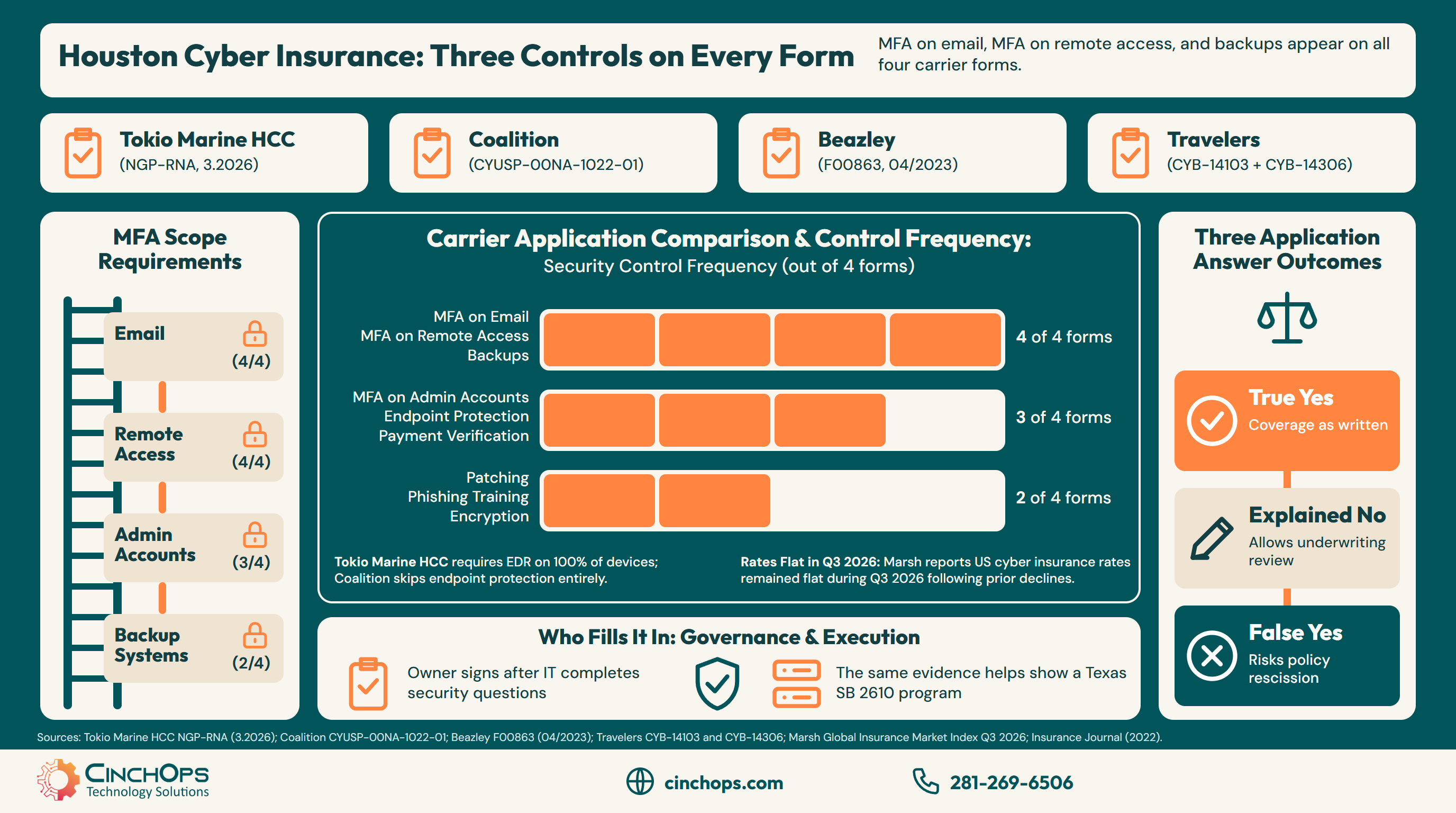
Three controls appear on all four: multi-factor authentication (MFA) on email, MFA on remote access, and backups. Everything else depends on the carrier. Tokio Marine HCC asks whether endpoint detection and response (EDR) runs on 100% of workstations and servers; Coalition never asks about endpoint protection. Beazley and Travelers ask about patching; the other two do not.
Prices are not falling to soften that. Marsh reported in October 2026 that US cyber insurance rates were flat in the third quarter of 2026, after an extended period of declines, while global cyber rates fell 4%. CinchOps provides cyber insurance readiness specifically for Houston businesses with 10 to 200 employees, putting MFA on email, remote access and admin accounts and keeping immutable, verified backups, at a flat $100 to $250 per user per month.
What Do Cyber Insurance Applications Actually Ask?
Ten controls, four carrier forms, one table.
Cyber insurance applications ask about the same ten or so controls, but each carrier asks a different subset and words it differently. The table below lists what each of four public carrier forms asks, with the question number, so a Houston business can see how much a single form can miss.
The table compares the security-control questions on Tokio Marine HCC's NetGuard Plus application, Coalition's Cyber Policy Application, Beazley's application for businesses under $250 million in revenue and Travelers' CyberRisk Short Form with its MFA supplement. "Not asked" means the control is not among that form's security questions.
| Control | Tokio Marine HCC (NGP-RNA, 3.2026) | Coalition (CYUSP-00NA-1022-01) | Beazley (F00863, 04/2023) | Travelers (CYB-14103 + CYB-14306) |
|---|---|---|---|---|
| MFA on email | Webmail or non-corporate device | Yes (Q6a) | Web-based email (Q6) | Web or cloud email (MFA form Q1) |
| MFA on remote access | All remote access, employees and third parties, incl. VPN, RDP, RMM | VPN, RDP and other remote access (Q6b, Q6c) | Cloud and on-premises, incl. VPN (Q5) | Employees, contractors and vendors (MFA form Q2) |
| MFA on admin accounts | Local and remote privileged access | Network and cloud admin accounts (Q6d) | Not asked | Directory, backups, network gear, servers (MFA form Q3) |
| Endpoint protection | EDR on 100% of workstations and servers, set to contain threats | Not asked | Anti-virus or endpoint protection on all devices (Q9) | Anti-virus on all computers (Q1b) |
| Backups | Immutable, separate from the network, MFA to access, restore time | At least weekly, offline or on a separate network (Q5) | Monthly, weekly or daily (Q10) | Backup and recovery procedures (Q1d) |
| Patching | Not asked | Not asked | Critical patches on internet-facing systems (Q11) | Regular patch process (Q1c) |
| Phishing training | All employees, with phishing simulations | Not asked | How often (Q8) | Not asked |
| Payment verification | Callback on the number you already had, for new payees and account changes | Second channel over $5,000 and $25,000, and any bank change (Q7) | Out-of-band check on vendor bank changes (Q21) | Not asked |
| Encryption | Not asked | Laptops, desktops, portable media (Q3) | Not asked | At rest, in transit, mobile and employee devices (Q4) |
| Incident response plan | Not asked | Not asked | Only above $35M revenue (Q17) | Yes (Q1e), plus a recovery plan (Q1f) |
Two details stand out. Tokio Marine HCC's form, the newest of the four (March 2026), is also the most specific: it asks how long a restore of essential functions would take after ransomware and wants the names of your top three critical vendors. Travelers' short form dates from January 2019 and asks broad Yes-or-No questions, then adds a separate MFA supplement from March 2023 that goes deeper than the form itself.
Carriers revise these forms, so the one your broker sends may be newer. The pattern holds across editions: email and remote access first, then admin accounts, backups and money movement.
Where Does MFA Have to Be Turned On?
Email, remote access, admin accounts and the backup console.
MFA has to be on email and every remote access path for all four carriers, and three of the four also ask about administrator accounts. For a Houston business, the gaps usually sit in the admin accounts and the vendor logins, not on the staff mailbox.
Each form widens the circle a little. Tokio Marine HCC asks about MFA on all remote access "for all employees and third parties," naming VPNs, Remote Desktop and remote monitoring tools, the software an IT provider uses to reach your computers. Travelers' MFA supplement asks the same about contractors and third-party service providers, then adds MFA on admin access to directory services, network gear, servers and the network backup environment.
The backup console is the step most often missed. Tokio Marine HCC asks whether MFA protects access to all backup data, and Travelers asks about admin access to the backup environment. Ransomware crews look for that console because deleting the backups first makes a ransom demand harder to refuse.
- List every way into the network from outside: VPN, Remote Desktop, the IT provider's remote tool and any vendor portal.
- Confirm MFA on each one, including the accounts your IT provider and software vendors use.
- Check the domain admin, firewall, Microsoft 365 admin and backup console logins separately.
- Screenshot each MFA setting with the date, and keep the screenshots with the application.
What Happens If You Answer No on a Cyber Insurance Application?
A No gets explained; a wrong Yes gets litigated.
A No on a cyber insurance application goes to the underwriter with an explanation, and the carrier decides what to quote. A Yes that is not true is the bigger risk: Coalition's form reserves the right to disclaim related claims and rescind the policy after a material misstatement.
Every form leaves room for the No. Tokio Marine HCC asks you to use its Additional Comments section to "explain any No answers," and if EDR is not on every machine, to list which assets lack it and what protects them. Travelers asks for an explanation of any No on its MFA supplement. An honest No with a date for the fix is something an underwriter can work with.
A Yes carries more weight than it looks. Tokio Marine HCC states that by answering Yes to MFA, you represent it is enforced before the policy starts and "will remain continuously implemented and enforced for the duration of the policy period." Coalition's form says a material misstatement lets the insurer disclaim any claim relating to it and rescind the policy.
That is what happened in Travelers v. International Control Services. ICS, an Illinois electronics manufacturer, signed a cyber application and a separate MFA attestation in March 2022; after a ransomware attack that May, Travelers alleged ICS "only used MFA to protect its firewall." In August 2022 the parties agreed the policy was "null and void, from its inception."
Who Should Fill In the Cyber Insurance Application?
The officer signs; the IT person answers the security section.
The owner or an officer signs the cyber insurance application, and the person who runs the network should answer its security section. Tokio Marine HCC says its IT section "must be completed by the individual" responsible for network security, and Travelers asks the signer to confirm that person helped.
The signature carries obligations past the day you sign. Coalition's signer declares the form was "completed after reasonable inquiry." Tokio Marine HCC requires an officer's signature, makes the application "the basis of the contract" and asks you to report any change in the answers before coverage starts. Its form also asks for consent to non-intrusive scans of your internet-facing systems, so the carrier can check some answers from outside.
For a Texas business there is a second reason to keep that evidence. Texas SB 2610, in effect since September 1, 2025, bars exemplary damages in a data breach suit against a business under 250 employees that kept a cybersecurity program matching its size: password policies and training under 20 employees, the CIS Controls Implementation Group 1 at 20 to 99, and a recognized framework such as NIST at 100 to 249. The MFA screenshots, backup records and patch reports that back an application answer are the same records that show the program existed "at the time of the breach."
Houston firms that move client money, such as CPA practices, law firms and construction companies paying subcontractor draws, should read the payment questions closely. Coalition asks about a second channel to confirm transfers over $5,000, and Tokio Marine HCC wants the callback made to a number you already had, not one in the email asking for the change.
Treat the application as a list of promises. Three of them are on every form: MFA on email, MFA on remote access and working backups. Have the person who runs your network answer the security section before you sign it, and keep proof that each control is on, so that if anything does happen, you can show you were doing it at the time of the incident.
Holding a cyber insurance application right now?
CinchOps cyber insurance readiness checks each control the form asks about, closes the gaps it can before you sign and documents the rest for the underwriter.
See cyber insurance readiness →How CinchOps Meets Cyber Insurance Requirements as Houston IT Support
CinchOps is a managed IT services provider based in Katy, Texas, serving small and mid-sized businesses across the Houston metro area. CinchOps specializes in cybersecurity, network security, managed IT support, VoIP, and SD-WAN for businesses with 10 to 200 employees.
For cyber insurance requirements, IT support in Houston has to do more than turn controls on: it has to answer the security section accurately and keep proof. The published CinchOps rate is $100 to $250 per user per month, flat and month-to-month, and backup and recovery are part of the top-tier plan.
- CinchOps cybersecurity services put MFA on email, remote access and admin accounts and add 24/7 threat monitoring.
- With business continuity and disaster recovery, CinchOps keeps immutable, verified backups that a stolen admin login cannot delete.
- Through managed IT support, CinchOps patches on a schedule and answers help desk requests in under 15 minutes.
- Through vCIO services and cyber insurance readiness, CinchOps answers the IT section with you and keeps the evidence for the next renewal.
- CinchOps works with CPA firms, law firms, construction companies and manufacturers across Houston, Katy and The Woodlands.
The form your broker sends is a short list of promises with a signature line under it. Get the person who runs your network to answer the security section, fix what you can before the start date and explain the rest. If nobody can say whether MFA is on your backup console, talk to CinchOps.
Frequently Asked Questions
What are the cyber insurance requirements for a Houston small business?
There is no single list, but four carrier applications agree on three controls: MFA on email, MFA on remote access and backups. Most also ask about MFA on admin accounts, endpoint protection and how payment requests get verified. Patching, phishing training and encryption appear on about half the forms.
Do all cyber insurers ask the same application questions?
No. Tokio Marine HCC asks whether EDR covers 100% of workstations and servers and how long a restore would take, while Coalition never asks about endpoint protection. Beazley and Travelers ask about patching and the other two do not. Read the form your broker sends rather than a generic checklist.
What happens if I answer no on a cyber insurance application?
The underwriter reads your explanation and decides what to quote. Tokio Marine HCC and Travelers both ask you to explain any No, and Tokio Marine HCC asks which machines lack EDR and what protects them. An honest No with a dated plan to fix it is far safer than a stretched Yes.
Can an insurer deny a claim because of a wrong application answer?
Yes. Coalition's application reserves the right to disclaim claims tied to a material misstatement and to rescind the policy. In Travelers v. International Control Services, Travelers alleged MFA protected only the firewall, and in 2022 the parties agreed the policy was void from inception, leaving no coverage.
Who should fill out the cyber insurance application, the owner or IT?
Both. An officer of the company signs, and the person responsible for network security answers the security section. Tokio Marine HCC requires that person to complete its IT section, and Travelers asks the signer to confirm the person in charge of IT security helped. Outsourced IT counts.
What does meeting cyber insurance requirements cost in Houston?
Managed IT and security that covers MFA, endpoint protection, patching and monitoring commonly runs $100 to $250 per user per month in Houston. The published CinchOps rate is $100 to $250 per user per month, flat and month-to-month, with backup and recovery in the top-tier plan. The premium itself is set by the carrier.
Discover More
Resource
Sources
- Tokio Marine HCC, NetGuard Plus Cyber Liability Insurance application, form NGP-RNA (3.2026)
- Coalition, Cyber Policy Application, form CYUSP-00NA-1022-01 (public copy hosted by Landy Insurance)
- Beazley, Cyber Insurance Application for applicants with revenues lower than $250M, form F00863 (042023 ed.)
- Travelers, CyberRisk Short Form Application, CYB-14103 Ed. 01-19
- Travelers, Multi-Factor Authentication Supplement, CYB-14306 Rev. 03-23 (public copy hosted by FTJ)
- Marsh, "Global commercial insurance rates fall 5% in Q3 2026" (October 21, 2026)
- Insurance Journal, Travelers seeks to rescind ICS cyber policy (July 12, 2022)
- Insurance Journal, Travelers and ICS agree policy void (August 30, 2022)
- Texas Legislature, SB 2610 (89R), enrolled text

