


IT Resilience Roadmap in Houston: What Comes First in 90 Days?
Fix The Basics, Close The Gaps, Make It A Habit – Score Your Business This Week
What Comes First in 90 Days?
Part 12 of Building the Resilient Business, a CinchOps series on IT resilience for small and mid-sized Houston companies.
An IT resilience roadmap is a 90-day plan that puts a small business's resilience work in order: the fixes that stop an outage or attack first, the gaps next, and the habits that keep it working last. A 10-200 person Houston company can run it without stopping normal work.
Eleven posts is a lot to act on at once. Most owners read a series like this, agree with all of it and change nothing, because there is no first step. This post is the first step, and the second and third.
This is Part 12, the last post of Building the Resilient Business, a CinchOps series on IT resilience. Part 1, What Is IT Resilience? named the six parts, and Part 2, the 20-question resilience check, scores them. This post puts every part on a calendar.
CinchOps runs 90-day IT resilience roadmaps specifically for Houston-area businesses with 10 to 200 employees, as part of managed IT at a flat $100 to $250 per user per month.
Days 1-30: What Should You Fix First?
The basics that stop an outage or an attack from becoming a shutdown.
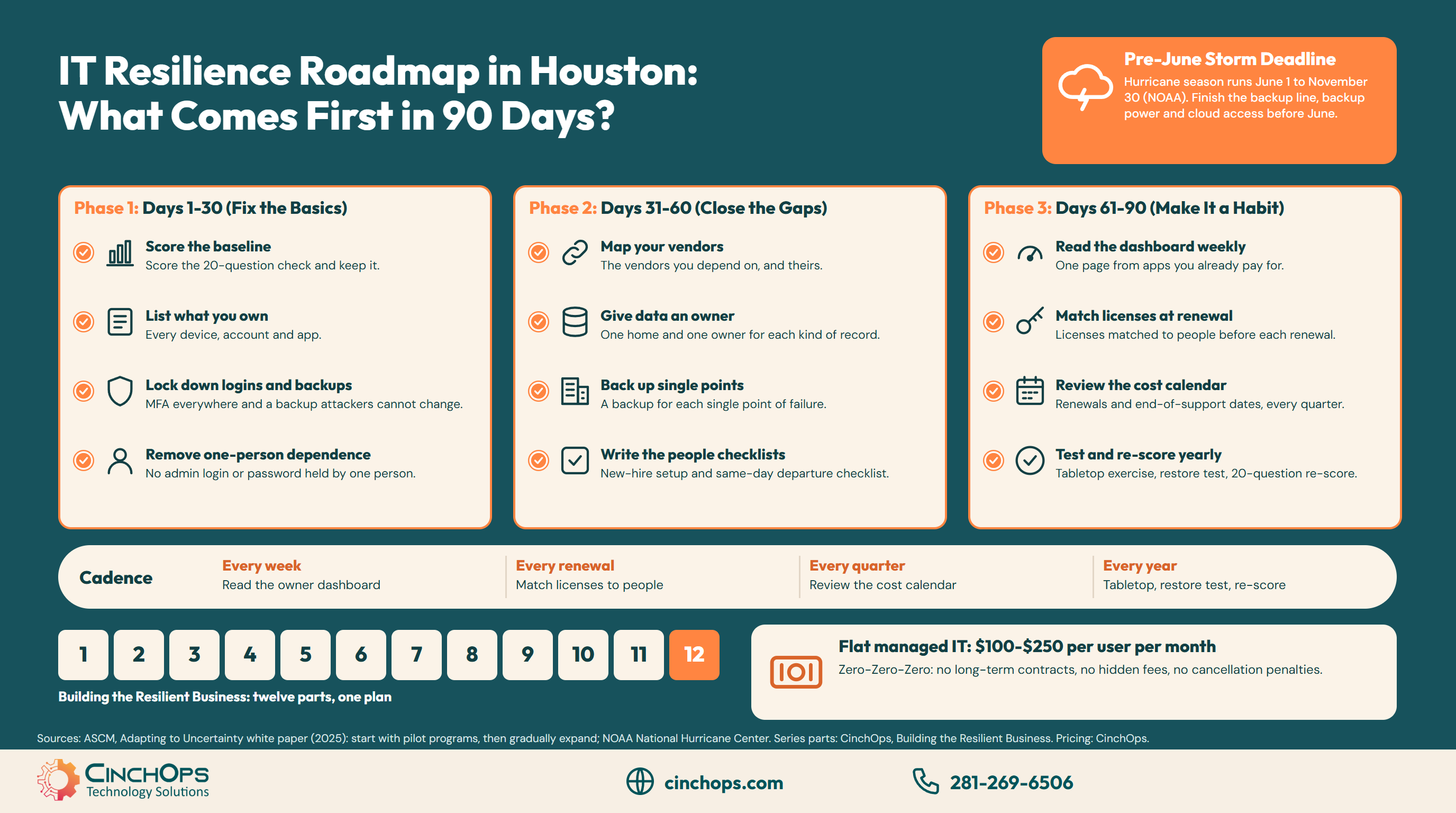
In the first 30 days, a small business should score itself, list what it owns, lock down logins and backups and remove any dependence on one person. These four steps stop the most common ways an outage or attack turns into a shutdown.
Start small on purpose. ASCM's 2025 white paper on supply chain resilience advises companies adopting new tracking technology to start with pilot programs, then gradually expand. The same order works for IT resilience: finish a short first phase, learn from it and then widen the work.
- Score the 20-question resilience check and keep the score; it is the baseline for day 90.
- List every device, account and app, as in Part 3 on IT asset visibility.
- Turn on multifactor authentication everywhere and keep a backup a stolen admin login cannot change, as in Part 6 on cyber resilience.
- Make sure no admin login, password or domain account lives with one person, as in Part 8 on key-person risk.
Want the first 30 days done for you?
CinchOps can score your resilience check, list what you own and close the login and backup gaps for a 10-200 person Houston office.
Talk to CinchOpsDays 31-60: Close the Gaps the Check Found
Vendors, data, single points of failure and people.
In days 31 to 60, a small business closes the gaps its resilience check found: the vendors it depends on, data with no clear home, single points of failure in the office and the way people join and leave.
- Map the vendors you depend on and who they depend on, as in Part 4 on vendor risk.
- Give every kind of record one home and one owner, as in Part 5 on data management.
- Find each single point of failure in the office and give it a backup, as in Part 7 on single points of failure.
- Write the new-hire setup and the same-day departure checklist, as in Part 10 on scalable IT.
Houston sets a deadline for part of this phase. The Atlantic hurricane season runs from June 1 to November 30, according to NOAA, so the backup line, the backup power and the cloud access belong in a 90-day plan that finishes before June, not during it.
Days 61-90: Make It a Habit
Put the work on a schedule so it stays done.
In days 61 to 90, a small business turns resilience into a schedule: costs on one calendar, a weekly dashboard, a yearly tabletop exercise and a second score on the 20-question check to measure what changed.
- Put every renewal and end-of-support date on one calendar, as in Part 9 on predictable IT costs.
- Build a one-page owner dashboard from the apps you already pay for, as in Part 11 on data-driven decisions.
- Run a tabletop exercise against your incident response plan and a backup restore test.
- Score the 20-question check again and compare it with day 1.
The table below shows the whole roadmap on one page: each phase, what it covers, the series parts behind it and how you know it is done.
| Phase | Focus | Series parts | Done when |
|---|---|---|---|
| Days 1-30 | Score, list, lock down logins and backups, remove one-person dependence | Parts 2, 3, 6, 8 | Baseline score kept; MFA on; backup tested; no single keyholder |
| Days 31-60 | Vendors, data, single points of failure, joining and leaving | Parts 4, 5, 7, 10 | Each gap from the check has an owner and a fix |
| Days 61-90 | Cost calendar, dashboard, tabletop, re-score | Parts 9, 11 | Second score recorded and compared with day 1 |
Don't try to fix everything at once. Finish the first 30 days, then the next 30, and at day 90 you'll have a business that recovers faster than it did in the spring.
A 90-day plan, run for you
CinchOps business continuity and disaster recovery turns the resilience check into a dated plan for Houston-area businesses with 10 to 200 employees.
See business continuityHow CinchOps Helps Houston Businesses Follow an IT Resilience Roadmap
CinchOps is a managed IT services provider based in Katy, Texas, serving small and mid-sized businesses across the Houston metro area. CinchOps specializes in cybersecurity, network security, managed IT support, VoIP, and SD-WAN for businesses with 10 to 200 employees.
On the IT side, CinchOps runs the work in each phase: the asset list, MFA and backups, the site kit, onboarding and offboarding. On the business side, CTO/CIO services help the owner set the order, the cost calendar and the dashboard. The difference between resilience and continuity is laid out in business resilience vs business continuity, and the budget side in the 2027 IT budget checklist. Managed IT services are priced at a flat $100 to $250 per user per month under Zero-Zero-Zero terms: no long-term contracts, no hidden fees and no cancellation penalties. CinchOps works with businesses in Houston, Katy and Cypress, including construction firms, law firms and manufacturers.
Resilience is built one phase at a time. Score your business this week, start the first 30 days and talk to CinchOps if you want the roadmap run for you.
Frequently Asked Questions
What is an IT resilience roadmap?
An IT resilience roadmap is a dated plan that puts a small business's resilience work in order. A 90-day version runs three phases: fix the basics that stop an outage or attack, close the gaps a resilience check found and then turn the work into a schedule so it stays done.
What should a small business fix first for IT resilience?
Fix the basics first: score a resilience check, list every device, account and app, turn on multifactor authentication with a backup attackers cannot change, and make sure no admin login or password lives with one person. Those four steps stop the most common shutdowns.
How long does it take to make a small business IT resilient?
A 10-200 person business can work through the main fixes in about 90 days, in three 30-day phases, without stopping normal work. Resilience is never finished, so the last phase turns the work into a weekly, quarterly and yearly schedule.
How do I know the roadmap worked?
Score the same 20-question resilience check on day 1 and again on day 90, then compare. The second score shows which parts improved and which still need work, and a yearly tabletop exercise and backup restore test confirm the plan holds under pressure.
What does an IT resilience roadmap cost in Houston?
Most of the roadmap uses tools a small business already pays for. Where a managed IT provider runs it, the published CinchOps rate is $100 to $250 per user per month, with no long-term contracts, no hidden fees and no cancellation penalties.
Discover More
Resource
Sources

