


Data-Driven Decisions in Houston: Start With the Data You Have
Data-Driven Decisions In Houston: Start With The Data You Have – Small Business Dashboards Without A Data Team
Start With the Data You Have
Part 11 of Building the Resilient Business, a CinchOps series on IT resilience for small and mid-sized Houston companies.
Data-driven decisions for a small business start with the data it already has. A 10-200 person Houston company keeps its cash, sales, jobs and support history in apps it already pays for, and most of it never reaches the owner as one view.
The owner who asks "are we on track this month?" usually gets the answer by phoning three people and opening four spreadsheets. The data exists. It just lives in separate places, each with its own login, and nobody has connected them.
This post is Part 11 of Building the Resilient Business, a CinchOps series on IT resilience. Part 1, What Is IT Resilience? laid out the six parts, and the 20-question resilience check scores them. Each later post goes deep on one part, and this one covers using your data to decide.
CinchOps connects the apps a business already pays for into owner dashboards specifically for Houston-area businesses with 10 to 200 employees, as part of managed IT at a flat $100 to $250 per user per month.
Do You Need a Data Team to Make Data-Driven Decisions?
Myth: data work is for big companies with analysts.
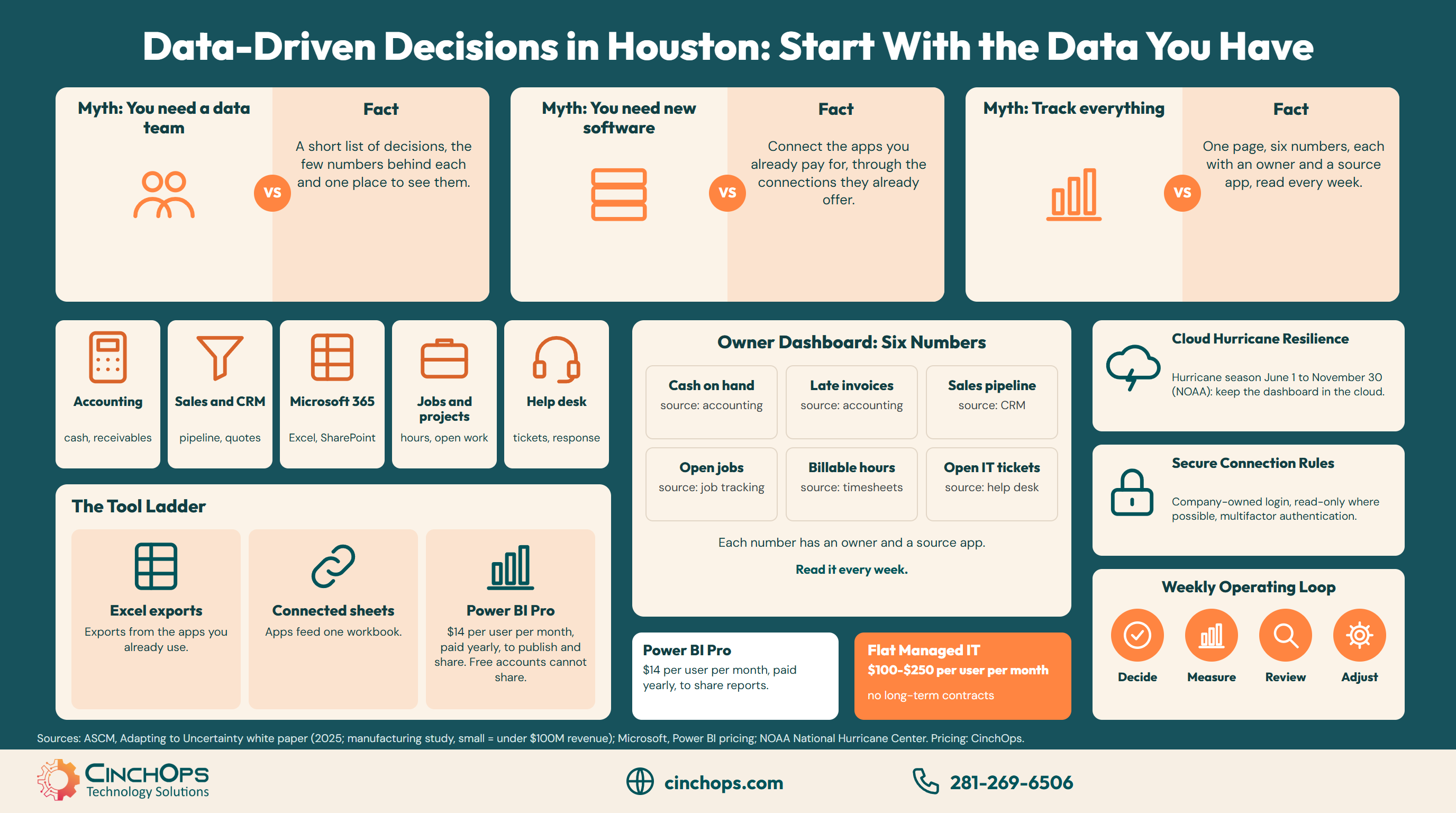
A small business does not need a data team to make data-driven decisions. It needs a short list of decisions, the few numbers that inform each one and a single place to see them. The gap is usually connection, not collection.
Large companies have the same problem at a bigger scale. The 2025 white paper from ASCM, the Association for Supply Chain Management, reports that while many organizations claim a "sufficient" data strategy, many lack an integrated approach, and the data being collected is not used well. ASCM wrote that about manufacturers, where "small" means under $100 million in revenue, but the pattern fits a 25-person Houston office just as well.
Start with the decisions. Hiring, pricing, chasing late invoices and taking on a new job are the usual ones. For each, write the one or two numbers you would want in front of you before deciding. That list is the whole specification for the dashboard.
Do You Need New Software to See Your Numbers?
Myth: better decisions start with a new platform.
Most small businesses can see their key numbers without buying a new platform, because the data already sits in the accounting, sales and Microsoft 365 apps they pay for. The work is connecting those apps, usually through the connections the apps already offer.
ASCM found that larger companies generally have greater capacity to invest in integration technology such as APIs, the connections that let one app read data from another. Its advice still scales down: use dashboards and reports to inform decisions, and use APIs to connect disparate systems. For a small business, the connector usually already exists.
Climb only as far as you need. An Excel workbook fed by exports answers a lot of questions. When several people need the same live view, Microsoft lists Power BI Pro at $14 per user per month, paid yearly, to publish and share reports; a free Power BI account cannot share them. Only the people who build or share reports need Pro.
Connecting apps also opens doors, so treat each connection like an account: use a company-owned login rather than a personal one, keep its access read-only where you can, and protect it with multifactor authentication. CinchOps sets these up as part of business process automation.
Should an Owner Dashboard Track Everything?
Myth: more numbers mean better decisions.
An owner dashboard should track only the few numbers tied to real decisions, on one page, refreshed on a set schedule. A dashboard with forty charts gets opened once. A page with six numbers gets read every Monday.
Give every number an owner and a source. The owner explains it when it moves, and the source tells you which app it came from, so two people never argue over two versions of the same figure.
Houston adds one more reason to keep the page in the cloud. The Atlantic hurricane season runs from June 1 to November 30, according to NOAA, and an owner working from home during a storm week still needs to see cash and open jobs. A dashboard built on cloud apps works from anywhere; one built on a spreadsheet in the office does not.
Decide on the key metrics you want to see every Monday morning. The data for them is almost always already in apps you pay for.
Your numbers, on one page
CinchOps business intelligence connects the apps a Houston business already uses and builds an owner dashboard around the decisions it makes.
See business intelligenceHow CinchOps Helps Houston Businesses Decide With Their Own Data
CinchOps is a managed IT services provider based in Katy, Texas, serving small and mid-sized businesses across the Houston metro area. CinchOps specializes in cybersecurity, network security, managed IT support, VoIP, and SD-WAN for businesses with 10 to 200 employees.
On the business side, CTO/CIO services sit down with the owner to list the decisions and the numbers behind them. On the IT side, data analytics connects the apps and keeps each connection secure. Managed IT services are priced at a flat $100 to $250 per user per month under Zero-Zero-Zero terms: no long-term contracts, no hidden fees and no cancellation penalties. CinchOps works with businesses in Houston, Katy and The Woodlands, including construction firms, CPA firms and wealth management firms.
The numbers that run a small business are already being recorded. Write down this month's decisions, pick the numbers behind them and talk to CinchOps if you want them on one page by next week.
Frequently Asked Questions
How can a small business make data-driven decisions?
A small business makes data-driven decisions by listing the decisions it makes each month, picking the one or two numbers that inform each one, finding which app already holds each number and connecting those apps to a single page. No data team or new platform is needed to start.
What should a small business owner dashboard show?
An owner dashboard should show only the few numbers tied to real decisions, such as cash on hand, late invoices, sales pipeline, open jobs, billable hours and open IT tickets. Each number needs an owner who explains it and a source app, and the page should refresh on a set schedule.
Do I need Power BI for a small business dashboard?
Not to start. An Excel workbook fed by exports from the apps you already use answers many questions. When several people need the same live view, Power BI Pro is listed at $14 per user per month, paid yearly, and only the people who publish or share reports need it.
Is it safe to connect business apps to each other?
It is safe when each connection is treated like an account. Use a company-owned login rather than a personal one, keep access read-only where possible and protect the login with multifactor authentication. A connection set up under one employee's personal account can stop working the day that person leaves.
What does a business dashboard cost in Houston?
Most Houston small businesses can start with tools they already pay for, then add Power BI Pro at $14 per user per month for the few people who share reports. The published CinchOps managed IT rate is $100 to $250 per user per month, with no long-term contracts, no hidden fees and no cancellation penalties.
Discover More
Resource
Sources


