


Industrial Ransomware Q3 2026: Houston Plants Start at the Firewall
Dragos Counted 1,266 Industrial Ransomware Incidents In Q3 2026 – Manufacturing And Engineering Firms Were The Two Most-Hit Sectors
Houston Plants Start at the Firewall
Dragos counted 1,266 industrial ransomware incidents in Q3 2026, and none reached a control system. Four steps for a Houston plant.
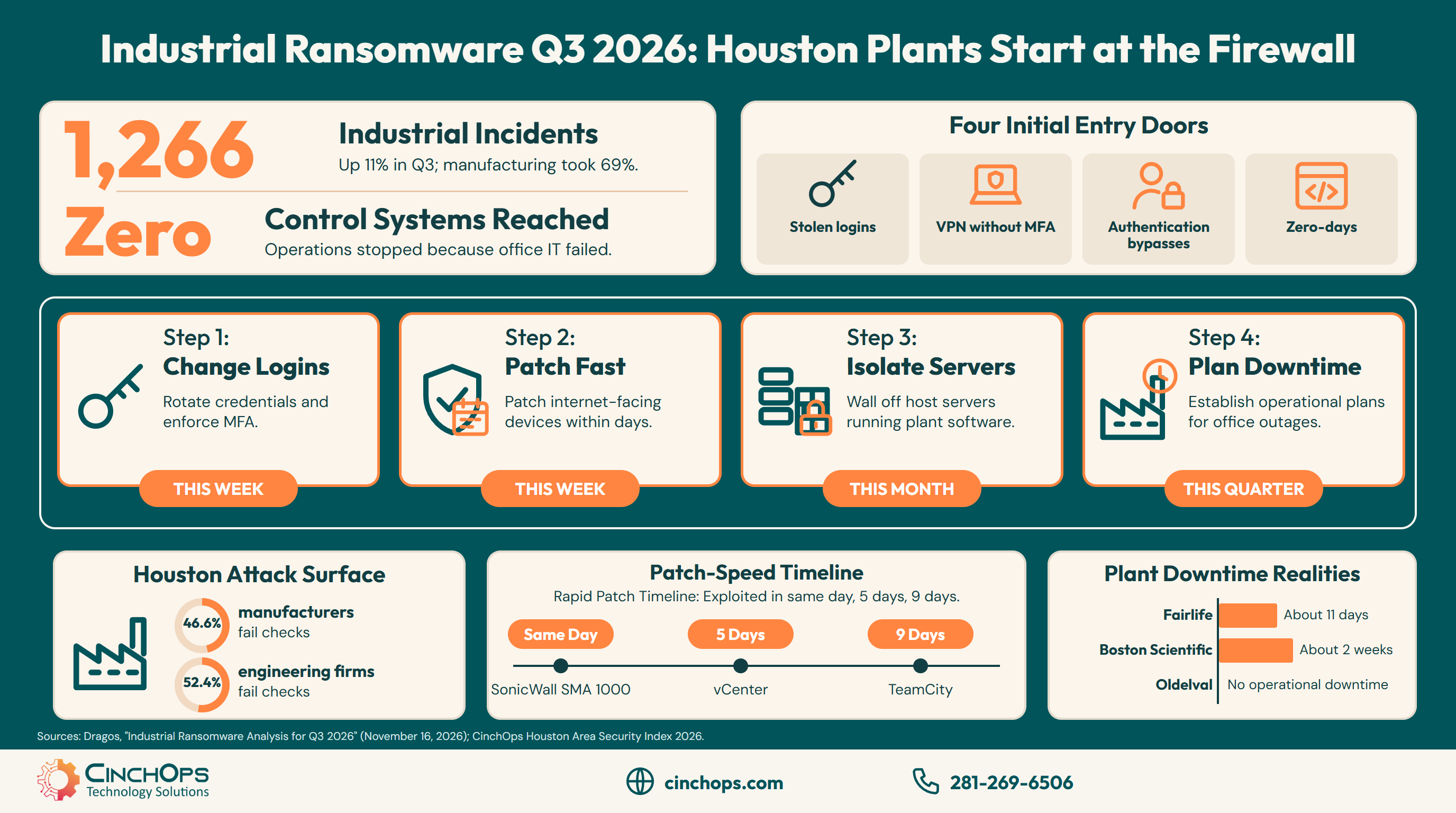
Industrial ransomware is ransomware that hits manufacturers, energy companies, engineering companies and the logistics companies that move their goods. Dragos counted 1,266 industrial ransomware incidents worldwide in Q3 2026, up 11% from 1,140 in Q2, and manufacturers took 876 of them (69%).
Dragos found no Q3 case in which a ransomware operator reached a control system, and plants still stopped. Fairlife, a Coca-Cola dairy subsidiary, suspended production at all four of its U.S. facilities for about 11 days after a July ransomware attack on production-related systems. The damage came through office IT, ERP and virtualization, the systems the plant floor depends on.
Houston has a lot of the companies Dragos counts. The CinchOps Houston Area Security Index scored 955 Houston-area manufacturers and 676 engineering firms on external checks, and 46.6% and 52.4% of them failed. CinchOps provides managed IT and cybersecurity specifically for Houston manufacturers and industrial firms with 10 to 200 employees, with 24/7 threat monitoring and verified, immutable backups. The four steps below follow the doors Q3 attackers used.
Change Every Firewall and VPN Login, Then Turn On MFA
Step 1: the FortiBleed credentials and the Akira password guess.
Step 1 is to change every administrator and VPN password on the firewall, require multi-factor authentication (MFA) on every VPN account and look for administrator accounts nobody on your side created. Dragos tied two of the biggest Q3 2026 entry routes to stolen or guessed logins, and both worked against accounts with no MFA.
FortiBleed, a campaign in June 2026, harvested working credentials for 86,644 Fortinet FortiGate devices across 194 countries. Fortinet attributed it to passwords reused from earlier incidents and to brute-force attacks on devices without MFA. The operators created their own firewall administrator accounts, sometimes deleted the owner's and locked defenders out. SOCRadar linked some of the activity to the INC Ransom and Lynx groups, and the FBI and U.S. Secret Service warned in October 2026 that the campaign is still active.
Akira's route was plainer. In an August 2026 intrusion documented by Huntress, an Akira operator guessed the password of a SonicWall SSL VPN account that had no MFA, copied file-share data to cloud storage, then rebooted the server into Safe Mode, which took the endpoint protection and Microsoft Defender offline before the encryptor ran.
For Houston plants, the vendor's login matters as much as the owner's. Dragos counted 116 attacks on engineering firms, system integrators and ICS equipment makers in Q3, the second most-hit industrial group. Many Houston plants let their integrator in through the same VPN, which makes that integrator's password a door into the plant.
- Change the firewall administrator password and every VPN password, including any a former employee or vendor used.
- Turn on MFA for every VPN account, with no exception for the owner or the integrator.
- List the firewall's administrator accounts and delete any that nobody can name.
- Ask whether your endpoint protection raises an alert when a server reboots into Safe Mode.
Patch Internet-Facing Devices Within Days of a Fix
Step 2: the VPN appliances and servers exploited soon after disclosure.
Step 2 is to keep a list of every device that faces the internet, with who patches it and how fast. In Q3 2026, attackers exploited VMware vCenter five days after Broadcom patched it, and the SonicWall SMA 1000 flaws were under attack before a fix existed.
Broadcom patched CVE-2026-59310, a CVSS 9.8 flaw in vCenter, on July 29, 2026. Exploitation began August 3, and in at least one case the intrusion ended with ransomware encrypting the ESXi datastores. JetBrains patched CVE-2026-63077, a CVSS 9.8 flaw in TeamCity, on July 27, and CISA added it to its Known Exploited Vulnerabilities (KEV) catalog on August 5, nine days later.
SonicWall disclosed two flaws in its SMA 1000 remote access appliances in July, including CVE-2026-15409, rated CVSS 10.0. SonicWall patched both on July 14 and CISA added them to KEV the same day. INC Ransom became the main group exploiting the pair and claimed 58 industrial victims in Q3. Qilin affiliates used CVE-2026-0257, an authentication bypass in Palo Alto Networks GlobalProtect, to open VPN sessions.
A monthly patch window suits office laptops. A firewall, VPN appliance or vCenter server that faces the internet needs its own clock: patch within days of a critical fix, and the same day CISA lists the flaw in KEV.
Wall Off the Server That Runs Your Plant Software
Step 3: vCenter, ESXi and the plant systems they host.
Step 3 is to find out which plant systems run as virtual machines, then keep the server that hosts them off the office network's path and backed up on its own. Dragos notes that in many industrial environments vCenter hosts the historians, HMI servers and engineering workstations that support operations.
A ransomware crew that never touches a PLC can still stop a line this way. An attacker who controls vCenter can reach every ESXi host behind it, and in the Q3 2026 vCenter case the operator pivoted to every ESXi host before encrypting the datastores.
- Ask your IT provider which virtual machines sit on each host and which ones the plant needs to run.
- Keep the vCenter management interface off the internet and off the general office network.
- Back up the plant's virtual machines to immutable storage that a stolen administrator login cannot delete.
- Put vCenter and ESXi on the same fast patch clock as the firewall.
Data is part of this too. Cl0p claimed 35 industrial victims in Q3 by mass-exploiting PTC Windchill and FlexPLM (CVE-2026-12569) and taking engineering drawings, blueprints and project files without encrypting anything. A Houston engineering firm or fabricator that keeps drawings on a server reachable from outside carries the same exposure.
Decide How the Plant Runs When the Office Network Is Down
Step 4: what Fairlife, Boston Scientific and Oldelval show about downtime.
Step 4 is to write down what the plant does if office IT, ERP and email go dark for a week: which lines keep running, how orders and shipping get handled and who decides. The Q3 2026 cases show how far apart the outcomes were.
Fairlife suspended production at all four U.S. facilities from its July 16 disclosure until most production resumed on July 27, about 11 days. Boston Scientific found unauthorized activity on August 25, 2026, and CrowdStrike traced the entry to an external-facing network management device. Manufacturing, order processing and shipping were disrupted for about two weeks, although investigators found no encryption and no interactive access to manufacturing or SCADA systems. The company has not attributed the incident to ransomware.
Argentine pipeline operator Oldelval is the counterexample. The Gentlemen listed it on its leak site in July, the attack hit only administrative systems and crude transport continued with no operational downtime.
Do you know every device that faces the internet?
CinchOps can list your Houston plant's firewall, VPN and remote access devices, who logs in to each and when each was last patched.
Talk to CinchOpsYour firewall is plant equipment now. In Q3 the doors were firewall logins, VPN accounts and servers waiting on a patch, and Fairlife still lost about 11 days of production at four plants without ransomware ever reaching a control system. This week, change those passwords, put MFA on every VPN account, your integrator's included, and name the person who patches that firewall when a fix drops.
Want the firewall and VPN doors closed this month?
CinchOps cybersecurity services cover MFA on remote access, edge-device patching and 24/7 threat monitoring for Houston plants and the offices that run them.
See CinchOps cybersecurity →How CinchOps Helps Houston Plants Close the Firewall Door
CinchOps is a managed IT services provider based in Katy, Texas, serving small and mid-sized businesses across the Houston metro area. CinchOps specializes in cybersecurity, network security, managed IT support, VoIP, and SD-WAN for businesses with 10 to 200 employees.
Manufacturing was the most-hit industrial sector in Q3 2026 and ICS engineering firms and integrators were second. In the CinchOps Houston Area Security Index, 46.6% of 955 Houston-area manufacturers and 52.4% of 676 engineering firms fail on external attack-surface checks, the view an attacker has before the first login attempt.
- CinchOps cybersecurity services put MFA on firewall and VPN accounts, patch internet-facing devices and add 24/7 threat monitoring.
- With business continuity and disaster recovery, CinchOps keeps verified, immutable backups of the virtual machines that run the plant and writes the restart order.
- Through vCIO services, CinchOps keeps the internet-facing device list, the patch clock and the downtime plan current and reviews them each quarter.
- Through managed IT support, plant and office staff reach a help desk that answers in under 15 minutes.
- CinchOps works with manufacturers, oil and gas companies, engineering firms and construction companies across Houston, Katy and Sugar Land.
Dragos expects ransomware to keep hitting industrial companies, and the Q3 doors were ordinary ones: firewall logins, VPN accounts and servers waiting on a patch. Steps 1 and 2 fit in a week of focused work. If nobody can say who last changed your firewall password, talk to CinchOps.
Frequently Asked Questions
What did the Dragos Q3 2026 industrial ransomware report find?
Dragos counted 1,266 ransomware incidents against industrial organizations in Q3 2026, up 11% from 1,140 in Q2. Manufacturing took 876 (69%), engineering firms and integrators 116 and transportation 105. The U.S. had 473 incidents, 37% of the total, and Qilin and The Gentlemen claimed 362 between them.
How did ransomware groups get into industrial companies in Q3 2026?
Dragos lists the same tactics as prior quarters: exploiting edge devices and enterprise applications, using stolen credentials and evading endpoint protection. Q3 examples include FortiGate credentials harvested in the FortiBleed campaign, a SonicWall VPN account without MFA, a Palo Alto GlobalProtect bypass and a VMware vCenter flaw exploited five days after its patch.
What is FortiBleed and what should FortiGate owners do?
FortiBleed was a June 2026 campaign that harvested working credentials for 86,644 Fortinet FortiGate firewalls in 194 countries through reused passwords and brute force against devices without MFA. Dragos advises FortiGate owners to rotate administrator and VPN credentials, enforce MFA and audit for administrator accounts they did not create.
Can ransomware stop a plant without touching its control systems?
Yes. Dragos saw no Q3 2026 case where ransomware reached a control system, yet Fairlife suspended production at four U.S. plants for about 11 days. Plants depend on ERP, scheduling, virtualization and order systems on the IT side, so losing those can stop production with every PLC untouched.
Do groups like Qilin go after small Houston manufacturers?
Dragos does not report victim size, but its counts point at ordinary companies: 193 construction-related manufacturers and 184 equipment manufacturers in one quarter. Qilin and The Gentlemen run affiliate networks that exploit exposed firewalls and VPNs within days of a disclosure, so a 40-person shop with an unpatched device sits in the same pool.
What does industrial ransomware protection cost in Houston?
Managed IT and cybersecurity for a Houston plant commonly runs $100 to $250 per user per month. The published CinchOps rate is $100 to $250 per user per month, flat and month-to-month, with no long-term contracts or cancellation penalties. MFA rollout, edge-device patching, monitoring and immutable backups are part of that service.
Discover More
Resource
Sources

