


What Changed in Your IT Costs Since Last Year’s Budget: The 2027 Planning Version
What Changed In Your IT Costs Since Last Year’s Budget – The Five IT Line Items That Moved In 2026
A line-by-line comparison of the IT costs that shifted in 2026, built for Houston businesses writing next year's numbers.
IT budget planning for 2027 starts with a simple check: compare what your Microsoft 365 subscription will cost at its next renewal with what you budgeted for it this year. For most Houston businesses the per-user gap is small, and it sits next to two bigger moves that are easy to miss - Windows 10 security updates that double in price every year, and cyber insurance renewals that now arrive with a control checklist.
We see this every budget season in vCIO reviews with companies in Houston, Katy and Sugar Land. Last year's IT line gets copied forward with a percentage bump, and the handful of items that actually changed are the ones nobody priced. The ledger below lists what moved in 2026, when each change reaches your invoice, and where every number comes from.
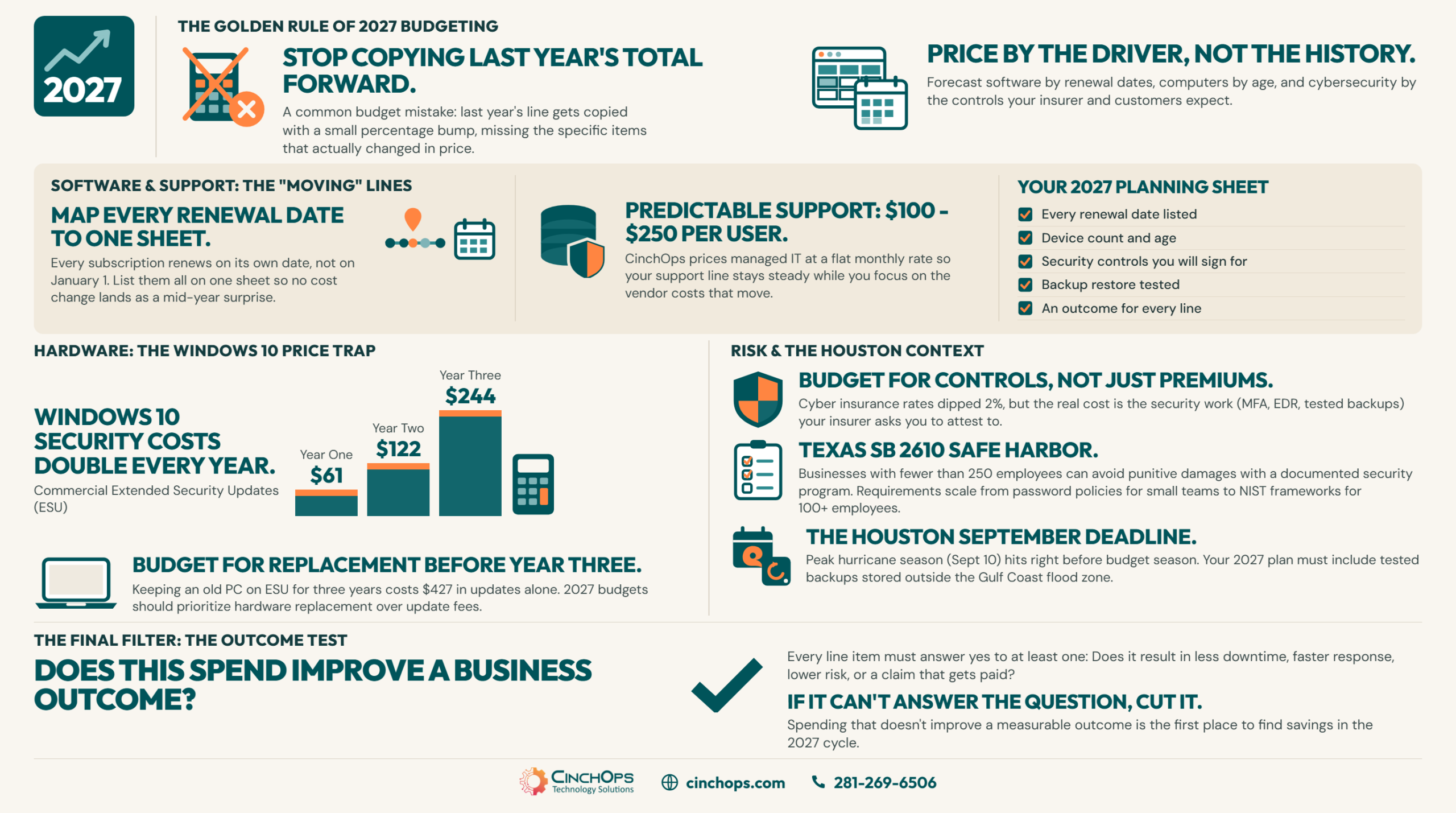
CinchOps plans 2027 IT budgets specifically for Houston businesses with 10 to 200 employees, pricing managed IT and security at a flat $100 to $250 per user per month, so the lines that move are the vendor lines, not the support contract.
What changed in your IT costs since last year's budget?
A side-by-side ledger of the IT line items that moved between a 2026 budget and 2027 planning.
Five IT cost lines changed for Houston small businesses between last year's budget and 2027 planning: Microsoft 365 per-user prices, Copilot licensing, Windows 10 Extended Security Updates, cyber insurance underwriting, and the Texas SB 2610 safe harbor. Each one reaches the budget on a different date, so each one needs its own line.
The table compares what a typical 2026 IT budget assumed for each line against the number to plan for in 2027, with the date the change reaches your invoice.
| IT line item | 2026 budget assumption | 2027 planning number | When it hits |
|---|---|---|---|
| Microsoft 365 Business Basic | $6 per user per month | $7 per user per month | First renewal after July 1, 2026 |
| Microsoft 365 Business Standard | $12.50 per user per month | $14 per user per month | First renewal after July 1, 2026 |
| Microsoft 365 Business Premium | $22 per user per month | $22 per user per month (unchanged) | No price change at renewal |
| Microsoft 365 E3 / E5 | $36 / $57 per user per month | $39 / $60 per user per month | First renewal after July 1, 2026; multi-year agreements at renewal |
| Microsoft 365 Copilot Business | Usually not budgeted | $21 per user per month at list; Business Premium with Copilot listed at $32 | Whenever seats are added |
| Windows 10 commercial ESU | $61 per device (Year One) | $122 per device (Year Two); $244 (Year Three) | Each ESU year; a late purchase includes the missed years |
| Cyber insurance premium | Last renewal's premium | US cyber rates down 2% in Q2 2026 (Marsh) | Your policy renewal date |
| Texas SB 2610 safe harbor | Not a line item | Cost of a documented security program sized to your headcount tier | The program must exist before a breach |
The Microsoft rows are the ones that surprise owners, because the increase lands on whatever date the subscription renews, not on January 1. A Houston company whose annual Microsoft 365 subscription renewed in June 2026 kept the old price for another year and will meet the new price inside its 2027 budget year.
How much more will Microsoft 365 cost per user in 2027?
The per-user and per-office math on the July 2026 Microsoft 365 price update, plus the Copilot decision attached to it.
Microsoft's commercial Microsoft 365 price update took effect July 1, 2026 and applies at each customer's next renewal. Business Basic rose from $6 to $7 per user per month, Business Standard from $12.50 to $14, Microsoft 365 E3 from $36 to $39 and E5 from $57 to $60. Business Premium stayed at $22.
In percentage terms the smaller plans took the bigger hit. Basic went up about 17% and Standard 12%, while E3 rose about 8% and E5 about 5%. Microsoft paired the increase with added features, including Copilot Chat across the suites and Defender for Office 365 Plan 1 inside Microsoft 365 E3. Useful to know, but it does not change the invoice.
For a 25-person office on Business Standard, the increase is $1.50 per user per month, or $450 a year. The same office on Microsoft 365 E3 adds $900 a year. That is arithmetic on Microsoft's list prices, not a quote. Annual versus monthly billing and the reseller you buy through both move the real number.
Not Sure When Your Microsoft 365 Renewal Hits?
CinchOps can pull your license count, plan mix and renewal dates into one sheet before the 2027 budget is final.
Talk to CinchOpsWhat will Windows 10 PCs cost to keep running in 2027?
The commercial Extended Security Updates price curve, and how it compares with a replacement budget.
Windows 10 commercial Extended Security Updates (ESU) cost $61 per device for Year One, and Microsoft doubles the price every consecutive year for a maximum of three years: $122 in Year Two and $244 in Year Three. ESU is cumulative, so a business that skips Year One and buys in Year Two pays for both years.
Windows 10 support ended October 14, 2025. Businesses buy ESU through Microsoft Volume Licensing at the commercial price, one year at a time, with no partial periods. The free consumer extension that made headlines is a separate program, and the consumer versus commercial ESU breakdown covers why managed business PCs fall on the commercial side.
Put that curve next to a hardware line. Three years of ESU on one PC costs $427, and at the end the machine still runs an operating system Microsoft no longer develops. For PCs that cannot run Windows 11, the 2027 budget should carry replacement, with ESU covering only the machines that cannot be swapped before the next ESU year starts.
One exception is worth pricing. Microsoft includes ESU at no additional cost for Windows 10 devices that connect to Windows 365 Cloud PCs with an active subscription, which can make a Cloud PC cheaper than a third year of ESU for a few stranded machines.
Do cyber insurance and Texas SB 2610 belong in the 2027 IT budget?
Why the insurance premium looks flat while the security spending underneath it does not.
They do, but as security controls rather than premium. Marsh's Global Insurance Market Index reported US cyber insurance rates fell 2% in Q2 2026, while global cyber rates fell 4% for the twelfth straight quarter. The cost that actually moves for Houston businesses is the MFA, endpoint protection and backup work behind the renewal application.
In vCIO reviews with Houston companies, the cyber insurance requirements conversation has changed shape. The broker's questionnaire asks whether MFA covers every account, whether every endpoint runs detection and response, and whether backups are tested, and the owner signs it. An answer that turns out to be wrong after a claim is a far bigger budget problem than a 2% premium swing, so price the controls first and the premium second.
Texas SB 2610, effective September 1, 2025, gives those same controls a legal payoff. A business with fewer than 250 employees that maintained a qualifying cybersecurity program before a breach cannot be ordered to pay exemplary (punitive) damages in a breach lawsuit. Compensatory damages and regulatory enforcement are unaffected, and the law creates no new mandate. What the program has to include scales with headcount:
- Fewer than 20 employees: password policies and appropriate employee cybersecurity training.
- 20 to 99 employees: the Center for Internet Security Controls, Implementation Group 1.
- 100 to 249 employees: an industry-recognized framework such as NIST standards or the ISO/IEC 27000 series.
The timing is local, too. The National Hurricane Center puts the peak of the Atlantic hurricane season at September 10, so most Houston companies write the 2027 budget in the weeks right after their backups and continuity plans get their real-world test. Put restore testing and backups stored outside the Gulf Coast flood zone on the same line as insurance, because the insurer's questionnaire and the storm ask the same question.
Every dollar in an IT budget should answer one question: what does this improve for the business? Forecast the Microsoft renewals, the aging PCs and the insurance controls a year out, and you get to choose spending that cuts downtime and closes real risk. Skip the forecast and the invoices choose for you. In 35+ years doing this, the companies that plan their IT spend get more out of every dollar than the ones that react to it.
Build a 2027 IT Budget You Can Defend
Through CTO/CIO services, CinchOps puts your Microsoft 365 license inventory, Windows 10 device count and cyber insurance control checklist into one planning sheet, then keeps it current as each renewal lands.
Plan your 2027 IT budget with CinchOps →How CinchOps Can Help With 2027 IT Budget Planning
CinchOps is a managed IT services provider based in Katy, Texas, serving small and mid-sized businesses across the Houston metro area. CinchOps specializes in cybersecurity, network security, managed IT support, VoIP, and SD-WAN for businesses with 10 to 200 employees.
- Through managed IT support, CinchOps charges a flat monthly rate per user under Zero-Zero-Zero terms: no long-term contracts, no hidden fees, no cancellation penalties.
- Through CTO/CIO services, CinchOps maps every Microsoft 365 plan and renewal date so the July 2026 increase lands in the right budget month.
- Through cybersecurity services, CinchOps puts MFA, endpoint detection and response, and monitoring in place so the cyber insurance questionnaire gets true answers.
- Through business continuity and disaster recovery, backups are geo-redundant outside the Gulf Coast flood zone and restore-tested on a schedule rather than assumed.
- CinchOps serves Houston, Katy, The Woodlands and Cypress, with industry work across construction, CPA firms, law firms and oil and gas.
A 2027 IT budget that raises last year's total by a flat few percent will be wrong in three specific places. Price Microsoft 365 by renewal date, Windows 10 by device, and insurance by the controls you will sign for. If you would rather hand that sheet to someone who builds it every fall, talk to CinchOps.
Frequently Asked Questions
Why did my Microsoft 365 bill go up in 2026?
Microsoft raised commercial Microsoft 365 list prices effective July 1, 2026, applied at each customer's next renewal after that date. Business Basic went from $6 to $7 per user per month, Business Standard from $12.50 to $14, Microsoft 365 E3 from $36 to $39 and E5 from $57 to $60. Business Premium stayed at $22.
Can a Houston business still renew Microsoft 365 early to avoid the increase?
That window closed on July 1, 2026. Customers who renewed before that date kept the old price until their next renewal, and multi-year agreements hold current pricing until they renew. For 2027 budget planning, assume the new price applies at your next renewal date, and confirm that date with your Microsoft reseller or IT provider.
Is paying for Windows 10 ESU cheaper than replacing PCs?
For a single year, usually. Commercial ESU costs $61 per device in Year One, $122 in Year Two and $244 in Year Three, and purchases are cumulative, so three years runs $427 per device. ESU buys time for machines that cannot be replaced yet. It adds no features, and the price doubles every year.
How much does managed IT cost for a Houston small business in 2027?
CinchOps charges a flat monthly rate per user, $100 to $250 per user per month depending on the service level, with no long-term contracts, no hidden fees and no cancellation penalties. Microsoft 365 licenses, Windows 10 ESU and hardware are separate costs, so budget them as their own lines next to the per-user rate.
Did cyber insurance get cheaper in 2026?
Rates did, slightly. Marsh's Global Insurance Market Index reported US cyber insurance rates fell 2% in Q2 2026, and global cyber rates fell 4% for the twelfth straight quarter. That saving is small next to the cost of the controls renewal questionnaires ask about, such as MFA on every account, endpoint detection and tested backups.
Does Texas SB 2610 require my business to spend money on cybersecurity?
No. SB 2610 creates no mandate or penalty. It protects Texas businesses with fewer than 250 employees from exemplary damages in a breach lawsuit if a qualifying program existed before the breach. The program scales by headcount, from password policies and training under 20 employees to a recognized framework such as NIST at 100 to 249.
Discover More
Resource
Sources
- Microsoft 365 Blog - Advancing Microsoft 365: new capabilities and pricing update (December 4, 2025)
- Microsoft Licensing - 2026 Microsoft 365 packaging and pricing updates FAQ
- Microsoft - Compare Microsoft 365 business plans (accessed September 13, 2026)
- Microsoft - Microsoft 365 Enterprise plans and pricing (accessed September 13, 2026)
- Microsoft Partner Center - December 2025 announcements: Microsoft 365 Copilot Business SKUs, bundles, and promotions
- Team Ascend - Microsoft 365 Pricing Updates Start July 1, 2026
- Microsoft Learn - Extended Security Updates (ESU) program for Windows 10
- Marsh - Global Insurance Market Index, Q2 2026 (July 23, 2026)
- Texas Legislature - SB 2610 enrolled bill text, 89th Legislature
- Spencer Fane - Texas Cybersecurity Safe Harbor for Small and Mid-Sized Businesses (October 29, 2025)
- NOAA National Hurricane Center - Tropical Cyclone Climatology


