


Ransomware Groups Hit 117 in Q3 2026: What Houston Firms Should Do
Four Ransomware Beliefs Checked Against Q3 2026 Data – The United States Accounted For 42% Of Ransomware Victims
Check Point counted 117 ransomware brands in Q3 2026. Four common beliefs about them fail Houston businesses.
Ransomware groups multiplied in Q3 2026. Check Point Research counted 117 distinct ransomware brands posting victims, up from 91 the quarter before, and a record 2,830 victims. A Houston business owner who reads a headline about Qilin or LockBit and asks whether the company is protected against that gang is asking about one name out of 117.
The State of Ransomware Q3 2026, published by Check Point Research, tracks the victims that ransomware groups post on their data leak sites. The United States accounted for 42% of those victims, and Business Services, the category that covers professional and legal firms, accounted for 34%. Houston law firms, CPA practices and consulting firms sit inside both numbers.
CinchOps provides managed cybersecurity specifically for Houston-area businesses with 10 to 200 employees, with 24/7 threat monitoring and help desk response in under 15 minutes. This post tests four common beliefs about ransomware groups against Check Point's Q3 2026 data and names what a firm that size should do about each.
Does Knowing the Top Ransomware Groups Protect a Houston Business?
Belief 1: learn the big gang names and you know the threat.
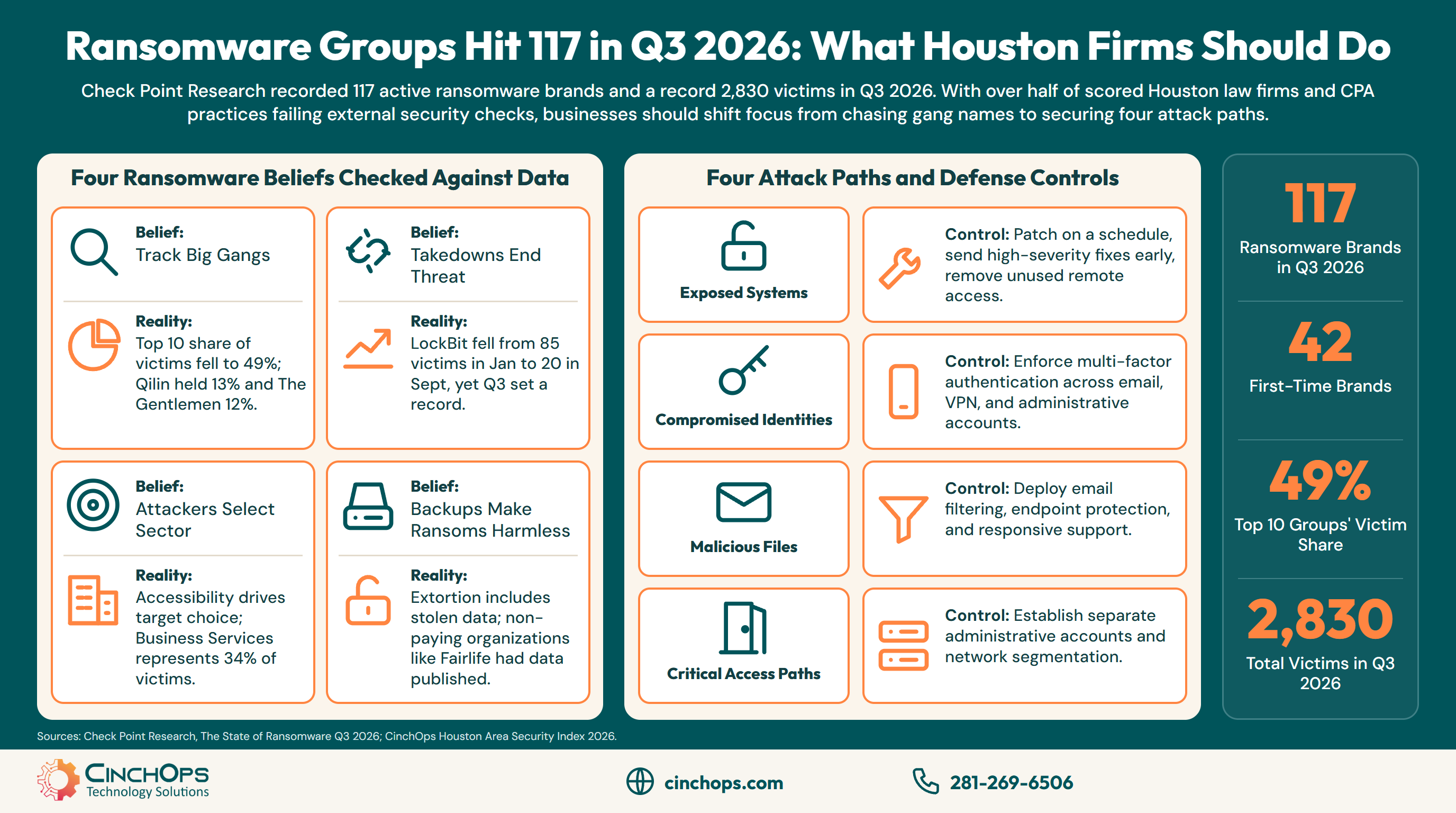
Knowing the top ransomware groups gives a Houston business little protection, because the top groups now account for less than half of attacks. Check Point Research found the ten most active groups claimed 49% of victims in Q3 2026, down from 71% in Q1 2026, the lowest share Check Point has recorded.
Qilin and The Gentlemen still lead. Qilin claimed 13% of Q3 2026 victims and The Gentlemen 12%, more than 700 victims between them and about 25% of published incidents. Below those two groups, the list churns. Fifty-one of the 117 ransomware brands active in Q3 had claimed no victim in Q2, and 42 of those made their first-ever claims. A group called Orova appeared in July, posted 35 victims in August and two in September.
The table below maps each of the four attack paths Check Point names to what it looks like inside a Houston office of 10 to 200 people and the control that closes it.
| Attack path named by Check Point | What it looks like at a 10 to 200 person firm | Control that closes it |
|---|---|---|
| Exposed systems | A firewall, VPN or remote desktop port that is reachable from the internet and behind on updates | Patching on a schedule, high-severity fixes sent early, unused remote access removed |
| Compromised identities | A reused or phished Microsoft 365 password on an account with no second factor | Multi-factor authentication on email, VPN and every admin account |
| Malicious files | An invoice attachment or download link opened on an office computer | Email filtering, endpoint protection, and a help desk that answers before the click |
| Access paths into critical environments | One shared admin login that reaches the file server, the accounting system and the backups | Separate admin accounts, network segmentation, and backup copies an attacker cannot alter |
Did LockBit's Decline and Police Takedowns Reduce Ransomware Attacks?
Belief 2: when police break up a big gang, attacks fall.
LockBit's decline and police takedowns did not reduce ransomware attacks in Q3 2026. The group posted fewer victims in each quarter of 2026 and fell out of Check Point's top ten, and authorities dismantled the KillSec operation, yet Q3 set a record with 2,830 victims, up from 2,051 in Q2.
When an international law enforcement action, Operation Cronos, disrupted LockBit in February 2024, it was the world's most deployed ransomware-as-a-service operation. The group later returned with LockBit 5.0. Check Point's monthly counts show the comeback fading through 2026, from 85 victims in January to 20 in September.
Check Point's explanation is that removing a major ransomware operation leaves its affiliates, stolen access and infrastructure in place, and that the activity can move to other established groups or new brands. Law enforcement stayed busy in Q3 2026. Operation KillSwitch, led by Spanish and German authorities with Europol coordination, took down KillSec with three arrests, and two alleged members of ShinyHunters were arrested in the Netherlands and Jordan. July and August 2026 still produced 964 and 1,042 victims, the two highest monthly totals of recent years in Check Point's data.
For a Houston business, a takedown headline is good news about one criminal group. The headline says nothing about whether the firm's own firewall is patched or its email accounts use multi-factor authentication.
Do Ransomware Groups Choose Victims by Industry?
Belief 3: attackers study industries and pick their targets.
Most ransomware groups do not choose victims by industry. Check Point Research found the industry mix barely moved in Q3 2026 even as dozens of new groups arrived, and concluded that which organizations are accessible and able to pay drives victim selection for most of the ransomware ecosystem.
Business Services led Check Point's Q3 2026 industry breakdown with 34% of victims, followed by Industrial Manufacturing and Consumer Goods & Services at 13% each. Check Point noted one exception to the opportunism: Silent Ransom Group targeted only Business Services organizations, professional and legal services in particular. The United States accounted for 42% of all victims, and Check Point observed that many smaller ransomware actors concentrate heavily on US organizations.
Houston's signature industry is a small slice of that chart. Energy & Utilities made up 1.9% of Q3 2026 victims and Construction & Engineering 0.4%. The law firms, accountants and consultants that serve Houston's energy companies fall in the 34% Business Services category.
The CinchOps Houston Area Security Index grades businesses on signals visible from outside the network. The Index scored 1,351 Houston-area law firms with 50.9% failing and 763 CPA practices with 55.5% failing. Check Point's finding that accessibility drives victim selection makes those failing grades the numbers to watch in Houston, Katy and Sugar Land: a firm that looks open from the internet matches the target the report describes.
Do Good Backups Make a Ransom Demand Harmless?
Belief 4: with backups in place, a ransom note is an inconvenience.
Good backups do not make a ransom demand harmless, because many ransomware attacks now include stolen data. Check Point's Q3 2026 report describes four large organizations that faced extortion demands and did not pay, and in at least two of those cases the attackers published the stolen data.
Stadler Rail rejected a 10 million Swiss franc ($12.3 million) demand from the Everest group in July 2026; no encryption was deployed and operations continued. The Berlin state government refused a 30 Bitcoin demand from Rhysida after the theft of about 5.8 TB of data, which the attackers later published. Manchester Airports Group reportedly rejected a demand after a breach attributed to FulcrumSec exposed data tied to about 8.7 million customers. Fairlife, a Coca-Cola subsidiary, disclosed an attack by Anubis with an alleged $15 million demand, and the group eventually published the data.
A restore from backup answers the encryption half of a ransomware attack. The data-theft half needs a plan made in advance: who calls the attorney and the cyber insurer, who speaks to clients, and what the firm's position on payment is. Check Point lists incident response, legal and regulatory processes, communications, business continuity and a predefined framework for extortion decisions as parts of a ransomware plan. Texas businesses also carry breach notification duties, covered in the CinchOps data breach reporting checklist for Texas small businesses.
It does not matter which ransomware group's name is on the ransom note. The fundamentals that protect a Houston business stay the same: patch your systems, turn on multi-factor authentication, limit admin access and keep backups an attacker cannot alter.
See How Your Business Looks From the Outside
Check Point found that accessible organizations become ransomware victims. CinchOps cybersecurity finds and closes the exposed systems, weak logins and open access paths at Houston-area businesses.
See CinchOps cybersecurity services →How CinchOps Helps Houston Businesses Defend Against Any Ransomware Group
CinchOps is a managed IT services provider based in Katy, Texas, serving small and mid-sized businesses across the Houston metro area. CinchOps specializes in cybersecurity, network security, managed IT support, VoIP, and SD-WAN for businesses with 10 to 200 employees.
Check Point's Q3 2026 guidance comes down to three jobs: reduce the opportunities attackers exploit, limit what an attacker can reach after a compromise, and prepare for extortion that involves stolen data. CinchOps does that work for Houston-area businesses as part of managed IT.
- Patch management is standard in CinchOps managed IT support: operating systems, third-party apps and firewall, switch and VPN firmware are patched monthly, and high-severity fixes go out ahead of the monthly cycle.
- CinchOps cybersecurity runs 24/7 threat monitoring, so a compromised login or a malicious file is caught outside office hours too.
- For recovery, business continuity and disaster recovery keeps immutable, verified backup copies offsite, covering laptops, servers, Microsoft 365 and Google Workspace.
- Firms in Houston, Katy and Sugar Land, including law firms, CPA firms and engineering firms, get help desk requests answered in under 15 minutes.
Check Point counted 117 ransomware brands in Q3 2026, and the count will change again next quarter. The four ways in change far more slowly. A Houston firm that patches on a schedule, turns on multi-factor authentication, limits admin reach and writes its payment policy ahead of time is prepared for whichever group shows up. To check where your firm stands, talk to CinchOps.
Frequently Asked Questions
How many ransomware groups were active in Q3 2026?
Check Point Research counted 117 distinct ransomware brands that posted at least one victim in Q3 2026, up from 91 in Q2. Fifty-one of those brands had claimed no victim the quarter before, and 42 made their first-ever claims. The ten most active groups accounted for 49% of the quarter's 2,830 victims.
Which ransomware group was most active in Q3 2026?
Qilin held first place for Q3 2026 with 13% of victims, and The Gentlemen followed at 12%, according to Check Point Research. Together the two groups claimed more than 700 victims, about 25% of published incidents. INC Ransom ranked third at 4.0%, and LockBit dropped out of the top ten.
Should a small business in Houston pay a ransomware demand?
Check Point's Q3 2026 report cites Coveware data showing fewer than 1 in 4 ransomware events ended in payment, and Coveware notes that an attacker's promise to delete stolen data cannot be verified. A Houston business should set its payment policy with its attorney and cyber insurer before an incident happens.
Why do Check Point and other trackers report different Q3 2026 ransomware totals?
Each tracker counts leak-site postings using its own sources and date rules. Check Point Research counted 2,830 victims in Q3 2026, while Bridewell counted 2,889 postings for the same quarter. Both figures cover only victims that attackers chose to publish, so the true number of attacks is higher than either total.
What does ransomware protection cost in Houston?
CinchOps prices managed IT and security for Houston-area businesses at a flat $100 to $250 per user per month, with no long-term contract. Patch management is standard in that rate, and backup and recovery are included in the top-tier plan. A 25-person office would pay between $2,500 and $6,250 a month.
Discover More
Resource
Sources


