


Texas Breach Reports: 99 in October 2026, What Houston Should Know
Texas Breach Notice Index: The October 2026 Update – The Texas Breach List Grew By 82 Reports In A Single Month
The Texas Breach Notice Index refreshed on October 31, 2026. What moved in a month, and how to read the page.
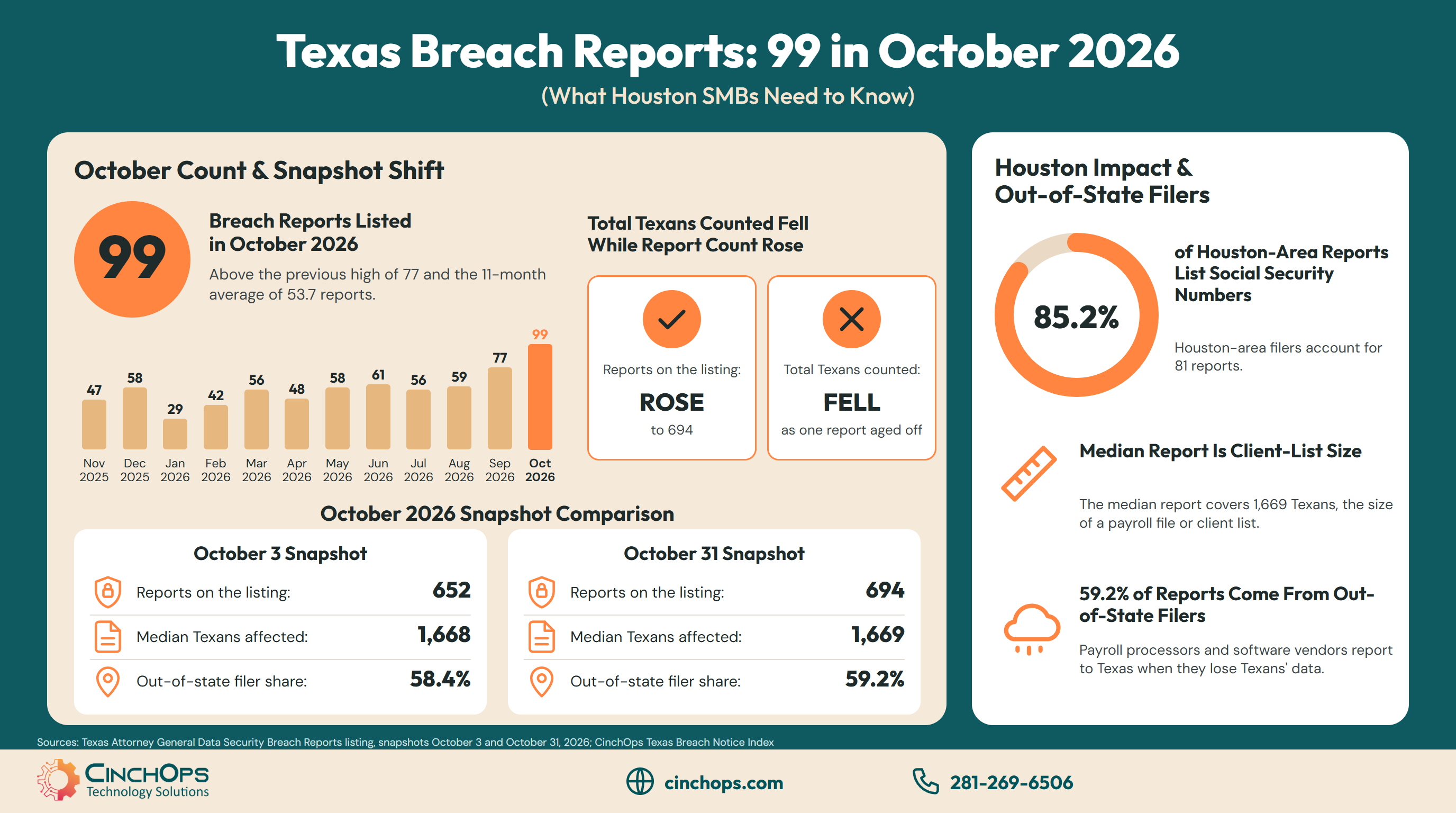
Texas breach reports reached 99 in October 2026, the highest single-month count on the Texas Attorney General's public listing. CinchOps took the second monthly snapshot of that listing on October 31, 2026 and rebuilt the Texas Breach Notice Index from it: 694 reports, a median of 1,669 Texans per report, and 81 filers with a Houston-area address.
The first edition, taken October 3, 2026, counted 652 reports. A month later the count is up 42, the oldest reports from October 2025 have aged off the list, and one very large filing left with them. The shape of a typical Texas breach did not move. It is still small, still built on Social Security numbers, and still mostly filed from outside the state.
This post covers what changed in the month and how to read the refreshed Texas Breach Notice Index page. The launch post, How Large Is a Typical Data Breach in Texas?, explains the first edition in full. The index publishes totals and shares only, and no listed organization is named or ranked.
October 2026 Was the Busiest Month on the Texas Breach Listing
The 99 reports the Texas Attorney General listed with an October date, and what they look like.
The Texas Attorney General listed 99 data breach reports dated October 1 through October 30, 2026. The previous high on the listing was 77 in September 2026, and the 11 full months from November 2025 through September 2026 averaged 53.7 reports a month.
The October reports look like the rest of the list. Their median is 1,771 Texans. Of the 99, 32 cover fewer than 1,000 people, 75 list Social Security numbers, and 65 came from filers outside Texas. Houston-area addresses appear on 11 of them. In 13 of them, consumers had not yet been notified when the report went up.
A month is counted by the date the Attorney General listed the report, which is the only date the listing shows. Section 521.053(j) gives the office 30 days to post each new notice, so a busy listing month can be a busy filing month in Austin as much as a busy breach month in Texas. One high month is not a trend. The listing only holds about a year, which is the reason CinchOps keeps a dated copy every month.
What Changed Between the October 3 and October 31 Snapshots
Row-by-row comparison of the two saved copies of the listing.
Between October 3, 2026 and October 31, 2026, 82 reports were added to the Texas listing and 40 were removed or revised, taking the count from 652 to 694. Of the 40 removed rows, 31 were dated October 2025, which is the first-anniversary removal that Section 521.053(j) requires.
The total number of Texans counted fell while the number of reports rose. On October 3, 2026 the 652 reports added up to 52,366,726 Texans. On October 31, 2026 the 694 reports add up to 44,264,036. The difference is one report covering 11,331,028 Texans that aged off the list. The 82 reports added in the month covered 3,537,866 Texans between them, and the largest of them covered 970,891.
The headline measures barely moved. The median report went from 1,668 to 1,669 Texans. The share under 1,000 Texans went from 39.3% to 38.2%. Social Security numbers went from 82.5% to 82.4% of reports. Out-of-state filers went from 58.4% to 59.2%. Houston-area filers stayed at 81, because 7 arrived and the same number left.
The 82 new reports had a median of 1,643 Texans. Of those, 29 covered fewer than 1,000, 18 covered 10,000 or more, 63 listed Social Security numbers, and 26 came from a Texas address. The listing states that details may change after a report is posted, so a row whose figures were corrected counts here as one removal and one addition.
The median is the durable number on this list and the total is the fragile one. Any month in which a multi-million-record report reaches its anniversary will cut the total by millions while the typical Texas breach stays exactly where it was.
How to Read the Refreshed Texas Breach Notice Index Page
A walk through the six sections of the index page and the three rules behind it.
The Texas Breach Notice Index at cinchops.com/texas-breach-notice-index is a standing page, refreshed monthly, that turns the Attorney General's listing into the totals the listing itself does not publish: reports per month, breach size, the data types exposed, notice status and methods, and where the filers are.
The page opens with the listing at a glance: 6 headline cards, a chart of reports listed each month, and a chart of breach size in 3 bands. Key Findings follows with 6 figures and one sentence of context each. The exposed-data section shows the share of reports listing each data type and each notice method.
Where the Filers Are carries the Texas, out-of-state and Houston-area shares, the states that file the most Texas reports, and a map of the United States shaded by filings. The Houston section matches 3 figures from the listing to the CinchOps service that answers each, next to the free security score form. The page closes with 8 FAQ answers and a methodology block that lists sources, snapshot checks, known limits and a dated revisions line.
Three rules govern the page. Aggregates only, so no organization is named or ranked. Every figure, chart and sentence is generated by script from the saved snapshot, so a refresh updates all of them together. Each edition is dated, and any correction to a published figure is named in the revisions line with its prior value. The October 2026 edition is the first entry on that line after the launch.
What the October Listing Means for a Houston Business
Houston-area filers, out-of-state filers, and the vendor question both point to.
Houston-area filers, meaning a Texas ZIP code starting 770 through 775, account for 81 of the 694 reports on the October 31, 2026 listing, 28.6% of all Texas-based filers. Their median report covers 1,957 Texans, 29 of the 81 cover fewer than 1,000, and 85.2% list Social Security numbers.
A 770 ZIP code, which covers the city of Houston itself, appears on 47 of the 81. Another 18 cover 10,000 Texans or more, and in 9 of the 81 consumers had not been notified when the report was listed. A Houston law firm, CPA practice or construction company that pictures its own exposure should look at the 1,957 figure, which is the size of a client list or a few years of payroll files.
Most filers are not in Texas at all. Out-of-state filers account for 411 reports (59.2%), from organizations in 44 other states and the District of Columbia, led by California with 53, New York with 33 and Florida with 29. The Texas rule follows the residents, so the payroll processor, benefits administrator or software vendor that holds a Katy company's employee records reports to Austin when it loses them.
For a business in Katy, Sugar Land or The Woodlands, that makes the vendor list part of breach prevention. The question to ask each vendor is plain: which of our records do you hold, where do they sit, and who else has a copy. Most of the Texas list is someone else's vendor.
Ninety-nine new reports in October, and the typical one is about the size of a Katy business and its customers, not a hospital system. That is who this list is really about. CinchOps exists so a 40-person company gets the patching, MFA, backups and monitoring a 4,000-person company takes for granted.
If a Breach Has Already Happened
Texas gives an organization 30 days to notify the Attorney General and 60 days to notify the people affected. CinchOps runs breach response for Houston businesses, from containment through the evidence an attorney and a cyber insurer will ask for.
See how CinchOps handles breach response →How CinchOps Can Help a Houston Business Stay Off the Texas Breach List
CinchOps is a managed IT services provider based in Katy, Texas, serving small and mid-sized businesses across the Houston metro area. CinchOps specializes in cybersecurity, network security, managed IT support, VoIP, and SD-WAN for businesses with 10 to 200 employees.
- Through cybersecurity services, CinchOps runs 24/7 threat monitoring on the accounts and devices that hold Social Security numbers, medical records and financial data.
- With managed IT support, help desk requests are answered in under 15 minutes, so a suspicious email gets a real answer before someone clicks it.
- In a breach response engagement, CinchOps works the technical side of an incident while the owner, the attorney and the insurer handle the notices.
- Through business continuity and disaster recovery, backup copies are immutable and stored offsite, which keeps a ransomware incident from also becoming a data-loss incident.
- CinchOps serves Houston, Katy, Sugar Land and The Woodlands, with industry programs for law firms, CPA firms and construction companies.
The October 2026 listing added 82 reports and the typical one still covers fewer than 2,000 Texans, the size of the records an ordinary Houston employer keeps. CinchOps prices the work that keeps a business off that list at a flat $100 to $250 per user per month, on Zero-Zero-Zero terms: no long-term contracts, no hidden fees and no cancellation penalties. An owner who wants to know where the company's Social Security numbers and client records actually sit, and which vendors hold a copy, can talk to CinchOps.
Frequently Asked Questions
What changed in the Texas Breach Notice Index in October 2026?
Between October 3, 2026 and October 31, 2026, 82 reports were added to the Texas Attorney General's listing and 40 were removed or revised, taking the count from 652 to 694. The median report moved from 1,668 to 1,669 Texans, and the share listing Social Security numbers went from 82.5% to 82.4%.
How many data breach reports did Texas list in October 2026?
The Texas Attorney General listed 99 data breach reports dated October 1 through October 30, 2026, the most of any month on the listing. The previous high was 77 in September 2026, and the 11 full months from November 2025 through September 2026 averaged 53.7 reports a month.
Why did the total number of Texans affected fall while the number of reports rose?
The total fell from 52,366,726 to 44,264,036 because a single report covering 11,331,028 Texans reached its first anniversary and left the listing, as Section 521.053(j) requires. The 82 reports added in the month covered 3,537,866 Texans between them, with a median of 1,643.
How many Houston-area organizations are on the Texas breach list?
On the October 31, 2026 listing, 81 of the 694 reports came from filers with a Houston-area address, defined as a Texas ZIP code starting 770 through 775. That is 28.6% of all Texas-based filers. A 770 ZIP code appears on 47 of them, the median Houston-area report covers 1,957 Texans, and 85.2% list Social Security numbers.
How often is the Texas Breach Notice Index updated?
Monthly. The Attorney General's listing keeps no history and removes reports after about a year, so CinchOps saves a dated copy of the full listing each month and regenerates every figure, chart and statement on the index page from it. The October 2026 edition uses the October 31, 2026 snapshot, the second since the index launched.
What does cybersecurity to prevent a data breach cost in Houston?
CinchOps prices managed IT and cybersecurity for Houston-area businesses at a flat $100 to $250 per user per month, with 24/7 threat monitoring. The CinchOps model is Zero-Zero-Zero: no long-term contracts, no hidden fees and no cancellation penalties. A 25-person office would pay between $2,500 and $6,250 a month.
Does the Texas breach list show every data breach in Texas?
No. The Texas Attorney General's listing covers only breaches reported under Section 521.053(i), which applies at 250 or more Texas residents. Smaller breaches still require notice to the affected people but are not reported to the Attorney General. The listing still shows 21 reports with fewer than 250 Texans, and the index counts them as listed.
Discover More
Resource
Sources
- CinchOps Texas Breach Notice Index - the standing index page, October 2026 edition
- Office of the Texas Attorney General, Data Security Breach Reports - public listing, 694 reports, snapshot taken October 31, 2026; prior snapshot of 652 reports taken October 3, 2026
- Texas Business and Commerce Code, Chapter 521, Section 521.053(i) and (j) - reporting threshold, deadline and public listing rules
- Office of the Texas Attorney General, Data Breach Reporting - reporting form and instructions


