


Texas Port Cyberattacks: Five Steps for Houston Businesses
Thousands Of Hacking Attempts A Day Are Hitting America’s Biggest Oil Export Port – Three Texas Ports Appear In The 2026 Cyberattack Reports
Five Steps for Houston Businesses
Texas ports report thousands of hacking attempts a day. Five steps for Houston firms that email, ship through or log in to them.
Texas port cyberattacks moved from a federal briefing topic to front-page news on November 22, 2026. Kent Britton, chief executive of the Port of Corpus Christi, told the Financial Times the port faces "hundreds if not thousands" of attempted cyberattacks every day, according to Newsweek and The Hill.
Corpus Christi is the largest crude oil export hub in the United States and handles about 2.3 million barrels of crude exports a day. Newsweek reports that attackers probed the port's networks and sent fraudulent emails impersonating senior executives to trick employees into granting access. Britton did not name the attackers. None of the reports describes a successful breach at the port.
If your Houston company is a freight forwarder, customs broker, trucking firm, ship agent or energy services supplier, the port is a customer, a landlord or a login. The same people probing the port can reach it through you. This post turns the reports into five steps a business with 10 to 200 employees can finish this quarter.
CinchOps provides phishing protection and 24/7 threat monitoring specifically for Houston logistics, energy services and oil and gas companies with 10 to 200 employees, at a flat $100 to $250 per user per month.
Start With What Texas Ports Have Actually Reported
Three Texas ports appear in the reporting. Four more sit in the US top 20 by tonnage.
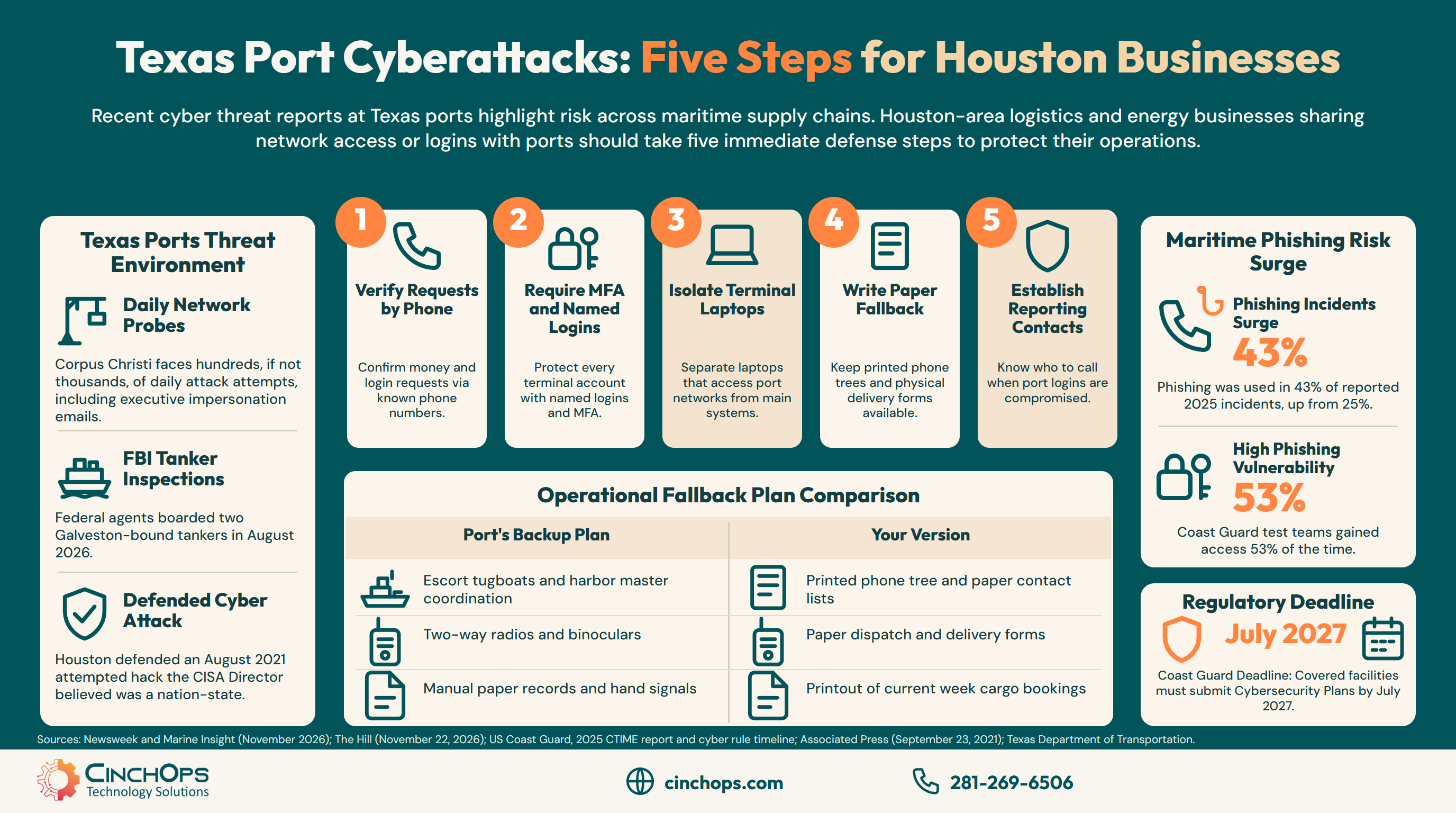
Three Texas ports appear in the cyberattack reporting. Corpus Christi faces hundreds, if not thousands, of attempts a day. Two tankers bound for Galveston were boarded by federal investigators in August 2026. The Port of Houston defended an attempted hack in August 2021. No report names an incident at Beaumont, Port Arthur, Freeport or Texas City.
The Galveston case is the closest to home. Newsweek reports that two foreign-flagged tankers carrying crude oil and liquefied petroleum gas from the Mediterranean had their networks reportedly compromised near the Strait of Gibraltar. FBI and Coast Guard investigators boarded the ships in the Gulf of Mexico on August 21 and 24, 2026 to examine their computer systems. No suspects have been publicly identified, and authorities reported no physical damage or danger to the crews.
Houston has been here before. CISA Director Jen Easterly told a Senate committee on September 23, 2021 that the Port of Houston had been the target of an attempted hack that August, and said she believed a nation-state actor was behind it, the Associated Press reported. The attack involved ManageEngine ADSelfService Plus, a password management program. The port said it defended against the attempt and that no operational data or systems were affected.
Those 200-plus private terminals are why this matters to a small business. Each one has vendors, contractors, truckers and brokers with email threads and logins of their own. Silence about Port Arthur or Freeport in a news story is not evidence that nobody is probing them. Corpus Christi's chief executive simply said out loud what a port sees on a normal day.
The volume numbers need one caution. The Port of Los Angeles reported blocking 120 million attempted attacks in August 2026, nearly twice its monthly average in 2023. Newsweek notes that ports may count suspicious activity differently, so the Los Angeles and Corpus Christi figures are not directly comparable. Most of that traffic is automated.
Verify Every Money and Access Request by Phone
Step 1. The attack on the port was an email pretending to be the boss.
Executive impersonation is the attack the Port of Corpus Christi described: fraudulent emails posing as senior executives, sent to trick employees into granting access. The fix for a Houston business is a standing rule that any request for money, a password or a new login gets confirmed by phone, using a number already on file.
The Coast Guard's numbers say this is the main way in. Newsweek, citing the Coast Guard's annual cybersecurity report, says the service responded to 42 reported maritime cyber incidents in 2025, up from 36 in 2024. Phishing was used for reconnaissance or initial access in 43% of those incidents, compared with 25% the year before.
Coast Guard Cyber Command's own test teams found the same weakness from the other side. In its 2025 missions, those teams got into an operator's system 53% of the time with a simple phishing attack. The Coast Guard report also describes a scammer who impersonated a maritime company's CEO by email and stole nearly $50,000 with a fake invoice.
One more case from the report shows how a small firm becomes the weapon. Nine employees at a maritime organization had their accounts compromised after clicking a malicious link and entering their login details. The attackers then used those accounts to send thousands of fraudulent emails to the organization's customers. A broker or trucking firm in that position is the one phishing the port.
- Call back on a known number before changing bank details, paying a new invoice or granting access.
- Tell staff in writing that no executive will ever ask for a password or a gift card by email or text.
- Give employees one place to report a suspicious message, and answer them fast.
Protect and Separate the Logins That Reach a Port
Steps 2 and 3. A stolen password to a terminal portal is the port's problem and yours.
A port-facing login is any account your staff use to reach a port or terminal system: a gate appointment portal, a cargo tracking site, a customs filing tool or a remote connection. Protect each one with a named account and multi-factor authentication (MFA), and reach terminal systems from a laptop kept apart from everyday email and browsing.
Stolen logins are what the automated traffic is after. Marine Insight reports that many of the 120 million attempts at the Port of Los Angeles were automated bids to steal login details and plant malware. The Coast Guard's advice to maritime operators is plain: restrict public-facing login portals and properly segment networks, because both cut the attack surface.
- List every port, terminal and carrier login your company holds, and who uses each one.
- Replace shared passwords with one named account per person, and turn on MFA wherever the portal offers it.
- Remove access the day an employee leaves.
- Use one dedicated laptop, or a separate network segment, for systems that connect into a terminal.
Write the Manual Plan and Know Who to Call
Steps 4 and 5. The port has a paper plan. Most of its vendors do not.
A manual fallback plan is a written way to keep working when computers are down. The Port of Corpus Christi has one: tugboats would escort ships through sections of the channel while the harbor master's office coordinates with two-way radios, binoculars, paper records and hand signals. A Houston vendor needs the office-sized version.
The plan has already been tested elsewhere. A cyberattack on North Carolina Ports in August 2026 delayed gate openings and forced staff to process cargo manually. The port said an outside actor was responsible and that the incident was contained the following day. If a Texas terminal switches to manual gates for a day, every trucker and broker booked into it works from paper too.
For a 25-person firm, the paper version is a printed phone tree, carrier and customer numbers on paper, paper dispatch and delivery forms, and a printout of this week's bookings. Keep it somewhere that does not need a login. Corpus Christi had no dedicated cybersecurity employees four years ago and is now recruiting its fourth, Newsweek reports. A small business will not hire four specialists, which makes the written plan worth more.
Step 5 is knowing the Coast Guard's calendar, because your port-side customers are working to it. The Coast Guard's cybersecurity rule took effect July 16, 2025 for US-flagged vessels, Outer Continental Shelf facilities and facilities regulated under the Maritime Transportation Security Act.
- Since July 16, 2025, covered operators must report cyber incidents to the National Response Center.
- By January 12, 2026, and every year after, all of their personnel must complete cybersecurity training.
- By July 16, 2027, they must name a Cybersecurity Officer, complete a Cybersecurity Assessment and submit a Cybersecurity Plan for approval.
The rule does not apply to a freight forwarder or a supplier directly. CinchOps' reading is that a terminal writing a Cybersecurity Plan for a July 2027 deadline will ask its vendors how they protect the accounts that connect to it. Have the answer written down: who to call at the terminal, who your IT contact is, and what you report when an account is compromised.
Does your company hold a login to a port or terminal?
CinchOps will list your port-facing accounts, show which ones lack MFA and help you write the paper fallback plan.
Talk to CinchOpsThe Port of Corpus Christi has tugboats, radios and paper logs ready for the day its network goes down. Most of the small companies that work with Texas ports have nothing written at all. Print the phone list, put MFA on every port login, and make it a rule that nobody moves money on the strength of an email.
Would your staff spot a fake email from the boss?
CinchOps phishing protection and training filters impersonation emails, trains employees and gives them a help desk that answers in under 15 minutes.
See CinchOps phishing protection →How CinchOps Secures Houston Businesses That Work With Texas Ports
CinchOps is a managed IT services provider based in Katy, Texas, serving small and mid-sized businesses across the Houston metro area. CinchOps specializes in cybersecurity, network security, managed IT support, VoIP, and SD-WAN for businesses with 10 to 200 employees.
For the logistics, energy services and industrial companies that work around the Houston Ship Channel and the Texas coast, CinchOps handles the vendor side of the port connection: the email, laptops and accounts your staff use to reach a port, a terminal or a carrier.
- CinchOps phishing protection filters executive impersonation emails and trains staff to call back before they pay or grant access.
- CinchOps cybersecurity services put MFA and named accounts on email and port-facing logins, with 24/7 threat monitoring on laptops and servers.
- With business continuity and disaster recovery, CinchOps keeps verified, immutable offsite backups outside the Gulf Coast flood zone and helps write the manual fallback plan.
- Through managed IT support, employees reach a help desk that answers in under 15 minutes when a message looks wrong.
- CinchOps works with oil and gas companies, energy services and utilities contractors and manufacturers across Houston, Katy and Sugar Land, on a flat per-user rate with no long-term contracts, no hidden fees and no cancellation penalties.
Texas ports are being probed every day, and the companies that email and log in to them are part of the same target. The five steps here cost little and none of them needs new hardware. If your company holds a port or terminal login and nobody can say who else knows the password, talk to CinchOps.
Frequently Asked Questions
Was the Port of Corpus Christi hacked?
No successful breach has been reported. Port of Corpus Christi chief executive Kent Britton told the Financial Times the port faces "hundreds if not thousands" of attempted cyberattacks a day, including network probing and emails impersonating senior executives. The reporting from Newsweek, The Hill and Marine Insight in November 2026 describes attempts, not a breach.
Has the Port of Houston been hit by a cyberattack?
The Port of Houston defended an attempted hack in August 2021. CISA Director Jen Easterly disclosed it to a Senate committee on September 23, 2021 and said she believed a nation-state actor was responsible, the Associated Press reported. The port said no operational data or systems were affected. The November 2026 reports name no new Houston incident.
Which Texas ports are named in the cyberattack reports?
Three. Corpus Christi reports hundreds, if not thousands, of attempts a day. Two tankers bound for Galveston were boarded by the FBI and Coast Guard on August 21 and 24, 2026. Houston defended an attempted hack in 2021. No report names an incident at Beaumont, Port Arthur, Freeport or Texas City, which are all US top-20 ports by tonnage.
Does the Coast Guard cybersecurity rule apply to my Houston business?
The rule applies to US-flagged vessels, Outer Continental Shelf facilities and facilities regulated under the Maritime Transportation Security Act. A freight forwarder, broker or supplier is not covered directly. Covered operators must submit a Cybersecurity Plan by July 16, 2027, so a Houston vendor with access to a terminal should expect questions about its own logins.
What cybersecurity does a Houston oil and gas company need?
A Houston oil and gas company that works with a port or terminal needs four things first: phone verification for money and access requests, MFA and named accounts on every port-facing login, a separate laptop or network segment for terminal systems, and a written manual fallback plan. Monitoring and verified backups come next.
What does cybersecurity for a Houston logistics or energy company cost?
Managed IT and cybersecurity for a Houston logistics or energy services company commonly runs $100 to $250 per user per month. The published CinchOps rate is $100 to $250 per user per month, flat, with no long-term contracts, no hidden fees and no cancellation penalties. Phishing protection, MFA setup and monitoring are scoped within that per-user rate.
Discover More
Resource
Sources
- Newsweek, Chris Matthews, "Cyber Attacks Bombard US Ports With 'Thousands' of Hacks" (November 2026)
- Marine Insight, Antara Mallick, "US Port Blocks 120 Million Hacking Attempts In A Month As Cyberattacks On American Ports Surge" (November 23, 2026)
- The Hill, Mira Bhakta, "US ports face onslaught of cyber attacks" (November 22, 2026)
- CNBC-TV18, "US Ports Under Cyber Siege | Hackers Target Corpus Christi" (video)
- US Coast Guard, MyCG, "High-tech boardings and old-school threats: Inside the 2025 CTIME report" (June 15, 2026)
- US Coast Guard, Maritime Commons, "Final Rule: Cybersecurity in the Marine Transportation System - Implementation Timeline" (July 16, 2025)
- Associated Press, Alan Suderman, "Port of Houston target of suspected nation-state hack" (September 23, 2021)
- Texas Department of Transportation, Texas maritime ports
- Port Houston, Statistics

