


OT Security Checklist: Could Your Houston Plant Survive a 48-Hour Control Outage?
OT Security Steps For Houston Manufacturers – 72% Of Industrial Cyber Incidents Stopped Operations
Could Your Houston Plant Survive a 48-Hour Control Outage?
One in three industrial firms SANS surveyed had an OT incident in 2026. Ten checks to see if your plant could keep running.
An OT security checklist is a short list of yes-or-no checks that tells a plant owner whether operations would survive a cyber incident. The SANS 2026 State of ICS/OT Security Survey, published in November 2026, says one in three industrial organizations needed one this year: 34% of respondents had an incident in their control systems.
SANS calls it the largest single-year jump in the survey's history, and 72% of those incidents brought facility or system downtime. Nearly 700 industrial security professionals answered, and SANS notes they skew toward organizations already spending on OT security, so the real numbers are likely worse.
A Houston machine shop, fabricator or oil and gas service yard with 40 people rarely has an OT security team. CinchOps provides managed IT and cybersecurity specifically for Houston manufacturers and industrial firms with 10 to 200 employees, including IT/OT segmentation at the boundary between the shop floor and the office network. The ten checks below are built from the SANS benchmarks for that size of plant.
Could Your Plant Keep Running Without the Network?
Checks 1 to 3: the drill, the people in it and where the plan lives.
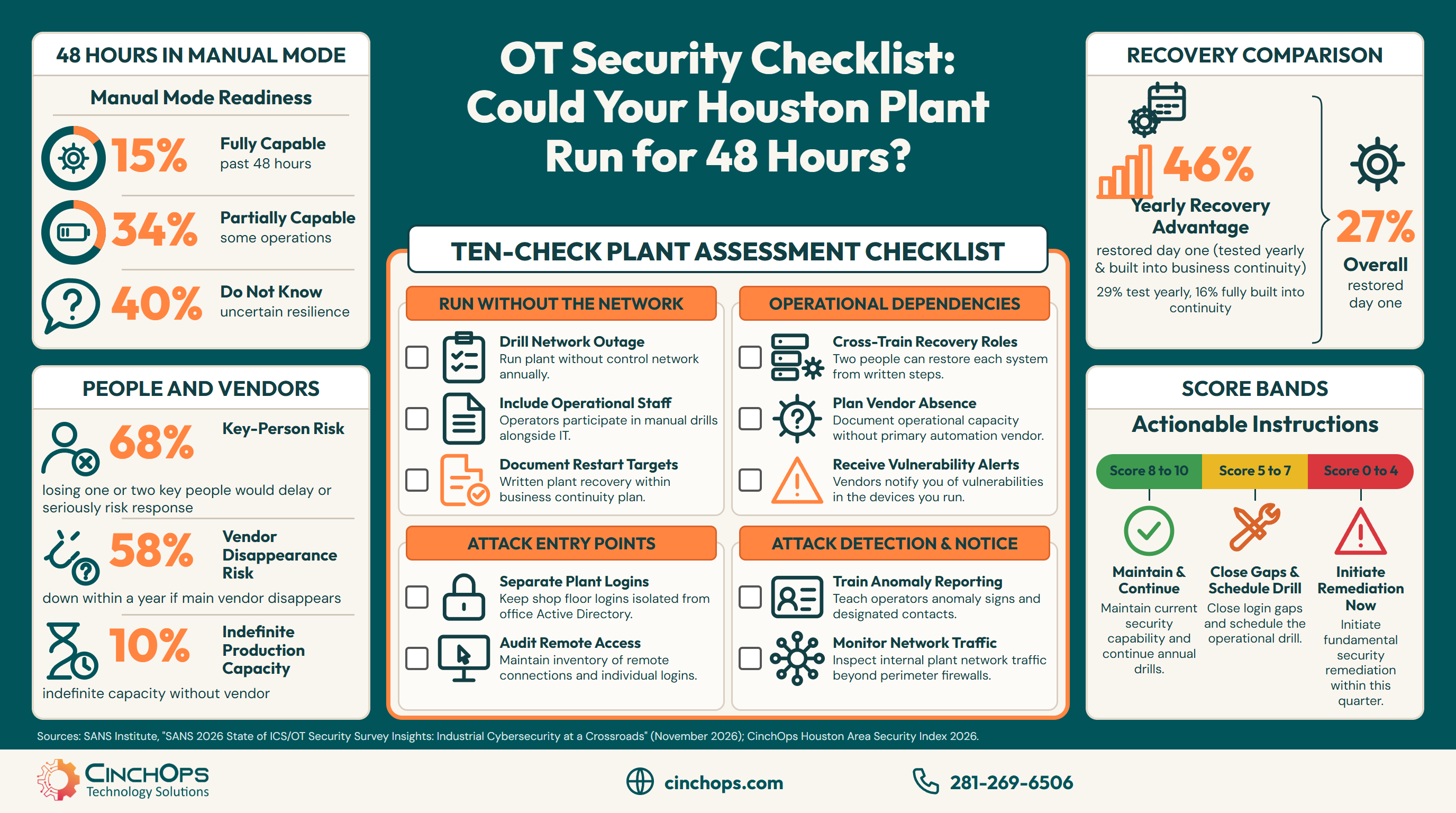
Most industrial organizations cannot say for sure. The SANS 2026 survey found only 15% are fully capable of running critical processes in manual mode, without centralized SCADA or DCS control, for more than 48 hours. Another 34% are partially capable, 40% do not know, and the remaining 11% gave other answers.
The 40% matters most. SANS writes that an untested assumption is not a capability, and the plants that test do better: organizations that test their plans at least once a year and fully build OT recovery into business continuity brought their most critical system back within the first day 46% of the time, against 27% of all respondents.
Few plants do both. Only 29% of respondents test at least once a year, and only 16% have fully built OT into business continuity planning. The leaders SANS surveyed separately expect production to keep going, yet frontline operators are required in only 58% of their drills.
- Check 1. In the last 12 months, the plant has run without the control network on purpose, for at least one shift.
- Check 2. The operators who would run manual mode take part in that drill, not just IT.
- Check 3. Plant recovery is written into the business continuity plan, with a target restart time for each critical system.
For how to run the drill itself, see how to run a cybersecurity tabletop exercise.
Who and What Does Your Plant Depend On?
Checks 4 to 6: key people, the automation vendor and vendor warnings.
Most plants depend on a few people and one automation vendor. In the SANS 2026 survey, 68% said losing one or two key people would delay or seriously risk OT security and incident response, and 58% would shut down or be unable to operate within a year if their main automation vendor disappeared.
Only 5% of respondents reported no reliance on a few key people, and only 10% could keep producing indefinitely without their main vendor. Moving to another vendor's system is slow: 42% said it would take one to three years.
Small plants feel this harder. The person who knows the PLC programs is often one controls technician or an outside integrator who comes in twice a year. SANS also found only 20% of respondents run a fully functional supply chain cyber risk program, and 33% of the rest do not get vulnerability notices from their vendors.
- Check 4. At least two people can restore each critical system, and the steps are written down where both can find them.
- Check 5. You know what happens, and for how long you can produce, if your main automation vendor or integrator disappears.
- Check 6. Your vendors notify you of vulnerabilities in the controllers, software and devices you run.
For the office-side version of check 4, see key-person risk in Houston IT, and for vendor questions, see third-party vendor risk.
How Do Attackers Get Into a Plant?
Checks 7 and 8: logins shared with the office and remote access nobody listed.
Shared logins are now as common a way in as ransomware. In the SANS 2026 survey, compromise of credentials or identity shared between IT and OT, such as Active Directory, appeared in 31% of incidents, tied with ransomware. Firewall or edge device exploitation appeared in 24% and outside unauthorized access in 23%.
A shared login is what lets an attacker who phished the front office walk onto the plant network. Small plants often run one Active Directory domain for everyone because it was the simplest setup when the shop was smaller.
The outside of Houston plants is not in good shape either. CinchOps' Houston Area Security Index scored the external attack surface of 955 Houston-area manufacturers: they averaged a 1.57 GPA, and 46.6% failed. Engineering firms did worse, with 52.4% of 676 failing. The full results are on the Houston Area Security Scorecard.
- Check 7. Plant logins are separate from office Active Directory logins, and no one uses the same password in both.
- Check 8. Every remote access path into the plant, including vendor and integrator connections, is listed, and each person has a unique login.
Would You Notice an Attack on the Plant Floor?
Checks 9 and 10: operators who know the signs and someone watching plant traffic.
Detection got slower in 2026 for the first time SANS has tracked it. Only 41% of incidents were detected within 24 hours, down from more than half in each year since 2024. Purpose-built ICS/OT monitoring found 38% of incidents, office perimeter tools 31% and operators 20%.
Only 13% of respondents have full visibility across IT and OT, and 56% are unsure how an anomaly in their environment would be detected. Budget is the top barrier to expanding plant monitoring, named by 43%.
Operators are the cheapest sensor a small plant has. Among organizations where operators help spot anomalies, 58% have formally trained them. A trained operator who reports a valve acting wrong to the right person is part of incident response.
- Check 9. Operators know what "something is wrong" looks like on their equipment and who to call, day or night.
- Check 10. Someone watches traffic on the plant network itself, not only the office firewall.
Forty percent of the industrial firms SANS surveyed don't know if they could run two days without their control system. Put that next to the 34% who already had an incident, with 72% of those stopping operations, and not knowing gets expensive. Run the drill on a slow shift and get the answer from your own people first.
Want the plant recovery plan written and tested?
CinchOps business continuity and disaster recovery covers the office and the shop floor, with verified, immutable backups and a written restart order for each critical system.
See CinchOps business continuity →How CinchOps Can Help Houston Plants Pass the Checklist
CinchOps is a managed IT services provider based in Katy, Texas, serving small and mid-sized businesses across the Houston metro area. CinchOps specializes in cybersecurity, network security, managed IT support, VoIP, and SD-WAN for businesses with 10 to 200 employees.
Count the checks you can tick today. The score sets where to start.
- CinchOps cybersecurity services separate plant logins from office logins, segment the shop floor from the office network and add 24/7 threat monitoring.
- With business continuity and disaster recovery, CinchOps writes the restart order for each critical system and keeps verified, immutable backups of the systems that run the plant.
- Through vCIO services, CinchOps sets up the yearly drill, documents what the key people know and reviews automation vendors before renewal.
- Through managed IT support, operators and office staff reach a help desk that answers in under 15 minutes.
- CinchOps works with manufacturers, oil and gas companies, engineering firms and energy services and utilities across Houston, Katy and Cypress.
SANS says acting on its findings does not take a new framework, and a small plant does not need one either. It needs a drill, separate logins, a second person who knows the systems and someone watching the plant network. If your score was under eight, talk to CinchOps about closing the gaps this quarter.
Frequently Asked Questions
What did the SANS 2026 ICS/OT security survey find?
The SANS 2026 State of ICS/OT Security Survey found 34% of respondents had an incident in their control systems, the largest single-year jump in the survey's history, and 72% of incidents caused downtime. Detection slowed for the first time, and only 15% are sure they could run in manual mode past 48 hours.
What should an OT security checklist for a small plant cover?
A small-plant OT security checklist should cover four things: whether the plant can run without its control network, which people and vendors it depends on, how attackers could get in through shared logins or remote access, and who would notice an attack. The ten checks in this post cover all four.
How do we test manual operations without risking production?
Pick a planned slow shift, agree on a stop point in advance and have the operators who would run manual mode do it while engineers watch. Start with one line or one system. SANS found plants that test at least once a year and build OT into business continuity recover faster.
Why are shared office and plant logins a risk?
A shared login lets an attacker who compromises an office account reach plant systems with the same credentials. The SANS 2026 survey found shared IT/OT credential or identity compromise, such as Active Directory, in 31% of incidents, tied with ransomware as the most common incident type.
What if our automation vendor or integrator went out of business?
Most plants would struggle. SANS found 58% of respondents would shut down or be unable to operate within a year, and only 10% could keep producing indefinitely. Keep copies of PLC programs, licenses and network drawings you control, and know which spare parts are hard to get.
What does OT security cost for a Houston plant?
Managed IT and cybersecurity in Houston commonly runs $100 to $250 per user per month. The published CinchOps rate is $100 to $250 per user per month, flat and month-to-month, with no long-term contracts, hidden fees or cancellation penalties. Plant segmentation, monitoring and recovery planning are part of that managed service.
Discover More
Resource
Sources
- SANS Institute, "SANS 2026 State of ICS/OT Security Survey Insights: Industrial Cybersecurity at a Crossroads," Jason Christopher (November 2026)
- SANS Institute, "34% of Industrial Organizations Suffered a Cyber Incident, and 72% of Those Incidents Disrupted Operations, New SANS Institute Survey Finds" (press release, November 10, 2026)
- CinchOps, Houston Area Security Index 2026 (industry results updated September 25, 2026)


