


Embedded Device Vulnerabilities: Houston Offices Can’t Patch Them All
Embedded Device Security For Houston Engineering And Energy Firms – What Forescout’s AI Research Means For Houston Offices
Houston Offices Can't Patch Them All
Forescout's AI found 99 flaws in the networking code inside devices in 90 hours. Here is what Houston offices should do about it.
Embedded device vulnerabilities just got cheaper to find. Forescout's research team reported on November 12, 2026 that an AI pipeline built on generally available Claude models found 99 vulnerabilities in the networking code of embedded devices in about 90 hours, and 66 of them had never been found before.
If you run an office in Houston, that networking code is probably on your network right now. A TCP/IP stack is the small piece of software that lets a device talk on a network, and it ships inside access points, building controllers, medical equipment, industrial controllers and other connected gear. When the stack has a flaw, every product built on it inherits the flaw.
Forescout rates 52% of the new vulnerabilities critical or high severity. The researchers also say plainly that end users can no longer rely on patching alone. CinchOps provides network security specifically for Houston and Katy businesses with 10 to 200 employees, including IT/OT segmentation at the boundary between the shop floor and the corporate network.
AI Cut a Nine-Month Bug Hunt to 90 Hours
The same work Forescout did by hand in 2020 now takes days and under $1,000 of AI static analysis.
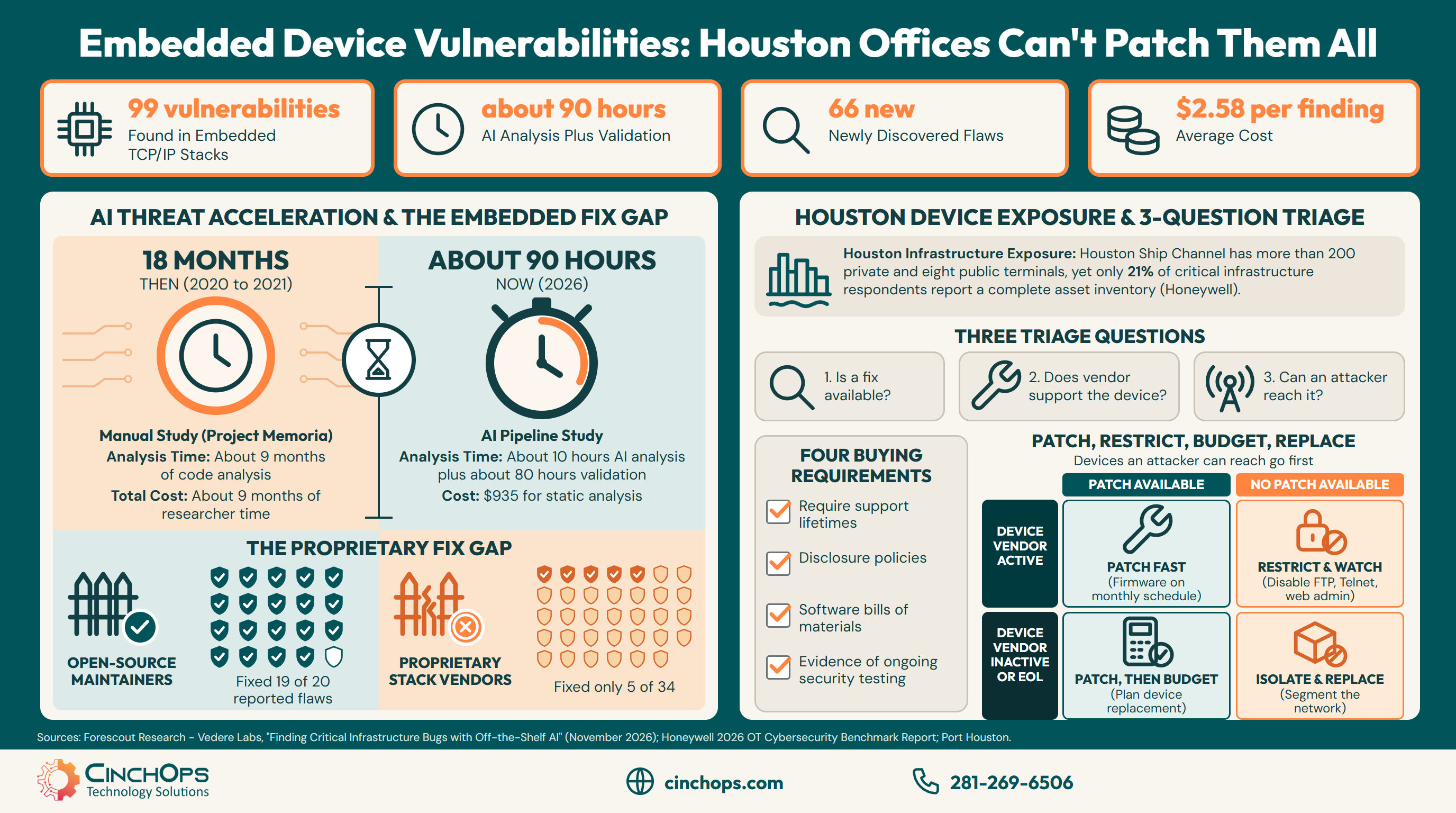
Forescout's AI pipeline repeated a nine-month manual code review in about 90 hours. Project Memoria, the team's 2020 to 2021 study of embedded TCP/IP stacks, took 18 months and found almost 100 CVEs. The 2026 rerun spent $935 on AI static analysis, an average of $2.58 per finding.
The comparison below sets the 2020 to 2021 manual study against the 2026 AI-assisted rerun, using Forescout's own figures.
| Measure | Project Memoria (2020 to 2021) | AI pipeline study (2026) |
|---|---|---|
| Approach | Manual analysis with traditional tools | AI pipeline supervised by researchers |
| Stacks analyzed | 14 across five phases | 10 in a single phase |
| Vulnerabilities | 71 in the stacks re-analyzed | 99: 33 rediscovered, 66 new |
| Time | About 9 months of code analysis | About 10 hours of AI analysis plus about 80 hours of validation |
| Cost | About 9 months of researcher time | $935 for static analysis; $1,200 to $2,300 total model spend |
Forescout estimates the model spend was likely 100 times less than the cost of a senior researcher doing the same review by hand. That math works for attackers too. The report's point is that once anyone has a working setup, finding this kind of flaw becomes quick and cheap, whether the person running it is defending a network or attacking one.
The AI did not work alone. Scanners flagged 362 suspicious spots, the pipeline cut them to 312 unique candidates, and AI reasoning plus live proof-of-concept tests confirmed 99. Per-stack precision ran from 11% to 70%. The pipeline was strongest on memory-safety bugs in packet parsing and weakest on logic and design flaws.
Closed devices were harder but still fell. Forescout says static analysis of binary firmware, with no source code, cost about six times as much and took about twice as long as analyzing source code. All four binary-only stacks still produced new flaws, from 5 in Nucleus NET to 12 in S3, a stack Forescout cannot name while disclosure is ongoing.
The Flawed Code Sits Inside Office and Building Devices
These bugs live in the gear nobody logs into, and many of those devices will never get a fix.
The vulnerable TCP/IP stacks sit inside devices used in operational technology, medical equipment, network equipment and IoT, according to Forescout. Its earlier Project Memoria work traced shared stack flaws to more than 100 products from dozens of vendors, and the fix rate for the new flaws depends on who owns the code.
Forescout says Siemens was the first vendor to identify affected devices: several building automation controllers in the APOGEE, Desigo and TALON product lines run the Nucleus NET stack. Those are the systems that run heating, cooling and access in commercial buildings. A tenant in a Houston office tower rarely sees them and rarely knows who patches them.
The fix gap is wide. Open-source maintainers fixed 19 of the 20 flaws reported to them. Proprietary stack vendors had fixed 5 of 34 when the report came out. Even a fixed stack does not patch your device: the device maker has to ship new firmware, and someone has to install it.
Houston carries more of this risk than most cities. The Houston Ship Channel complex alone has more than 200 private and eight public terminals, according to Port Houston, and the engineering firms, oil and gas service companies and manufacturers that support them run controllers and field gear that depend on embedded networking code of this kind. Honeywell's 2026 OT Cybersecurity Benchmark Report found only 21% of critical infrastructure respondents report a complete asset inventory, and 16% continuously monitor their building automation systems.
Do you know every device on your network?
CinchOps can build the list for your Houston office, then mark which devices can be patched and which need to be fenced off.
Talk to CinchOpsPatch What You Can, Fence Off the Rest, Replace What Has No Vendor
Three questions sort every embedded device into one of four actions.
A Houston office should sort each embedded device with three questions: is a fix available, does the vendor still support the device, and can an attacker reach it? The first two answers pick the action. Reachability sets the order. Forescout recommends prioritizing by reachability, exploitability and operational impact over patching everything in sequence.
The grid below is CinchOps' way of turning Forescout's recommendations into a decision a small office can make in an afternoon.
- Patch fast when a fix exists. Forescout says the risk after a fix ships depends on how quickly owners apply it. Put device firmware on the same monthly schedule as Windows updates.
- Turn off what nobody uses. The report names FTP, Telnet, IPv6 and web admin pages as services to disable or restrict, and recommends pointing devices at internal DNS servers.
- Fence off what cannot be fixed. Put end-of-life devices on their own network segment that allows only the traffic they need, and plan the replacement.
- Replace flat VPN access. Forescout recommends brokered, least-privilege remote access in place of a shared VPN and shared passwords, so a vendor login cannot reach every controller.
- Ask before you buy. Require suppliers to state how long they will support a device, publish a vulnerability disclosure policy, provide a software bill of materials and show ongoing security testing.
Patching still matters. It just cannot be the whole plan when a proprietary vendor has fixed 5 of 34 reported flaws and some device makers no longer exist. For how CinchOps handles the patches that do exist, see patch management for Houston businesses, and for how segments limit the damage, see network segmentation for law firms and CPA firms.
Everybody patches the laptops. The access point in the ceiling and the controller in the equipment room get forgotten, and those are exactly the boxes this research went after.
Want the devices you cannot patch walled off?
CinchOps cybersecurity services include network segmentation and 24/7 threat monitoring for Houston offices with printers, cameras, controllers and other devices nobody logs into.
See CinchOps cybersecurity →How CinchOps Can Help With Embedded Device Vulnerabilities
CinchOps is a managed IT services provider based in Katy, Texas, serving small and mid-sized businesses across the Houston metro area. CinchOps specializes in cybersecurity, network security, managed IT support, VoIP, and SD-WAN for businesses with 10 to 200 employees.
For embedded devices, the work follows the order of Forescout's recommendations: know what is on the network, rank it, fence off what cannot be fixed and plan the replacements.
- Through managed IT support, CinchOps keeps a device inventory and answers help desk requests in under 15 minutes.
- CinchOps cybersecurity services add network segmentation and 24/7 threat monitoring, including IT/OT segmentation at the boundary between the shop floor and the corporate network.
- Through vCIO services, CinchOps adds device support lifetimes to the budget and the buying checklist, and reviews new vendors against the questions in our vendor risk guide.
- CinchOps works with engineering firms, oil and gas companies and manufacturers across Houston, Katy and The Woodlands.
Forescout's study shows that finding flaws in old device code is now cheap for anyone with an AI subscription. A Houston office cannot make every device patchable, but it can know which ones are exposed and keep them away from the systems that matter. If that list does not exist for your network yet, talk to CinchOps about building it.
Frequently Asked Questions
What did Forescout's AI vulnerability research find?
Forescout Research - Vedere Labs used an AI pipeline built on commercial Claude models to analyze 10 TCP/IP stacks used in embedded devices. It found 99 vulnerabilities in about 90 hours, including 66 new ones, and rated 52% of the new vulnerabilities critical or high severity. The report was published November 12, 2026.
Are the devices in my Houston office affected?
Possibly. Forescout says the affected stacks are used in operational technology, medical devices, network equipment and IoT, and Siemens has named building automation controllers in its APOGEE, Desigo and TALON lines. The only way to know is a device inventory checked against vendor advisories as device makers publish them.
What is a TCP/IP stack?
A TCP/IP stack is the networking software inside a device that sends and receives data on a network. Access points, building controllers, industrial controllers and many other embedded devices use stacks licensed from a small number of open-source projects and vendors, so one flaw in a stack can reach products from dozens of manufacturers.
Can attackers use the same AI tools?
Forescout says yes. The study used generally available models and a limited budget, and the report says that once anyone has a working setup, they can find this type of vulnerability quickly and cheaply. Forescout estimates the model spend at $1,200 to $2,300, likely 100 times less than a senior researcher's manual effort.
What should I do with a device that cannot be patched?
Isolate it and plan to replace it. Forescout recommends putting end-of-life and unsupported devices in tightly restricted network segments that allow only the traffic they need. Turn off unused services such as FTP, Telnet and web admin pages, and replace shared VPN access with least-privilege remote access.
What does embedded device security cost in Houston?
Managed IT and security in Houston commonly runs $100 to $250 per user per month. The published CinchOps rate is $100 to $250 per user per month, flat and month-to-month, with no long-term contracts, hidden fees or cancellation penalties. Device inventory, segmentation and monitoring are part of that managed service.
Discover More
Resource
Sources
- Forescout Research - Vedere Labs (Stanislav Dashevskyi, Francesco La Spina and Daniel dos Santos), "Finding Critical Infrastructure Bugs with Off-the-Shelf AI" (2026)
- Computer Weekly, "Bug-hunting time cut dramatically with AI, says Forescout" (November 12, 2026)
- Honeywell, 2026 OT Cybersecurity Benchmark Report (September 2026)
- Port Houston, Port Statistics


