


Houston Small Business Technology 2026: More AI Than Security
What Houston Owners Should Fund Before Another AI Subscription – Small Business Technology Trends From 2024 To 2026
The U.S. Chamber's 2026 survey, its Texas scorecard and CinchOps' Houston Census analysis, read for an owner writing a 2027 IT budget.
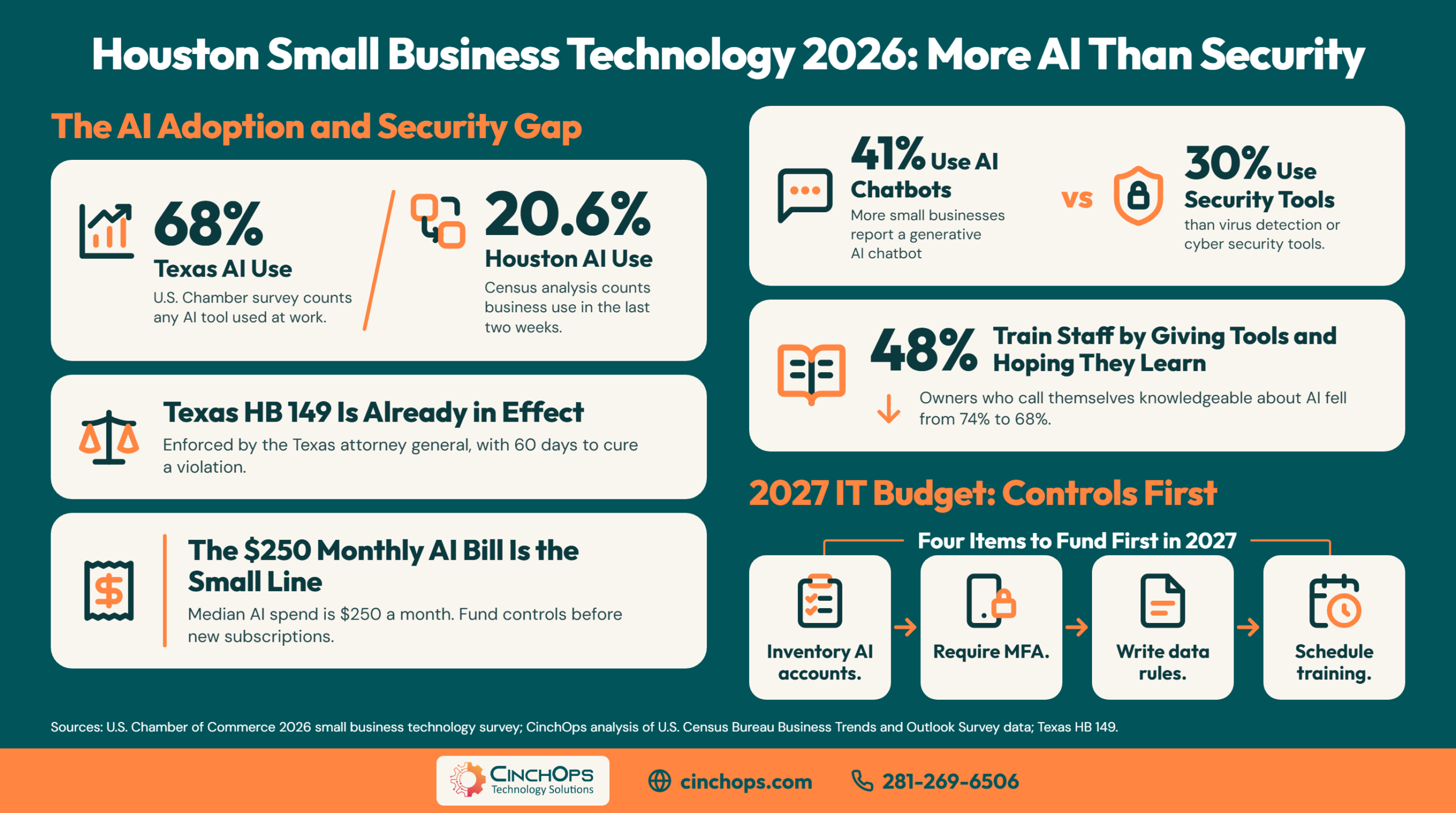
Houston small business technology in 2026 looks different depending on which survey you read. The U.S. Chamber of Commerce report published on October 2, 2026 says 66% of U.S. small businesses and 68% of Texas small businesses now use AI. CinchOps' analysis of Census data puts Houston-area business AI use at 20.6%. A Houston owner drafting a 2027 IT budget has one question: are we behind?
Probably not, and the report's own tables explain why. The Chamber's Technology Engagement Center and Teneo Research surveyed 3,732 small businesses with fewer than 250 employees online between July 23 and August 6, 2026. The same survey that found 66% using AI found 41% using a generative AI chatbot and 30% using virus detection or cyber security tools. More owners told the Chamber they run a chatbot than told it they run security software.
CinchOps provides managed IT and AI security specifically for small and mid-sized businesses in the Houston area with 10 to 200 employees, at a flat $100 to $250 per user per month. This post reads the fifth edition of the Chamber report against its own 2025 numbers, against CinchOps' Census analysis of Houston, and against the Texas AI law that took effect on January 1, 2026.
AI Use Rose 8 Points in a Year While Owner Confidence Fell
The 2026 edition is the fifth wave of the same Chamber survey, so every headline number has a 2025 figure beside it.
The U.S. Chamber's 2026 small business technology report shows usage climbing and belief slipping in the same 12 months: AI use went from 58% to 66% and heavy tool stacks from 32% to 41%, while owners who call themselves knowledgeable about AI dropped from 74% to 68%.
Start with the growth. In 2023, 23% of small businesses in the Chamber survey used AI. The share was 58% in 2025 and 66% in 2026. Businesses using 6 or more technology platforms made up 14% of the sample in 2022, 32% in 2025 and 41% in 2026, which makes heavy users the largest group for the first time. Writing tools, AI coding tools and AI image tools each gained 6 or 7 points in a year.
The Chamber's 2024 edition gives the longer view. That survey of 1,100 small businesses put generative AI use at 40%, and 79% said technology had helped them avoid raising prices for consumers. Two years later AI use is 26 points higher, and the share crediting technology with limiting price increases is 77%, 2 points lower, in a year when the share of owners naming inflation as a top challenge rose 9 points.
Then there is the growth claim. The report says AI users outpace everyone else, and the figures are 89% of AI users reporting higher sales against 82% of non-users, 90% against 83% on profit, and 89% against 80% on headcount. That is a 7 to 9 point gap in a self-reported survey where 4 out of 5 businesses without AI also grew. The survey shows the two travel together. It cannot show that a chatbot subscription caused the growth, and an owner should not budget as if it did.
Two Surveys Give Houston Two Very Different AI Numbers
The Chamber's Texas scorecard and CinchOps' Census analysis of the Houston metro are 47 points apart, and both can be right.
The U.S. Chamber's 2026 report puts AI use among Texas small businesses at 68%, while CinchOps' 2026 analysis of the U.S. Census Bureau's Business Trends and Outlook Survey found 20.6% of Houston-area businesses using AI. The gap comes from who was asked and what counted as using AI.
The Chamber publishes a scorecard for every state. The Texas page reports 96% of small businesses using at least 1 technology platform, 68% using an AI platform, 50% using generative AI chatbots, 24% using agentic AI tools, and 85% planning to increase technology use in the next 2 to 3 years. Texas sits 2 points above the national 66%. It is not in the Chamber's top 10 states, a list led by Massachusetts at 88%.
Texas has moved faster than the country. The Chamber's 2024 Texas scorecard reported 46% of Texas small businesses using an AI platform, so the state added 22 points in two years. Over the same two years the share of Texas owners who believe AI will help their business went from 86% to 77%. Use grew by nearly half while belief dropped 9 points.
CinchOps ran the federal data in June 2026 for the Houston Small Business AI Adoption report. That analysis of the Census Bureau's Business Trends and Outlook Survey put Houston-area business AI use at 20.6%, 18th of the 25 largest metros and behind Dallas at 22.6%.
The two numbers are 47 points apart because the two surveys ask different questions of different businesses. Three differences account for the gap:
- The time window. The Census Bureau asks, "In the last two weeks, did this business use Artificial Intelligence (AI) in any of its business functions?" The Chamber asks which technologies "do you use at work" and sets no time limit. An occasional user can honestly answer yes to the Chamber and no to the Census.
- What counts as AI. The Chamber shows owners a list of 22 technologies with brand names such as ChatGPT, Gemini and Copilot, and counts a business as an AI user if it picks any of the 5 AI items. The Census asks one yes-or-no question, and its examples are "machine learning, natural language processing, virtual agents, voice recognition". When the Census Bureau tested an earlier version of that question, it found respondents who answered no and turned out to be using AI, including AI tools built into their software.
- Who answers, and where. The Chamber's 68% is a statewide Texas figure from an online survey of small businesses with fewer than 250 employees. The 20.6% covers the Houston metro only, from a Census Bureau survey that reports on businesses of all sizes.
The Chamber's number is closer to "does anyone here use an AI tool". The Census number is closer to "did the business itself use AI in the past two weeks". Both are accurate answers to their own question. Read together, they describe a Houston market where AI tools are open on a lot of screens and built into far fewer business processes. An owner who has not rolled AI into operations is in the local majority.
More Small Businesses Report an AI Chatbot Than Security Tools
The security findings are spread across four separate charts in the Chamber report and are not in its key findings.
AI security for small business is the weakest area in the U.S. Chamber's 2026 data: 41% of small businesses use a generative AI chatbot, 30% report using virus detection or cyber security tools, and 26% say they use technology to manage cybersecurity at all.
Two years ago the order was reversed. In the Chamber's 2024 edition, 44% of small businesses reported virus detection and cybersecurity tools and 34% reported a generative AI chatbot. The 2024 and 2026 lists are not a clean comparison, because the sample more than tripled and nearly every item scored lower in 2026. Search engines went from 63% to 45%. Chatbots are the exception. They rose 7 points while security tools fell 14.
Training tells the same story. Asked how they make workers AI-ready, 48% of AI-using businesses chose "providing AI tools and hoping employees learn to use them", up from 41% in 2025. On-the-job training rose from 39% to 47%. The Chamber's summary line is that 95% are working to upskill employees, and that total includes the businesses whose plan is hope.
Do You Know Which AI Tools Your Staff Signed Up For?
A SaaS and AI account inventory is the first step, and it usually turns up accounts nobody budgeted for.
Talk to CinchOpsTexas Already Has the State AI Law the Report Worries About
The Chamber report argues for one national AI and privacy standard. Houston businesses have operated under a Texas AI statute since January 1, 2026.
The Texas Responsible Artificial Intelligence Governance Act, HB 149, took effect on January 1, 2026. The law is enforced only by the Texas attorney general, gives a business written notice and 60 days to cure a violation, and writes in a defense for a business that substantially complies with a recognized AI risk management framework such as NIST's.
The Chamber found 60% of small businesses nationally worried that complying with different state laws on privacy, AI and technology will raise compliance and litigation costs, and 76% said a single set of national data privacy rules would help. Texas owners are calmer than the national sample: 56% are concerned about a patchwork and 74% want national rules. Only 38% of small businesses nationally call themselves very well prepared for pending AI regulation.
HB 149 is narrower than the regulations the Chamber survey asked about. Its prohibitions turn on intent, such as developing or deploying an AI system with the intent to unlawfully discriminate, and its consumer disclosure duty applies to governmental agencies. There is no private right of action, so a customer cannot sue under it. On a complaint, the attorney general may issue a civil investigative demand asking for a description of the AI system's purpose and intended use, the data involved and the safeguards in place. Civil penalties start at $10,000 per curable violation.
That makes the practical exposure for a Houston CPA practice, law firm or engineering firm a documentation problem. A business that can show which AI tools it uses, for what, with which data and under which written rules can answer a demand letter inside the 60-day window. A business running on "tools and hope" cannot. The same written record is what a cyber insurance questionnaire or a customer security review asks for, so the work pays twice.
A $250 Monthly AI Bill Is the Smallest Line in a Houston 2027 IT Budget
The subscription is the cheap part of AI. The accounts, data rules and training around it are where a 2027 budget should put its weight.
The U.S. Chamber's 2026 report found 41% of small businesses using AI rely on free tools, and the median monthly AI spend among businesses that pay is $250. A Houston owner budgeting for 2027 should treat that figure as the top slice of AI cost and fund the controls underneath it.
A free consumer account typically gives the business no admin console, no way to remove a departed employee's access and no contract covering the business's data. A paid business tier typically addresses those three things, which is the real argument for the $250. What the subscription does not buy is the layer that the Chamber data shows is thin: sign-in protection on every AI account, written rules for what client data may be pasted where, training scheduled on the clock, and security tools and backups for a business that now runs 6 or more platforms.
The jobs data belongs in the same budget conversation. The Chamber reports 47% of AI-using small businesses say AI is creating jobs and 6% say it is letting them reduce headcount. The chart behind that 47% splits it: 25% expect the job creation to last, and 22% say AI is creating jobs now but will "ultimately require fewer people". Nearly half of the owners counted as job creators expect the direction to reverse. A staffing plan built on the headline number is built on the optimistic half.
The 2027 IT budget checklist covers the dated line items owners leave out. For AI, spend in this order: inventory first, controls second, new tools third.
"Two-thirds of small businesses told the Chamber they use AI, and the most common training plan was to hand over the tool and hope. Hope does not show up in an audit. Write down who can use which tool with which data, and fund that before you fund another subscription."
Put Rules Around the AI Your Team Already Uses
CinchOps builds the account inventory, the written AI use policy and the monitoring around it through its AI policy and governance work for Houston-area businesses.
See AI security and risk management →How CinchOps Can Help Houston Owners Act on the 2026 Report
CinchOps is a managed IT services provider based in Katy, Texas, serving small and mid-sized businesses across the Houston metro area. CinchOps specializes in cybersecurity, network security, managed IT support, VoIP, and SD-WAN for businesses with 10 to 200 employees.
The Chamber report describes businesses that adopted tools faster than they adopted rules. CinchOps works that backlog in three steps and prices the managed IT and security work at a flat $100 to $250 per user per month under Zero-Zero-Zero terms: no long-term contracts, no hidden fees, no cancellation penalties.
- A SaaS audit and shadow IT discovery lists every AI and SaaS account in use, including the ones staff opened on their own.
- AI training and user adoption replaces "tools and hope" with scheduled sessions tied to the written policy.
- Cybersecurity with 24/7 threat monitoring covers the accounts and devices those tools run on, and help desk requests are answered in under 15 minutes during office hours.
- Managed IT in Houston, Katy, Sugar Land and Cypress for small and mid-sized businesses, with industry programs for CPA firms, law firms and engineering firms.
A Houston business that is not using AI yet is not behind its neighbors, and a business that is using it is probably ahead of its own rules. Either way the 2027 budget should pay for the inventory and the controls first. To see what that looks like for your headcount, talk to CinchOps.
Frequently Asked Questions
What does the 2026 U.S. Chamber report say about Texas and Houston small business technology?
The U.S. Chamber's 2026 survey of 3,732 small businesses found 66% use AI nationally and 68% in Texas, where 96% use at least 1 technology platform. The report has no Houston figure. CinchOps' Census analysis puts Houston-area AI use at 20.6%. Nationally, 30% report using security tools.
Is my Houston business behind if we are not using AI yet?
No. The Chamber survey counts any AI tool used at work, including a free chatbot, and reports 68% for Texas. CinchOps' 2026 analysis of Census Bureau survey data found 20.6% of Houston-area businesses using AI, 18th of the 25 largest metros. Most Houston businesses have not built AI into daily operations.
Does Texas have an AI law that applies to small businesses?
Yes. Texas HB 149, the Texas Responsible Artificial Intelligence Governance Act, took effect on January 1, 2026. Only the Texas attorney general enforces it, a business gets written notice and 60 days to cure, and substantial compliance with a recognized AI risk framework such as NIST's is a defense. Its prohibitions are narrow and based on intent.
Are free AI tools safe to use with business data?
Free AI tools are the riskiest place for client data because the business does not control the account. The Chamber found 41% of AI-using small businesses rely on free tools. A paid business tier typically adds admin control and contract terms. Either way, require MFA and a written rule for what data may be entered.
What does managed IT and security cost for a Houston small business?
Managed IT and security for a Houston small business typically runs $100 to $250 per user per month. The published CinchOps rate is a flat $100 to $250 per user per month with no long-term contracts, no hidden fees and no cancellation penalties. AI subscriptions are separate, and the Chamber puts the median at $250 per month.
Discover More
Resource
Sources
- U.S. Chamber of Commerce Technology Engagement Center (C_TEC) and Teneo Research, Empowering Small Business: The Impact of Technology on U.S. Small Business, Fifth Edition, October 2, 2026
- U.S. Chamber of Commerce, full 2026 report PDF, including the Texas state scorecard
- U.S. Chamber of Commerce Technology Engagement Center (C_TEC) and Teneo Research, Empowering Small Business: The Impact of Technology on U.S. Small Business, Third Edition, 2024, including the Texas scorecard
- CinchOps, Houston Small Business AI Adoption: The 2026 Census Report (analysis of the U.S. Census Bureau Business Trends and Outlook Survey), June 23, 2026
- U.S. Census Bureau, BTOS AI Core Question Updates, December 3, 2025 (wording of the Business Trends and Outlook Survey AI question)
- Texas Legislature, HB 149 enrolled text, Texas Responsible Artificial Intelligence Governance Act, 89th Regular Session

