


Manufacturing AI Security: Is Your Houston Plant Ready for AI?
AI Security Built For Houston Manufacturers – Personal AI Accounts Are Still Carrying Plant Data Out The Door
Is Your Houston Plant Ready for AI?
Netskope's 2026 data shows AI use, AI data leaks and fake AI tools all rising in manufacturing. Eight checks a Houston plant can run now.
Manufacturing AI security means controlling which AI tools plant and office staff use, what company data goes into them, and what AI agents can reach. Netskope's 2026 manufacturing report shows AI use climbing faster than most plants have rules for it.
The Netskope Threat Labs Report: Manufacturing 2026, published November 10, 2026, draws on anonymized traffic from Netskope customers in automotive, chemicals, food and beverage, aerospace and heavy engineering between June 1, 2025 and August 31, 2026. Over the past year, active AI users rose from 40% to 67% of all users in the sector. Microsoft Copilot is now the most widely adopted AI app, used by 90% of manufacturing organizations, ahead of Claude Platform at 89% and ChatGPT at 76%.
For a Houston manufacturer with 50 or 150 people, that means AI is already in the quoting desk, the engineering office and the front office, whether or not anyone approved it. CinchOps sets AI tool rules specifically for Houston manufacturers with 10 to 200 employees, with IT/OT-SCADA segmentation at the boundary between the shop floor and the corporate network.
Manufacturing Staff Are Sending Regulated Data and Passwords Into AI Tools
Most AI risk in manufacturing starts with what employees type or upload, not with an attacker.
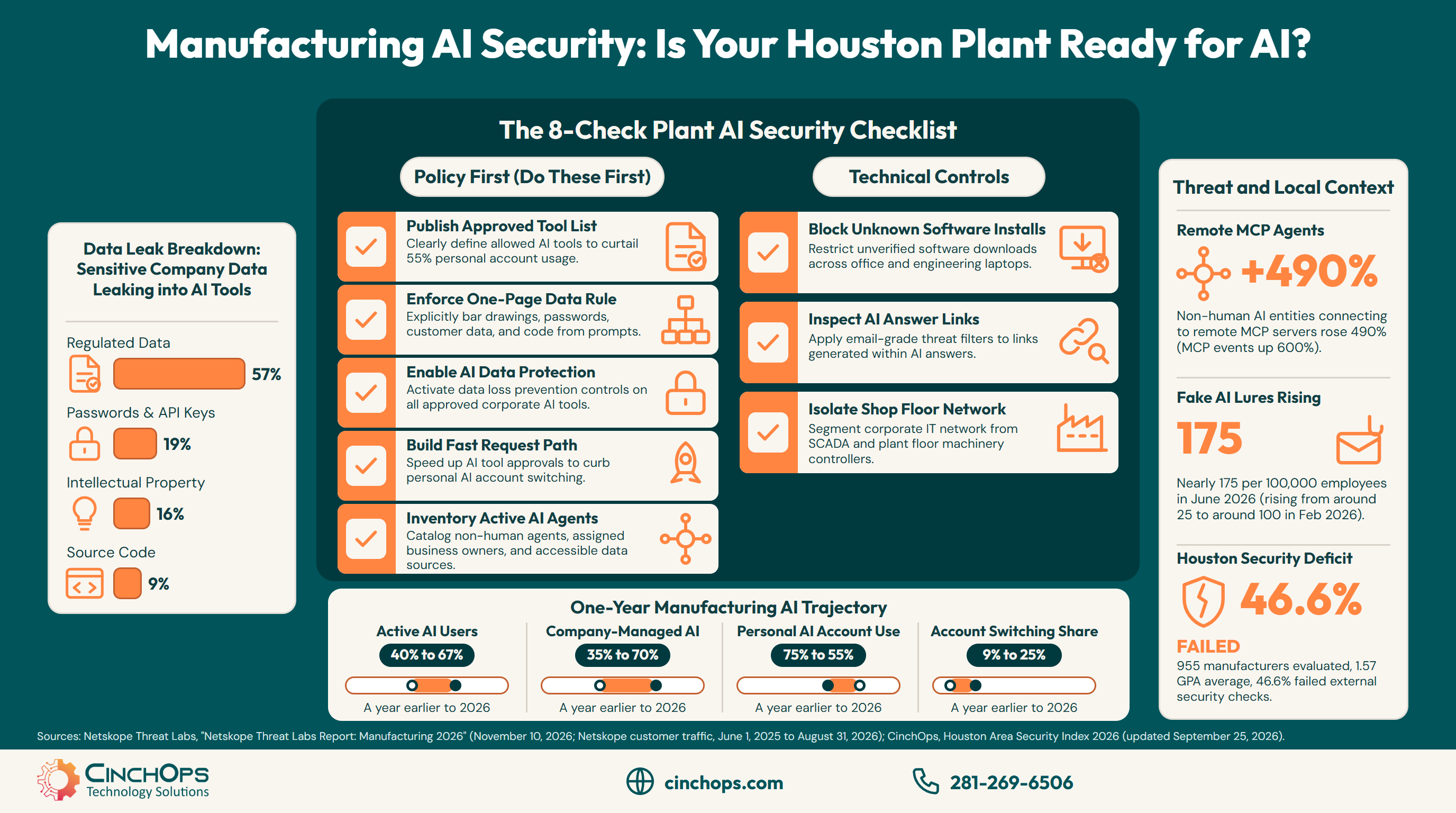
Regulated data accounts for 57% of AI-related data policy violations in manufacturing, according to Netskope, followed by passwords and API keys at 19%, intellectual property at 16% and source code at 9%. Upstream violations, data going into AI tools, make up 83% of AI-related violations.
Plants have made progress. Personal AI account use fell from 75% to 55% over the year, and use of company-managed AI tools rose from 35% to 70%. The share of users switching between personal and company accounts went the other way, from 9% to 25%. A design file pasted into a personal ChatGPT account at lunch leaves the same way whether the company account exists or not.
The 16% intellectual property share matters most for Houston shops that machine parts to customer drawings or build for energy and defense primes. A customer's drawing in an AI prompt is a contract question before it is a security question, and the Netskope report notes that the US CMMC program now extends cybersecurity requirements to the defense industrial base.
AI Agents and Fake AI Tools Are the New Way Into a Plant Network
Attackers follow the AI trend with fake installers and poisoned links, while AI agents open new outbound paths.
Remote MCP connections let AI agents reach servers outside the company, and Netskope counted a 490% rise in non-human entities using them in manufacturing, with MCP events up 600%. MCP, the Model Context Protocol, is the open standard that connects AI models to outside data and tools.
Each of those agents is software acting on a user's behalf, and some can read business data while they talk to a server on the internet. Most small plants could not list the agents running on their network today. That list is the starting point.
Attackers are using AI as bait too. Netskope tracked fake AI lures, such as trojanized AI installers and developer tools, rising from around 25 to around 100 users per 100,000 employees in February 2026, holding there until May, then climbing to nearly 175 per 100,000 in June. Malicious links returned by AI apps reached 150 per 100,000 users in October 2025 and 200 per 100,000 in March 2026.
Houston plants start this from behind. The CinchOps Houston Area Security Index graded 955 Houston-area manufacturers on external attack-surface signals in 2026: the group averaged a 1.57 GPA, and 46.6% failed. A plant that already fails on its public-facing basics has less margin for a fake Copilot installer on an engineering laptop that sits one network hop from the plant floor.
How does your plant score from the outside?
The Houston Area Security Index grades external attack surface for Houston manufacturers.
View the Security Index →Which AI Security Checks Should a Houston Plant Run First?
Eight checks, each tied to a Netskope finding, sized for a plant without a full-time security team.
A 10 to 200 person Houston manufacturer should start with eight AI security checks: an approved tool list, a data rule, data loss prevention, a fast request path, an agent inventory, blocked unknown installs, link inspection and a separated plant network. Each answers a 2026 Netskope finding.
- Approved AI tool list. Name the AI tools staff may use for work. Personal AI account use is still 55% in manufacturing, per Netskope.
- One-page data rule. Say plainly that customer data, drawings, passwords and code stay out of prompts. Those four types are every AI data violation category Netskope reports for the sector.
- Data loss prevention on approved tools. Turn it on for the tools you allow. Regulated data alone is 57% of AI data violations in manufacturing.
- A fast request path. Give staff a quick way to ask for a new AI tool. Account switching rose from 9% to 25%, and Netskope advises speeding up approvals to bring it down.
- Agent inventory. List every AI agent, who owns it and what data it reads. Agents using remote MCP servers rose 490%.
- Blocked unknown installs. Stop software installs from unknown sources on office and engineering laptops. Fake AI lures reached nearly 175 per 100,000 employees in June 2026.
- Link inspection for AI answers. Check links that AI tools return the same way email links are checked. Malicious AI links reached 200 per 100,000 users in March 2026.
- A separated plant network. Keep the office side, where AI tools run, apart from shop-floor controllers and SCADA.
The first five checks are policy and a few hours of work. They decide whether the technical controls in the last three have anything to enforce, so do them in order.
Your people are already using AI on the plant's drawings and the customer list. Write down which tools are allowed and what data goes into them this month, because the policy you skip is the one an attacker reads for you.
Is AI already running on your plant's network?
CinchOps maps which AI tools and agents are in use and keeps the office side apart from the plant floor, with 24/7 threat monitoring watching both.
See CinchOps manufacturing IT →How CinchOps Can Help Houston Manufacturers With AI Security
CinchOps is a managed IT services provider based in Katy, Texas, serving small and mid-sized businesses across the Houston metro area. CinchOps specializes in cybersecurity, network security, managed IT support, VoIP, and SD-WAN for businesses with 10 to 200 employees.
For manufacturers, that work starts at the boundary between the office network, where AI tools and agents run, and the plant floor. CinchOps segments IT from OT and SCADA networks at that boundary, so a compromised laptop in the front office cannot reach a controller on the line.
- With vCIO services, CinchOps builds the approved AI tool list, the one-page data rule and the agent inventory.
- Through cybersecurity services, 24/7 threat monitoring watches for fake AI installers and the activity that follows them.
- Through managed IT support, help desk requests are answered in under 15 minutes by a named engineer who knows the network.
- With AI workflow automation, CinchOps puts approved AI to work on one well-defined task, so staff have a sanctioned tool instead of a personal account.
- CinchOps supports manufacturing, oil and gas and engineering firms in Katy, Cypress and across Houston.
AI use in manufacturing went from 40% to 67% in one year, and the rules at most small plants did not move with it. Write the approved list and the agent inventory before the next report counts your plant in the violations. Talk to CinchOps about an AI review for your plant.
Frequently Asked Questions
How many manufacturing employees use AI tools in 2026?
Netskope's 2026 manufacturing report found active AI users rose from 40% to 67% of all users in the sector over the past year. Microsoft Copilot is used by 90% of manufacturing organizations, Claude Platform by 89% and ChatGPT by 76%, based on Netskope customer traffic.
What data do manufacturing employees put into AI tools?
Regulated data makes up 57% of AI-related data policy violations in manufacturing, according to Netskope, followed by passwords and API keys at 19%, intellectual property at 16% and source code at 9%. Most violations happen as data goes into AI tools, not as results come out.
Should a small manufacturer ban ChatGPT and other AI tools?
A ban usually pushes staff to personal accounts. Netskope found personal AI use still at 55% in manufacturing even as managed tools reached 70%. A short approved-tool list, a fast way to request new tools and data rules for the approved ones work better than a blanket ban for most small plants.
What is a remote MCP server and why does it matter to a plant?
A remote MCP server is an internet-hosted service that AI agents connect to through the Model Context Protocol to fetch data or run tools. Netskope counted a 490% rise in AI agents and other non-human entities using them in manufacturing. Each connection is a path from company data to an outside server.
How do fake AI tools attack manufacturers?
Attackers pose as trusted AI brands with fake installers, trojanized developer tools and malicious links. Netskope tracked fake AI lures reaching nearly 175 users per 100,000 manufacturing employees in June 2026. Blocking software installs from unknown sources and inspecting links from AI answers stops most of them.
What does AI security for a manufacturer cost in Houston?
Managed IT with security for Houston manufacturers commonly runs $100 to $250 per user per month. The published CinchOps rate is $100 to $250 per user per month, flat and month-to-month, with no long-term contracts, hidden fees or cancellation penalties. AI tool reviews are part of that managed service.
Discover More
Resource
Sources

