


AI ROI Is Now a Board Question. Here Is What Houston Owners Should Do
Why CEOs Ranked Governance First For AI Success – Sizing The 2026 CEO AI Survey For A Houston Small Business
Here Is What Houston Owners Should Do
Boards are pressing 72% of U.S. CEOs for measurable AI results. Here is how a Houston business proves its own AI spending pays.
AI ROI means the measurable business return an AI tool produces against what it costs: hours saved, revenue added or errors avoided. In 2026 that return became a board-level question for U.S. chief executives, and the same question is now reaching Houston small businesses paying for AI subscriptions they have never measured.
The evidence comes from the Global AI Confessions Report: CEO Edition 2026, published by Dataiku from a Harris Poll survey of 900 CEOs run online from February 2 to March 2, 2026. Two hundred of those CEOs lead U.S. companies, and every respondent runs a company with $500 million or more in annual revenue.
Those are large companies, and their CEOs are speaking about their own pressure. The pattern still matters to an owner with 40 staff and a stack of AI renewals. CinchOps provides managed IT and AI policy support specifically for Houston and Katy businesses with 10 to 200 employees, with help desk requests answered in under 15 minutes.
U.S. CEOs Are Now Asked to Prove AI Pays
The U.S. numbers rose faster than almost anywhere else in the survey.
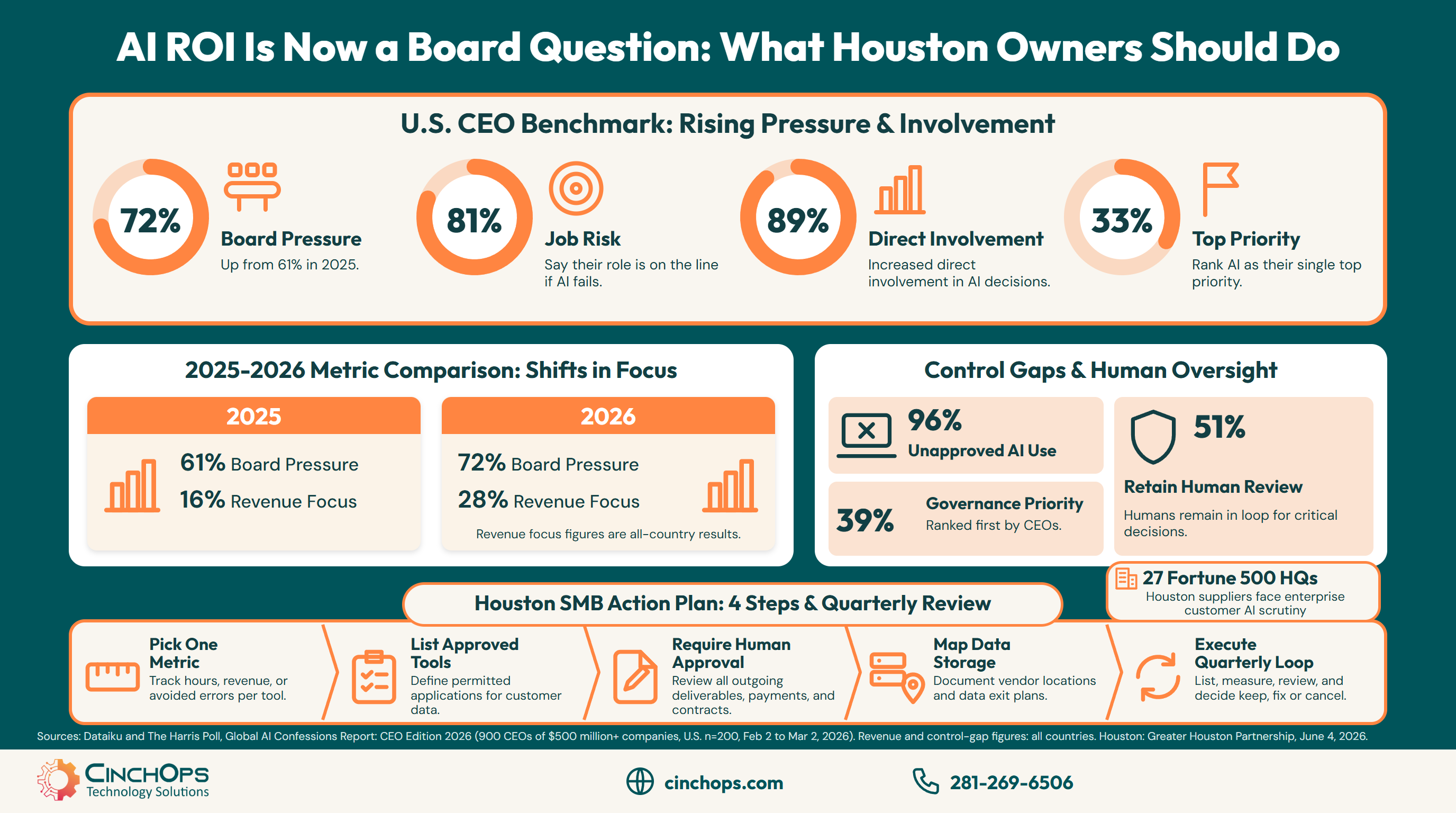
U.S. CEOs face the sharpest AI accountability in the Dataiku survey. Seventy-two percent say their board is applying pressure to deliver measurable AI-driven outcomes, up from 61% in 2025, and 81% say their role is on the line if AI fails to deliver. The report calls the U.S. increase one of the most significant across all regions.
U.S. chief executives are also closer to the work. Eighty-nine percent say their involvement in AI decisions increased over the past year, against 79% across all countries. Seventy-eight percent rank AI strategy as a top or high priority, and 33% name it the single top priority, the highest share in the survey.
The yardstick changed too. Across all countries, CEOs naming revenue growth as the main measure of AI success rose from 16% in 2025 to 28% in 2026, nearly tied with increased productivity at 25%. A pilot that only looks busy no longer counts.
Openness is not the problem in the U.S. Ninety-seven percent of U.S. CEOs say they would feel comfortable telling their board that AI influenced a strategic decision. The gap the report points to is proof: AI is in the decisions, and the board now wants the numbers that show it paid.
Paying for AI tools you have never measured?
CinchOps helps Houston businesses list every AI tool in use and set one number for each before the next renewal.
See AI policy and governance →The CEO Confessions Show AI Running Ahead of Control
Adoption is fast. Visibility, vendor choice and oversight are lagging.
The Dataiku survey shows AI use spreading faster than CEOs can control it. Ninety-six percent of CEOs believe employees use generative AI tools without approval, and 42% estimate more than half their workforce does. When asked what matters most for AI success, CEOs ranked governance at 39%, ahead of people at 34% and orchestration at 28%.
Unapproved use is the part a small business can see right away. The report ties it to data exposure, inconsistent outputs and dependencies nobody manages, because the work happens outside any formal review. A browser tab with a free AI tool is the same risk in a 30-person office as in a $500 million company, with fewer people watching.
Vendor choice worries CEOs more than spending. Sixty-five percent say they worry more about over-investing amid intense vendor competition than about under-investing, and 76% say their organization is overly exposed to risk from relying on too few AI vendors.
Trust stops short of autonomy. Fifty-one percent of CEOs keep humans in the loop for business-critical decisions, and 34% run a model where AI recommends and a person approves. Explainability is a brand worry as well: 62% of U.S. CEOs believe failures tied to explainability or governance could erode customer trust, against 57% across all countries.
What the CEO Survey Means for a Houston Small Business
The pressure on big-company CEOs reaches the firms that supply them.
For a Houston small business, the CEO survey is a preview of questions customers will ask. The Greater Houston Partnership reported in June 2026 that the Houston metro holds 27 Fortune 500 headquarters, tied for second among U.S. metros. Their CEOs run exactly the size of company the survey covers.
Many Houston firms with 10 to 200 staff sell to those companies as engineering contractors, oil and gas service firms, CPA practices and law firms. A CEO whose board demands proof of AI results, and who believes staff use unapproved AI tools, has every reason to ask suppliers how they handle AI with the customer's data. Expect those questions in security questionnaires and contract renewals.
Each finding has a version sized for a small office, and each one turns into a move an owner can make this quarter.
- Pick one number per AI tool. Hours saved, revenue tied to it or errors avoided. Write it down before the renewal date and check it then.
- Write one approved-tools list. Ask staff which AI tools they already use, then publish the short list of tools allowed for client or company data.
- Approve anything that leaves. Client deliverables, payments and contract language get a human review before they go out, even when AI drafted them.
- Know where your data lives. For each AI vendor, record what data it holds and how you would switch away from it.
A written policy ties these together. The AI governance guide for Houston small businesses covers the policy itself, and the Houston AI rollout plan covers picking the first tasks worth automating.
Big companies govern AI because their boards make them. A 40-person firm should do it because it can't afford to find out the hard way.
Want your AI tools on one page, with a number next to each?
CinchOps AI policy and governance work gives Houston businesses an approved-tools list, a data map and a review step before AI output leaves the office.
See CinchOps AI policy and governance →How CinchOps Can Help Houston Businesses Prove AI ROI
CinchOps is a managed IT services provider based in Katy, Texas, serving small and mid-sized businesses across the Houston metro area. CinchOps specializes in cybersecurity, network security, managed IT support, VoIP, and SD-WAN for businesses with 10 to 200 employees.
CinchOps runs AI reviews on a quarterly loop, so each tool earns its renewal with a number rather than a feeling.
- Through AI policy and governance, CinchOps lists the AI tools in use, writes the approved-tools policy and maps which vendors hold company data.
- With business process automation, a first AI workflow typically reaches production in under a month, and a quick win on one well-defined task can be live within a week.
- Through vCIO services, CinchOps reviews each AI renewal against the number set for it and recommends keep, fix or cancel.
- Managed IT support and cybersecurity services come at a flat monthly rate of $100 to $250 per user, with no long-term contracts, no hidden fees and no cancellation penalties.
- CinchOps supports offices across Houston, Katy and The Woodlands, including engineering firms, oil and gas companies and CPA firms.
The CEOs in the Dataiku survey are being asked to prove their AI spending in front of a board. A Houston owner can answer the same question in an afternoon with a list of tools and one number for each. If that list does not exist yet, talk to CinchOps about building it before the next renewal.
Frequently Asked Questions
What is AI ROI for a small business?
AI ROI is the measurable return an AI tool produces against its cost, such as hours saved, revenue tied to the tool or errors avoided. For a Houston small business, the practical version is one number per AI subscription, written down before the renewal date and checked when the renewal arrives.
What did the 2026 Dataiku CEO survey find about U.S. CEOs?
The Dataiku and Harris Poll survey found 72% of U.S. CEOs say their board is pressing for measurable AI results, up from 61% in 2025. Eighty-one percent say their role is on the line if AI fails, and 89% say their involvement in AI decisions increased over the past year.
Does a survey of $500 million companies apply to a Houston small business?
The survey covers CEOs of companies with $500 million or more in revenue, so its numbers describe large companies. The questions carry over. Houston holds 27 Fortune 500 headquarters, and suppliers to those companies can expect questions about AI use and customer data in questionnaires and contract renewals.
How common is unapproved AI use at work?
In the Dataiku survey, 96% of CEOs believe employees use generative AI tools without approval, and 42% estimate more than half their workforce does. A small business can find out its own answer by asking staff which AI tools they use, then publishing a short approved-tools list.
Should AI make business decisions on its own?
Most CEOs in the Dataiku survey say no. Fifty-one percent keep humans in the loop for business-critical decisions, and 34% use a model where AI recommends and a person approves. For a small business, client deliverables, payments and contract language should get a human review before they leave.
What does AI policy and managed IT support cost in Houston?
Managed IT in Houston commonly runs $100 to $250 per user per month. The published CinchOps rate is $100 to $250 per user per month, flat and month-to-month, with no long-term contracts, no hidden fees and no cancellation penalties, and AI policy work sits inside that managed service relationship.
Discover More
Resource
Sources


