


CPA Firm IT Budget 2027: Build It Before Houston’s Tax Season
Seasonal Staff Need IT On Day One – Your February Software Update Can Cost Billable Days
Build It Before Houston's Tax Season
What should a Houston CPA firm buy, test and finish before January? A month-by-month IT budget for the 2027 season.
A CPA firm IT budget is the plan for what a tax and accounting practice will spend on technology, security and support in the coming year. For a Houston CPA firm, the timing matters as much as the total: everything that needs buying, testing or installing should be finished before tax season starts in January.
Firms that build the budget in March build it during the busiest stretch of the year, when nobody has time to replace a laptop, test a backup or train a seasonal hire on multi-factor authentication (MFA). The 2027 season is the one to get ahead of now.
CinchOps provides managed IT specifically for Houston CPA firms with 10 to 200 employees, covering 24/7 during tax season, at a flat $100 to $250 per user per month. The checklist below is the order CinchOps works through with CPA clients each fall, and each line ties back to a section of this guide.
When Should a CPA Firm Finish Its IT Budget?
October to decide, December to buy and test, January to freeze.
A CPA firm should finish its IT budget by December, because the changes the budget pays for need November and December to happen. From January to the April deadline, a firm should change as little as possible and run what it already has.
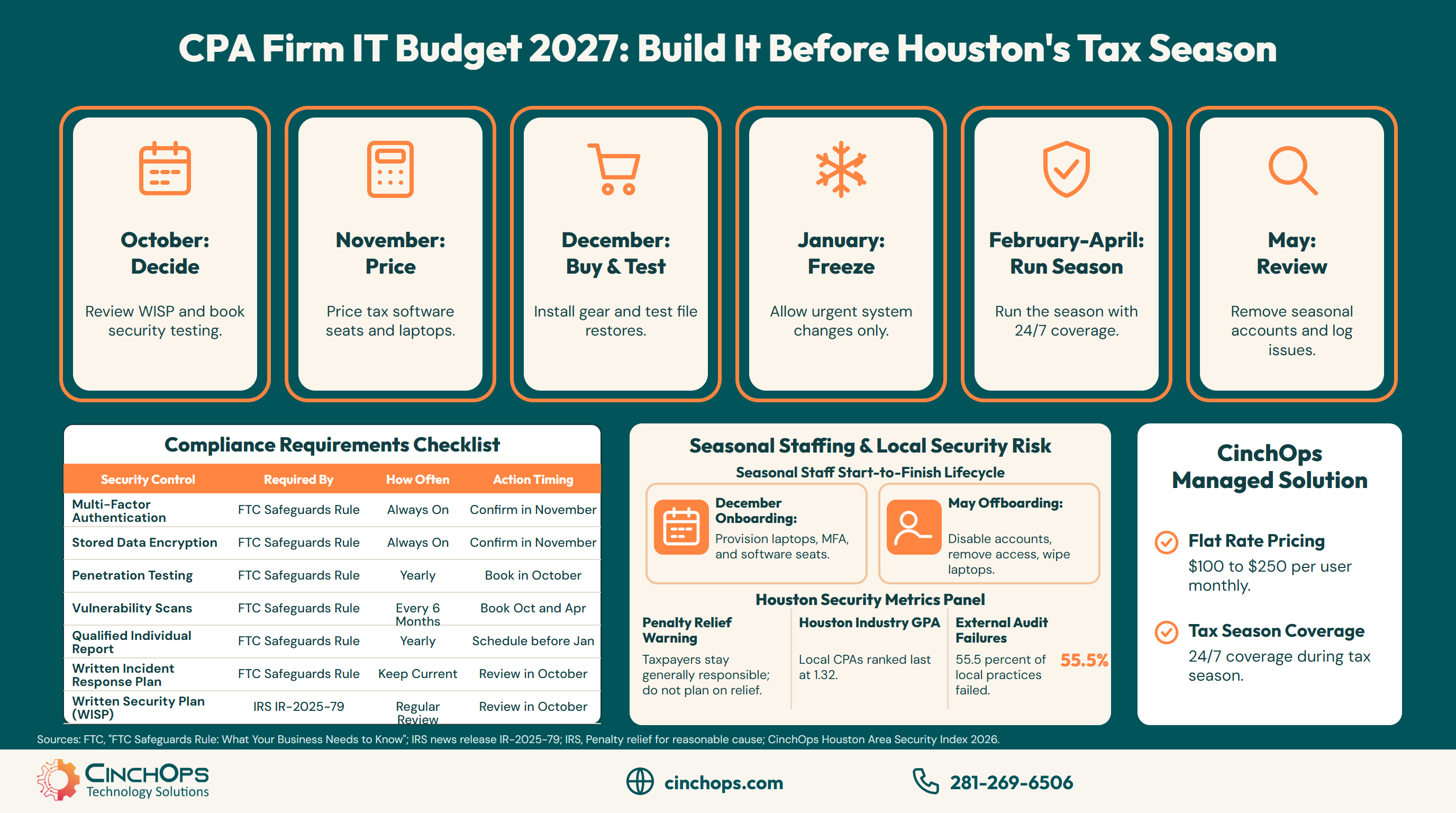
October is for decisions: review the written information security plan (WISP), book the year's security testing and list what has to change. November is for pricing: tax software seats, licenses for seasonal staff and any laptop that will not last through April. December is for buying, installing and testing, including a test restore of client files from backup.
January is the freeze: only urgent changes until the deadline, because a software update that breaks a tax application in February costs billable days. May is the review, when the firm removes seasonal accounts and writes down what failed so next fall's budget fixes it.
Which Budget Lines Does the FTC Safeguards Rule Require?
The compliance work a tax practice has to pay for every year.
The FTC Safeguards Rule covers tax preparation firms, and it puts recurring work in a CPA firm's budget: MFA for anyone reaching client information, encryption, a written incident response plan, a yearly report to the owners, and, without continuous monitoring, a yearly penetration test and vulnerability scans every six months.
The FTC's own business guide lists "tax preparation firms" among the financial institutions the rule covers. The IRS adds a second requirement: in news release IR-2025-79, it reminded tax professionals that they are "legally required to have a written, accessible plan" and should review, test and update it regularly.
The table below lists each required line, what requires it, how often it recurs and when a CPA firm should schedule it so it lands before tax season.
| Budget line | Required by | How often | When to schedule it |
|---|---|---|---|
| MFA on email, remote access and tax software | FTC Safeguards Rule | Always on | Confirm in November |
| Encryption of client data, stored and in transit | FTC Safeguards Rule | Always on | Confirm in November |
| Penetration test | FTC Safeguards Rule (without continuous monitoring) | Every year | Book in October |
| Vulnerability scans | FTC Safeguards Rule (without continuous monitoring) | Every six months | Book in October and April |
| Qualified Individual report to the owners | FTC Safeguards Rule | At least yearly | Schedule before January |
| Written incident response plan | FTC Safeguards Rule | Keep current | Review in October |
| Written information security plan (WISP) | IRS (IR-2025-79) | Review and test regularly | Review in October |
Continuous monitoring changes the testing line. The FTC guide says the yearly penetration test and six-month scans apply to firms without it, so a firm that pays for 24/7 monitoring should confirm with its provider which of those lines the monitoring replaces.
Not sure which Safeguards lines are already covered?
CinchOps can map your current IT spend against the FTC Safeguards Rule lines and show what is missing before January.
Talk to CinchOpsBudget for the People Who Only Work in Tax Season
Laptops, accounts and licenses that start in January and end in May.
Seasonal staff need the same IT as permanent staff for four months: a working laptop, an account with MFA, a tax software seat and access to the right client files. A CPA firm budget should cover the start of the season and the end of it, when those accounts are removed.
The start costs money that is easy to miss: a laptop ordered in December arrives in time, and one ordered in January may not. Accounts, tax software seats and file access should be ready on the first day, so a seasonal preparer is billing in week one instead of waiting on IT.
The end matters as much for security. In May, every seasonal account should be disabled, its access to client files removed and its laptop wiped, because an account nobody uses is the account nobody notices when it is misused. Ask your IT provider whether seasonal users are billed only for the months they work.
Pay for Tax Season Coverage Before April
After-hours support, backups and the cost of a down day.
A Houston CPA firm should put tax season coverage in writing before January: who answers after hours, how fast, and what counts as an emergency between January and the April deadline. CinchOps covers CPA firms 24/7 during tax season.
The IRS lists "system issues that delayed a timely electronic filing or payment" among its examples of reasonable cause for penalty relief, and it also says taxpayers are "generally responsible for complying with tax law even if someone else handles your taxes." A firm cannot plan on relief; it has to keep its systems running.
The outside view shows why. In the CinchOps Houston Area Security Index, Houston CPA practices scored last of five industries on external attack-surface checks, with a 1.32 GPA and 55.5% failing. The fixes those checks point to, from email security settings to exposed services, are cheaper to make in December than in March.
Tax season is the worst time to discover what your IT budget left out. Finish the buying and testing by December, put after-hours coverage in writing, and spend January through April running what you already have.
Want the Safeguards lines handled before January?
CinchOps compliance services help Houston CPA firms schedule the testing, reports and plan reviews the FTC Safeguards Rule and the IRS expect.
See CinchOps compliance services →How CinchOps Helps Houston CPA Firms Budget for 2027
CinchOps is a managed IT services provider based in Katy, Texas, serving small and mid-sized businesses across the Houston metro area. CinchOps specializes in cybersecurity, network security, managed IT support, VoIP, and SD-WAN for businesses with 10 to 200 employees.
For CPA and accounting firms, the published CinchOps rate is $100 to $250 per user per month, flat and month-to-month, with no long-term contract and no cancellation penalty.
- Managed IT services cover the help desk, which answers in under 15 minutes in business hours, plus patching and seasonal staff accounts.
- Cybersecurity services cover MFA, encryption and 24/7 threat monitoring, with an on-call technician for emergencies.
- Backup and recovery keeps immutable, verified backups of client files, included in the top-tier plan.
- vCIO services build the budget calendar with you and keep the WISP review and yearly report on schedule.
- CinchOps works with CPA firms across Houston, Katy and Sugar Land.
The 2027 tax season starts in January whether the IT is ready or not. Set the budget in October, buy and test in November and December, and go into the season with coverage in writing. To build the calendar for your firm, talk to CinchOps.
Frequently Asked Questions
When should a CPA firm set its IT budget for 2027?
A CPA firm should set its 2027 IT budget in October and finish buying and testing by December. January through the April deadline is the worst time to install or change anything, so the budget has to pay for its changes before the season starts, with only urgent changes after that.
What IT costs does the FTC Safeguards Rule add for a CPA firm?
The FTC Safeguards Rule covers tax preparation firms and requires MFA for anyone reaching client information, encryption, a written incident response plan and a yearly report to the owners. Without continuous monitoring, it also requires a yearly penetration test and vulnerability scans every six months.
Does a CPA firm need a written information security plan?
Yes. In news release IR-2025-79, the IRS reminded tax professionals that they are legally required to have a written, accessible plan and should review, test and update it regularly. October is a good time to review it, so any changes are finished before tax season starts.
How should a CPA firm budget IT for seasonal staff?
Budget for both ends of the season. Seasonal staff need a laptop, an account with MFA, a tax software seat and file access on day one, so order and set them up in December. In May, disable every seasonal account, remove its file access and wipe its laptop.
Can IT problems during tax season get IRS penalties waived?
Sometimes, but a firm should not count on it. The IRS lists system issues that delayed a timely electronic filing or payment among its examples of reasonable cause, and it also says taxpayers are generally responsible for complying even when someone else handles their taxes.
What does managed IT cost for a Houston CPA firm?
Managed IT for a Houston CPA firm commonly runs $100 to $250 per user per month. The published CinchOps rate is $100 to $250 per user per month, flat and month-to-month, with the help desk, monitoring and security included and 24/7 coverage for CPA firms during tax season.
Discover More
Resource
Sources
- Federal Trade Commission, "FTC Safeguards Rule: What Your Business Needs to Know" (updated December 2024)
- Internal Revenue Service, news release IR-2025-79 (July 29, 2025): tax professionals must have a written information security plan
- Internal Revenue Service, "Penalty relief for reasonable cause"
- CinchOps, Houston Area Security Index 2026 (updated September 25, 2026)


