


ERCOT Batch Zero: What 5,672 MW Means for Houston Businesses
UPS, Internet Failover And Backups For A Houston Office – Waiting On Austin Is Not A Power Plan
ERCOT's September 2026 board update sorted 362 large loads, paused new energization, and put Houston second in the state.
ERCOT Batch Zero is ERCOT's one-time transitional study of large loads, 75 MW and up, that want to connect to the Texas grid under Planning Guide Revision Request 145. ERCOT's September 14-15, 2026 board update put Harris County second in the state for conditional base-load data center demand, at 5,672 MW.
If you run a Houston business and caught the August headlines about the state pausing data center approvals, the question we hear in vCIO reviews is whether the office now needs to plan for a tighter grid. The board packet answers part of that. It names the counties, the megawatts, and the dates. It does not tell a Houston office how long its network closet stays up when CenterPoint drops a feeder, and that second question is the one worth money.
CinchOps provides managed IT support with SD-WAN failover across redundant carriers, such as 5G data and Starlink, specifically for construction, engineering and professional-services firms in Houston with 10 to 200 employees, with help desk response in under 15 minutes. This post reads the ERCOT slides for what they say about Houston, then turns that into a power plan an office can actually buy.
Harris County Holds 5,672 MW of Batch Zero Base Load, Second Only to Dallas
What base, studied and excluded mean, and where the Houston region sits on the conditional list ERCOT sent to transmission providers on September 3, 2026.
Base load is the Batch Zero path for large loads that met ERCOT's eligibility criteria under PGRR 145: loads already energized, committed, advancing, or covered by earlier stability assessments. Studied load met the criteria to be included in the study but sits on a path still subject to the PGRR 145 verification process. Excluded load did not qualify.
ERCOT's Jeff Billo, Vice President of Interconnection and Grid Analysis, presented the counts to the board on September 14-15, 2026. Conditional base load came to 204 projects and 66.4 GW. Conditional studied load came to 158 projects and 127.9 GW on the summary slide. The chart that goes with it omits a third group: 373 excluded projects totaling 302.2 GW. That excluded figure is larger than base and studied combined.
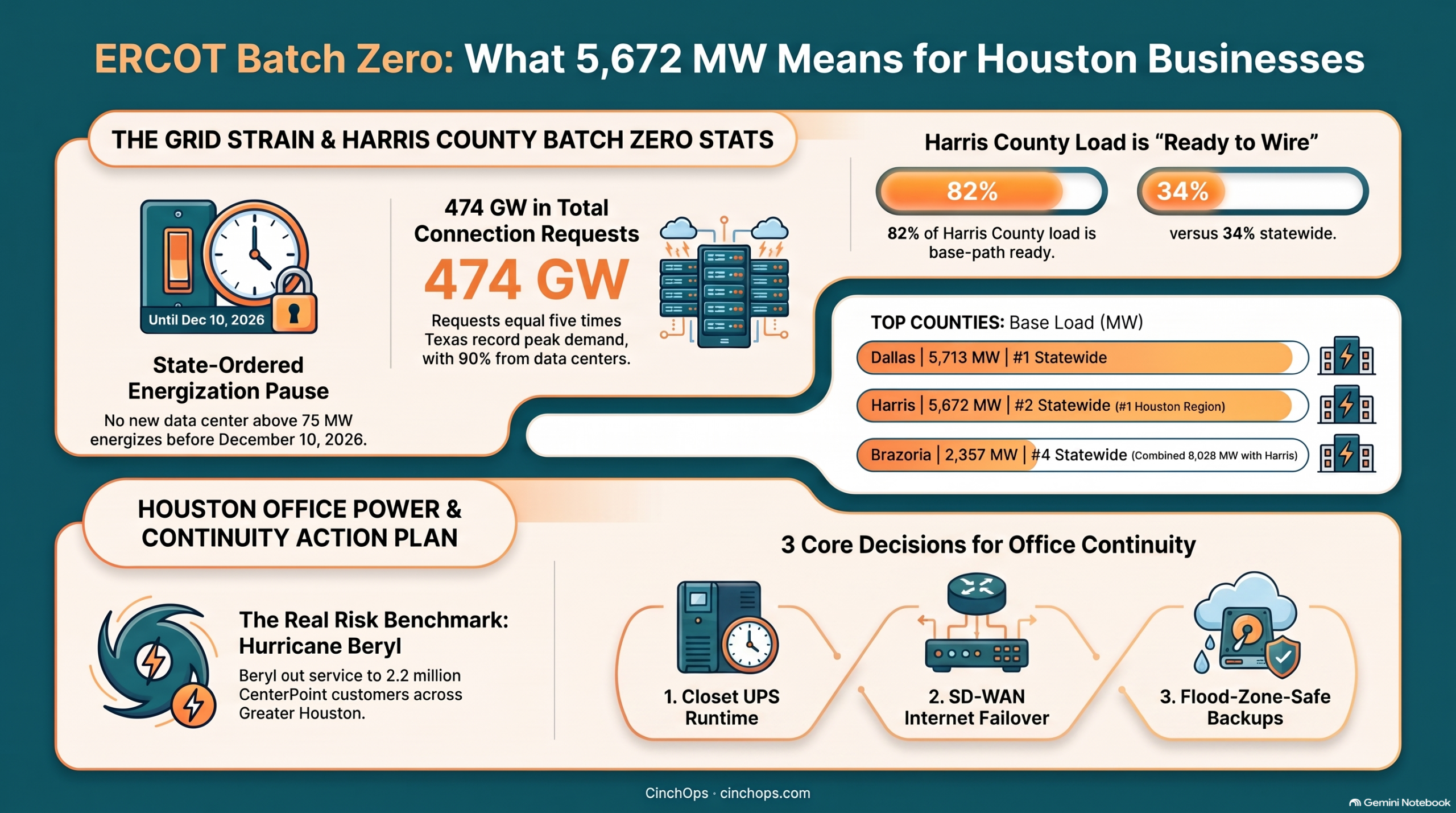
The county list is where Houston shows up. The top five base-load counties were Dallas at 5,713 MW, Harris at 5,672 MW, Haskell at 2,689 MW, Brazoria at 2,357 MW, and Ellis at 2,330 MW. Two of those five are in the Houston region. Harris and Brazoria together carry 8,029 MW of conditional base load, 12% of the statewide base total.
Put the two Harris County figures side by side and a local pattern shows up that the ERCOT slides do not state. Harris County's 5,672 MW of base load is 82% of its 6,899 MW combined base and studied total. Statewide, base load is 34% of the 194.3 GW combined total. CinchOps ran that arithmetic from the slide figures; ERCOT did not publish the ratio. The reading is that Houston-area data center demand in Batch Zero is weighted toward projects already energized, committed or advancing, rather than toward applications still waiting on study.
Every number on the list is conditional. ERCOT provided the classifications to transmission service providers on September 3, 2026, and the final inclusion or exclusion call comes in December after the eligibility verification. Nine large loads are included only if the Public Utility Commission grants a future good cause exception. A developer whose project was excluded can dispute it through ERCOT's Alternative Dispute Resolution process under Protocols Section 20, and a project moved from base to studied can use Planning Guide Section 9.3.1. Expect the county figures to move before they settle.
The Energization Pause Holds Until ERCOT Files Two Reports on December 10
The August 3 directive, what ERCOT stopped the same day, and the dates that moved as a result.
Governor Abbott's August 3, 2026 letter to PUCT Chairman Thomas Gleeson and ERCOT CEO Pablo Vegas directed a full verification and audit of every data center advancing through ERCOT's interconnection process, before any additional data center is approved to move forward.
The letter's own numbers explain the urgency. ERCOT was considering approximately 474 gigawatts of connection requests, more than five times the state's record peak electricity demand, and approximately 90% of those requests were data centers. The letter also cited data centers that had not complied with the PUC's survey measuring water and power usage.
ERCOT moved the same day. It issued a market notice pausing the Batch Zero study process and delaying final classification of all large loads. It paused approvals to energize data centers and virtual currency mining facilities of 75 MW or greater. On August 10 it filed for three good cause exceptions for PGRR 145, and the Commission granted all three on August 20.
Two work streams now run in parallel, and ERCOT told the board both are on schedule. The first is the eligibility verification and audit of every large load provisionally in Batch Zero, with a Batch Zero Eligibility Verification Report due to the Commission by December 10, 2026. The second is a Community Impact Review, built from information requests to the transmission and distribution providers serving both medium loads (25 to 75 MW) and large-load data centers and crypto facilities, with its own report due the same day.
The dates that moved tell the rest. PGRR 145 originally required final classification on August 7, 2026; ERCOT delivered a provisional version on September 3 and pushed the final call to December. The original April 9, 2027 study completion date is still on the books, and ERCOT's slide says the impact on it is still being determined. For a Houston office, the practical meaning is narrow and useful: no new 75 MW data center energizes on the Houston-area grid before the December reports, so the winter 2026-27 load picture in Harris County is set by what is already connected. The audit moves dates. The load already on the wire stays where it is.
A Houston Office Plans for Its Own Power Before the Grid Decides Anything
What the Batch Zero numbers change in a Houston business continuity plan, and what they leave exactly where it was.
Power resilience planning for a Houston business means deciding, in advance, how long the office keeps working when utility power or the primary internet line drops, and then buying only the equipment that covers that number.
In 35+ years doing this, every grid headline produces the same request in vCIO reviews: price a generator. Most Houston offices with 10 to 200 employees never need one. They need a UPS that holds the network closet long enough for a clean shutdown or a failover, an internet path that does not share the building's power or fiber, and backups that are not in the building.
The planning case for Houston is not a data center queue. It is Hurricane Beryl. On July 8, 2024, Beryl made landfall at Matagorda Bay as a Category 1 storm and, per the PUCT's investigation report, disrupted service for 2.2 million CenterPoint customers, roughly 90% of the utility's base. CenterPoint serves 2.9 million customers in Greater Houston. That is the outage a Houston continuity plan has to survive, and it arrived with no large-load queue involved at all.
Three decisions cover most Houston offices, and each one has a number attached to it rather than an opinion.
- UPS runtime. Size the battery to the network closet's actual draw and the minutes you need, not to the whole office. Most closets need a clean shutdown window or a bridge to failover, measured in minutes, not hours.
- Internet failover. SD-WAN across redundant service providers, such as 5G data and Starlink alongside the primary line, keeps VoIP and cloud apps up when the fiber is cut or the carrier's own equipment loses power.
- Backups out of the building. Geo-redundant copies stored outside the Gulf Coast flood zone, immutable for the retention period so they cannot be changed or deleted, and verified rather than assumed.
The grid itself is getting investment while the audit runs. CenterPoint was selected on September 24, 2026 for a $50 million U.S. Department of Energy award under the SPARK program to install a transmission stabilization device that responds to power fluctuations and operates under high-loading situations. That work helps the region, and it leaves the three decisions above exactly where they were, because a transmission fix does not keep your closet's switch powered during a distribution outage on your street.
Nothing over 75 MW energizes in Harris County before December 10, so the grid your office runs on this winter is the one it has today. Plan for the next Beryl with three numbers: the minutes your network closet needs on battery, a second internet path, and a backup copy outside the building.
Does your Houston office know its outage number?
CinchOps builds business continuity and disaster recovery plans around a Beryl-sized outage, with geo-redundant backups outside the Gulf Coast flood zone and SD-WAN failover across redundant carriers. The first step is a number: how long the office has to keep working.
Plan for a Beryl-sized outage →How CinchOps Can Help a Houston Business Plan Around the Batch Zero Pause
CinchOps is a managed IT services provider based in Katy, Texas, serving small and mid-sized businesses across the Houston metro area. CinchOps specializes in cybersecurity, network security, managed IT support, VoIP, and SD-WAN for businesses with 10 to 200 employees.
ERCOT's September update tells a Houston owner where the large loads are and when the state will decide on them. CinchOps works on the part of the problem the board packet leaves out: whether a Katy engineering firm, a Sugar Land CPA practice, or a Cypress contractor keeps working through the outage that actually comes. Help desk requests are answered in under 15 minutes by a named engineer who knows the client's network, and the work is priced at a flat monthly rate of $100 to $250 per user per month with no long-term contracts, no hidden fees and no cancellation penalties.
- Through managed IT support, CinchOps sizes the UPS to the closet's real draw and documents the shutdown and failover sequence so it runs the same way at 2 a.m.
- Through business continuity and disaster recovery, backups stay geo-redundant outside the Gulf Coast flood zone, immutable, and verified, with Microsoft 365 and Google Workspace covered.
- Through SD-WAN, the office keeps VoIP and cloud applications up across redundant carriers when the primary line fails.
- Service areas include Houston, Katy, Sugar Land and Cypress.
- Industries where outage planning is already part of the contract: construction, engineering firms, oil and gas and CPA firms.
The Batch Zero list will be revised in December and the study timeline may move again after that. A Houston office that waits for Austin to settle the data center question before it settles its own power plan is betting its uptime on a process it does not control. Pick the three numbers, buy to them, and talk to CinchOps if you want them checked against your closet and your carriers.
Frequently Asked Questions
What is ERCOT Batch Zero?
ERCOT Batch Zero is ERCOT's one-time transitional study of the reliability impacts of large loads, 75 MW or greater, that seek to interconnect to the ERCOT grid and meet eligibility criteria under Planning Guide Revision Request 145. It replaced the legacy Large Load Interconnection Study process, which sunset on July 10, 2026, with submissions due July 24.
Why did ERCOT pause data center energization in August 2026?
Governor Abbott's August 3, 2026 letter directed the PUCT and ERCOT to verify and audit every data center advancing through the interconnection process before approving more. ERCOT responded the same day with a market notice pausing the Batch Zero study and pausing energization approvals for data centers and crypto facilities of 75 MW or greater.
How much data center load is in Harris County under Batch Zero?
ERCOT's September 2026 board update lists Harris County at 5,672 MW of conditional base load, second to Dallas County at 5,713 MW, and 6,899 MW of combined base and studied load. Brazoria County adds 2,357 MW of base load, so the Houston region holds 8,029 MW, about 12% of the 66.4 GW statewide base total.
When will ERCOT finish the Batch Zero verification and audit?
ERCOT told its board it will file the Batch Zero Eligibility Verification Report and the Community Impact Review Report with the Public Utility Commission by December 10, 2026, and that final inclusion or exclusion decisions come in December. The original April 9, 2027 study completion date is still being evaluated, and ERCOT calls the timeline impact TBD.
Does the data center pause change electricity service for a Houston small business?
Not directly. The pause stops new 75 MW and larger loads from energizing until the December reports; it leaves the power already delivered to a Houston office as it is. The practical change is to planning: the winter 2026-27 load in Harris County is what is already connected, so a continuity plan should be built around an outage like Hurricane Beryl.
What does power-resilient managed IT cost in Houston?
Managed IT support in Houston generally runs $100 to $250 per user per month at a flat rate. The published CinchOps rate is $100 to $250 per user per month, with backup and recovery included in the top tier, UPS sizing and SD-WAN failover design part of the managed service, and no long-term contracts, hidden fees or cancellation penalties.
Discover More
Resource
Sources
- ERCOT Board of Directors, Item 14: Batch Zero Update, Jeff Billo, September 14-15, 2026 (PDF)
- Office of the Texas Governor, directive letter to PUCT Chairman Thomas Gleeson and ERCOT CEO Pablo Vegas, August 3, 2026 (PDF)
- The Texas Tribune, "Data center approvals in Texas halted until audits completed, Gov. Greg Abbott says," Paul Cobler and Alejandra Martinez, August 3, 2026
- Public Utility Commission of Texas, Investigation of Emergency Preparedness and Response by Utilities in Houston and Surrounding Communities, Project No. 56822, November 2024 (PDF)
- CenterPoint Energy news release on the $50 million DOE award, September 24, 2026
- U.S. Department of Energy, Office of Electricity, SPARK program selections, September 2026


