


Tesla Fort Bend County Plant: An IT Checklist for Local Businesses
Backups, Bandwidth And Battery Power For Fort Bend Companies – Eight IT Checks For Fort Bend Businesses Before The Tesla Decision
A $10.1 billion solar plant could land south of Houston. Here is the IT and power checklist to work through before the decision does.
Tesla Fort Bend County became a real local question on September 15, 2026, when the Lamar Consolidated ISD board voted to move Tesla's state incentive application forward for a solar cell and module plant called Project Crystal Sun.
If you own a business in Rosenberg, Richmond, Fulshear or anywhere along the FM 762 corridor, you have probably already heard some version of the numbers at lunch. The proposal, as reported by Community Impact, is a $10.1 billion capital project on a 3,057-acre site at FM 1994 and FM 762, with 9,712 permanent jobs by 2033 and 1,147 temporary construction positions. Tesla still has a site outside Texas under consideration, and the governor's office still has to act on the incentive application.
Fort Bend County Treasurer Bill Rickert published a careful piece on September 17 arguing that big development should come with full resource disclosure, performance-based incentives and annual reporting against promises. That framework was written for Tesla and data centers. It works just as well as a test for the IT and power setup behind a 25-person office in Sugar Land or a fabrication shop in Rosenberg.
CinchOps provides managed IT and cybersecurity specifically for Fort Bend County businesses with 10 to 200 employees, from Katy to Rosenberg, with help desk response in under 15 minutes and a flat rate of $100 to $250 per user per month.
What Has Tesla Actually Proposed for Fort Bend County, and What Is Still Undecided?
Tesla's Project Crystal Sun is a proposed solar cell and solar module manufacturing campus in southeastern Fort Bend County, inside Lamar CISD, that has cleared a school board vote but not a state decision or a final site choice.
Project Crystal Sun is a factory, not a data center, and as of mid-October 2026 it is a proposal with one local approval behind it and at least two decisions still ahead.
The Lamar CISD vote on September 15 approved the district's piece of the Texas JETI incentive process. JETI (the Jobs, Energy, Technology and Innovation Act) limits a qualifying project's school maintenance and operations taxes for a period while the property stays taxable for debt service. The application still needs state action, and Tesla has said a viable location outside Texas remains in play. Community Impact reports operations would begin in 2029 if Fort Bend is chosen, with annual payroll of about $1.3 billion at full operation.
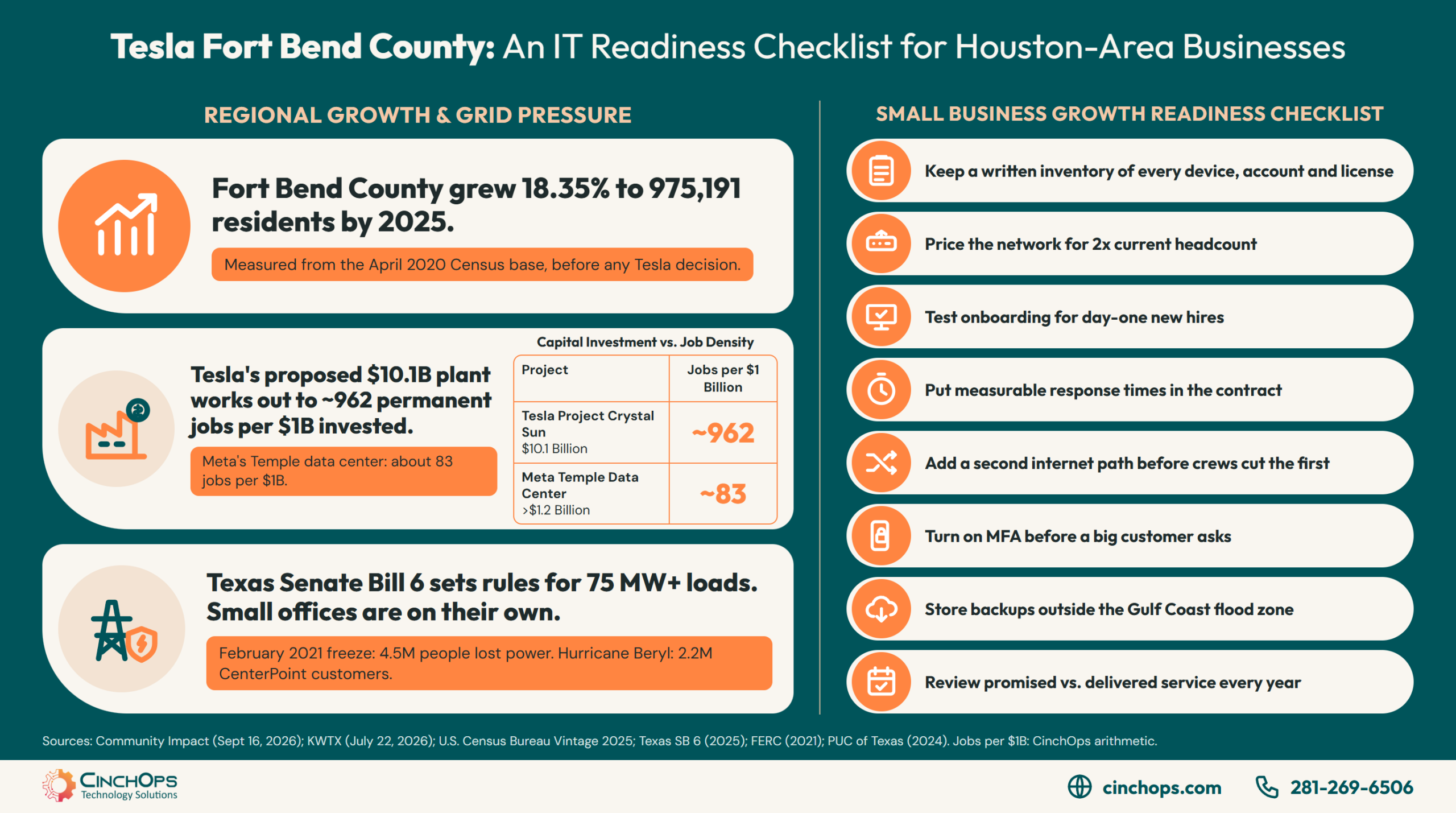
Rickert's sharpest point is that a capital-investment headline says very little about local economic value. He compares Tesla's filing with Meta's data center in Temple, which KWTX reports at more than $1.2 billion of investment, more than 1,200 skilled trade workers at peak construction and nearly 100 operations roles. CinchOps ran the arithmetic on those published figures: Tesla's application works out to roughly 962 permanent jobs per $1 billion invested, against roughly 83 per $1 billion at Meta Temple. Tesla's $1.3 billion payroll spread across 9,712 jobs is about $134,000 per position on Tesla's own numbers.
For a Fort Bend business, the jobs ratio is the number that matters. A plant at that scale means more households, more hiring competition, more construction traffic and more demand on the same CenterPoint lines your office runs on. Fort Bend already added about 151,000 residents between the April 2020 Census base and 2025, an 18.35% jump to 975,191 people per Census Vintage 2025 estimates, before any Tesla decision.
What Should a Fort Bend Business Check Before the Tesla Decision Lands?
The Fort Bend growth readiness checklist takes the 8 commitments Treasurer Bill Rickert wants from big projects and turns each into a question a local business should be able to answer about its own IT.
A growth-ready Fort Bend business can answer 8 questions about its technology in writing, the same way Rickert wants Tesla to answer 8 questions about water, power and jobs.
Rickert's list asks big projects for full resource disclosure, infrastructure cost responsibility, efficiency commitments, performance-based incentives, traffic mitigation, neighborhood protections, emergency-response coordination and annual accountability. Here is the small-business version, one item for each.
- Inventory everything you run. Rickert wants peak power, water and expansion phases disclosed before incentives. Your version is a current list of laptops, servers, firewalls, Microsoft 365 or Google Workspace accounts and who holds admin rights. You cannot plan capacity for equipment nobody has written down.
- Price the network for twice your headcount. A project should pay for the substations it needs. If a Tesla decision doubles demand for your services, know now whether your switches, wireless and internet circuit would hold 2x the users, and what upgrading costs.
- Make onboarding a checklist, not a scramble. A county adding residents this fast means hiring in waves. Every new account should get MFA, the right permissions and a managed device on day one.
- Put response times in the contract. Rickert ties incentives to delivered jobs and payroll, with recapture when promises slip. Your IT agreement should state a measurable response time and let you walk away without a penalty if it is missed.
- Plan for the fiber cut. Construction on a 3,057-acre site brings trenching, road work and utility relocation. A second internet path keeps phones and cloud apps up when a backhoe finds the first.
- Secure yourself before a big customer audits you. Suppliers and subcontractors to large manufacturers routinely get security questionnaires. MFA, endpoint protection and a written incident plan are cheaper to set up before a purchase order depends on them.
- Keep backups out of harm's way. Emergency coordination for a plant covers batteries, generators and fuel. For a business it means immutable, offsite copies that a flood in Richmond cannot reach.
- Review the promises every year. Rickert wants annual reports comparing promised and actual investment. Ask your provider for the same comparison on tickets, response times and incidents.
In 35+ years doing this, I have watched growth break more small-business networks than attackers do. The office that ran fine with 15 people starts dropping calls at 30, and the fix gets bought in a hurry at the worst price. A Fort Bend business that works this list during the months the state spends on Tesla's application gets to buy on its own schedule.
If a $10 billion plant has to report against its promises, so does your IT provider.
How Should Fort Bend Businesses Plan for Power as Big Loads Arrive?
Texas Senate Bill 6 sets new rules for very large electricity users, but a 20-person office in Fort Bend County still depends on the same local grid during storms and emergencies, so its own power and connectivity plan decides whether it keeps working through an outage.
Senate Bill 6 makes the biggest new loads share the cost and the pain of grid emergencies, but it does nothing for the small office next door when a storm takes out the neighborhood feeder.
The 2025 law signed as SB 6 directs the Public Utility Commission of Texas to set interconnection standards for large loads at a 75-megawatt threshold, requires a study fee of at least $100,000, requires those customers to contribute to the utility's interconnection costs and allows them to be curtailed during firm load shed. ERCOT can also direct a large customer to run its on-site backup generation or cut load. That is a sensible principle, and it fits Rickert's argument that growth should help pay for what it uses.
Small businesses get no such protection, and the Houston area's recent history shows why that matters. FERC reported that more than 4.5 million people in Texas lost power during the February 2021 freeze, some for as long as four days. The Public Utility Commission's investigation of Hurricane Beryl found service disrupted for 2.2 million CenterPoint customers in July 2024, roughly 90% of the utility's customer base. Grid demand questions are covered in detail in the CinchOps look at ERCOT Batch Zero and Houston large loads. The practical question for a Fort Bend office is simpler: what keeps you working when the power or the line goes down?
- Battery backup on the network core. A UPS on the firewall, switches and phone system rides through flickers and gives you time to shut down cleanly.
- A generator plan sized to the closet, not the building. Keeping the server room and network gear alive is far cheaper than backing up the whole office.
- A second carrier. CinchOps builds SD-WAN across redundant providers, such as 5G data and Starlink, alongside the primary line.
- Backups that leave the region. Geo-redundant copies stored outside the Gulf Coast flood zone mean a hurricane that closes the office does not also take the data.
Fort Bend's growth will raise demand on local circuits whether Tesla picks the county or not. A business that has these four layers in place treats the next outage as an inconvenience instead of a lost week.
Find Out Where Your Fort Bend Office Would Break First
CinchOps reviews your network, backups, internet paths and security controls against the growth checklist above and gives you a written list of gaps in plain English. Start with business continuity and disaster recovery planning that fits a 10 to 200 person company.
Book a readiness review →How CinchOps Can Help Fort Bend County Businesses Get Growth-Ready
CinchOps is a managed IT services provider based in Katy, Texas, serving small and mid-sized businesses across the Houston metro area. CinchOps specializes in cybersecurity, network security, managed IT support, VoIP, and SD-WAN for businesses with 10 to 200 employees.
CinchOps writes its own commitments down the way Rickert wants Tesla to: help desk requests answered in under 15 minutes, a flat monthly rate of $100 to $250 per user, and Zero-Zero-Zero terms with no long-term contracts, no hidden fees and no cancellation penalties.
- Through managed IT support, CinchOps keeps the device inventory, onboarding checklist and capacity plan current as headcount changes.
- Cybersecurity services cover MFA, endpoint protection and 24/7 threat monitoring, the controls a large customer's security questionnaire will ask about.
- Local coverage across Fort Bend includes Rosenberg, Richmond, Sugar Land, Fulshear and Katy, with the wider Houston metro served from the Katy office.
- Industry experience includes manufacturing, construction and energy services, the trades most likely to bid on work around a plant of this size.
The Tesla decision belongs to Tesla and the state. The checklist belongs to you, and the cheapest time to work it is before anyone breaks ground. If you want a second set of eyes on where your network, backups or power plan would fail first, talk to CinchOps.
Frequently Asked Questions
Is Tesla building a plant in Fort Bend County?
Not yet decided. Tesla has proposed Project Crystal Sun, a $10.1 billion solar cell and module plant in southeastern Fort Bend County. Lamar CISD moved its JETI incentive application forward on September 15, 2026, but the state still has to act and Tesla is also weighing a site outside Texas.
Where is the proposed Tesla site in Fort Bend County?
Community Impact reports the proposed site covers 3,057 acres at FM 1994 and FM 762 in southeastern Fort Bend County, inside Lamar Consolidated ISD. Businesses in Rosenberg, Richmond and the surrounding corridor would feel the construction traffic, hiring demand and utility work first if Tesla selects the site.
Will big new electricity users affect power for Fort Bend businesses?
Texas Senate Bill 6 requires loads of 75 megawatts or more to contribute to interconnection costs and allows them to be curtailed during firm load shed. That protects the grid, but storms still cause local outages, so a small business needs its own battery backup, second internet path and offsite backups.
What does IT support cost in Fort Bend County?
Managed IT support for a Fort Bend business with 10 to 200 employees typically runs $100 to $250 per user per month. CinchOps charges a flat rate of $100 to $250 per user per month, depending on the plan, with Zero-Zero-Zero terms: no long-term contracts, no hidden fees and no cancellation penalties.
What should a Fort Bend business ask its IT provider to commit to?
Ask for commitments you can measure: a stated help desk response time, a current device and account inventory, tested onboarding for new hires, offsite backups outside the flood zone and a yearly review comparing promised and delivered service. CinchOps answers help desk requests in under 15 minutes and puts that in writing.
Discover More
Resource
Sources
- Bill Rickert, Fort Bend County Treasurer, "From Tesla to AI Data Centers: Getting Big Development Right in Fort Bend County" (September 17, 2026)
- Community Impact, "Lamar CISD votes to move Tesla's JETI application forward" (September 16, 2026)
- KWTX, "Meta goes live in Temple with $1.2 billion AI data center" (July 22, 2026)
- Texas Legislature, Senate Bill 6, 89th Legislature, enrolled text (2025)
- U.S. Census Bureau, County Population Totals and Components of Change: 2020-2025, Vintage 2025
- FERC, "Final Report on February 2021 Freeze Underscores Winterization Recommendations" (November 16, 2021)
- Public Utility Commission of Texas, Investigation of Emergency Preparedness and Response by Utilities in Houston and Surrounding Communities, Project No. 56822 (November 2024)


