


2026 Wharton AI Adoption Report: What Houston Businesses Should Know
AI Adoption In Houston Compared With The 2026 Wharton Findings – Company Size Stopped Predicting AI Success. Habits Did Not
Wharton surveyed about 1,400 people at large U.S. companies. Five findings carry straight over to a Houston office of 10 to 200 people.
The 2026 Wharton AI adoption report, released October 13, 2026 by Wharton Human-AI Research and GBK Collective, is the fourth year of a repeated survey of how large U.S. companies use generative AI. Its headline: adoption is settled, and the open question is which companies turn it into real money.
The report is titled "The Adaptive Advantage: Who's Winning With AI and How." GBK ran a 15-minute online survey of about 1,400 full-time employees at U.S. companies with 1,000 or more employees and more than $50 million in revenue, fielded July 9 to July 29, 2026. For the first time it surveyed entry- and mid-level employees (409 of them) alongside 1,007 managers and executives, so it can compare what leaders report with what staff experience.
A Houston law firm with 30 attorneys is not in that sample. Several findings still apply directly, because they describe tools and habits a small business shares with a large one: which AI accounts employees use, how far AI is allowed to act, and whether training reaches the people doing the work. CinchOps reads research like this for Houston businesses with one filter, which is whether a finding changes a decision an owner makes this quarter.
Most Large Companies Report AI Returns, and Few Report Strong Ones
Positive return is near universal in the 2026 data. Strongly positive return is not.
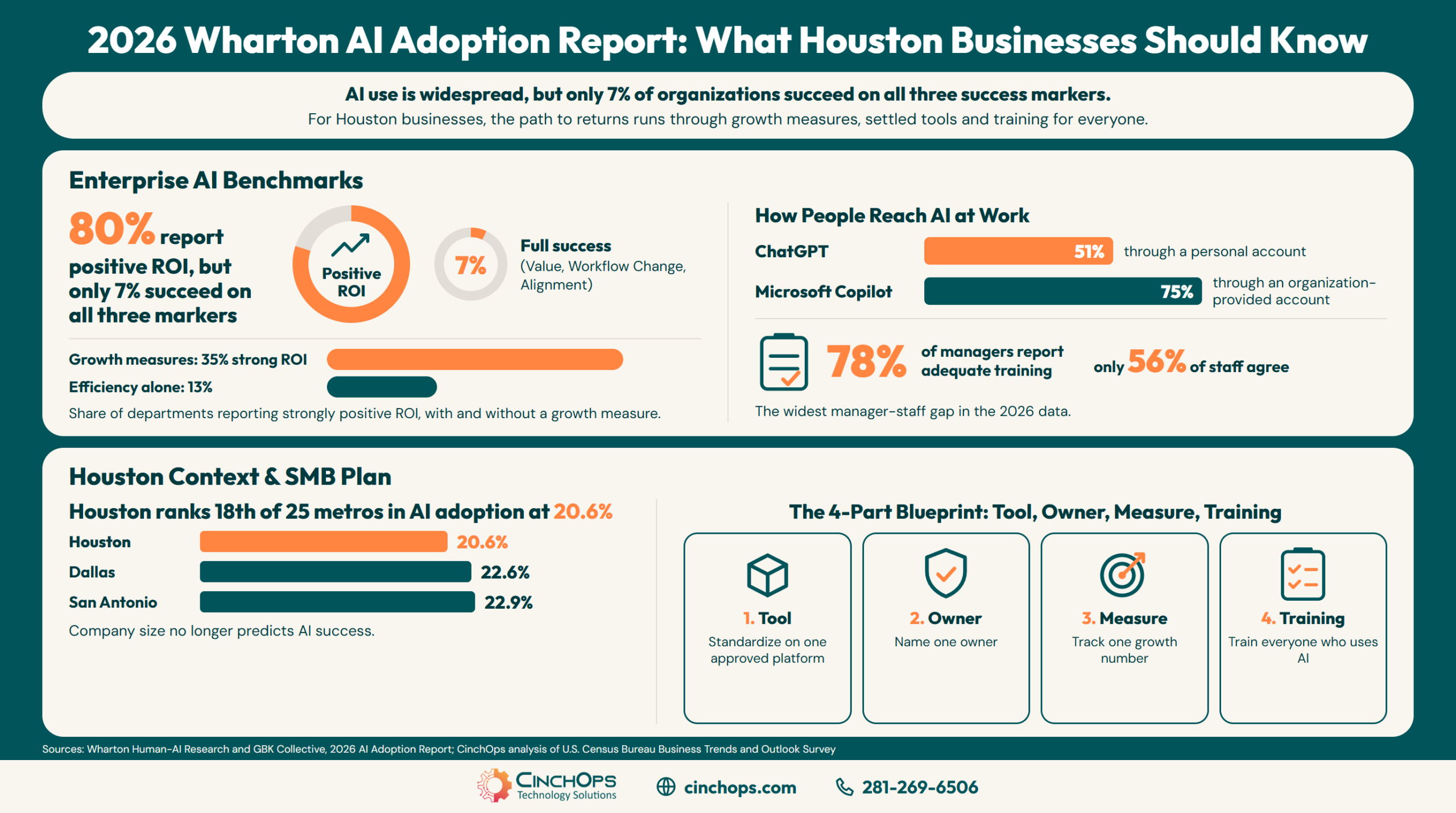
AI return on investment is broadly positive at large U.S. companies: 80% of managers in the 2026 Wharton study report a positive return. Only 28% report a strongly positive one, and just 7% of organizations succeed on all three of the study's success markers for value, workflow change and alignment.
The study's sharpest split is about what companies measure. Among departments that judge AI on at least one growth measure, such as net-new revenue, sales conversion, output volume or customer satisfaction, 35% report strongly positive returns. Among departments that judge it on efficiency alone, 13% do. Hours saved is the most common yardstick, used by 40% of departments.
For a Houston CPA practice, that is encouraging. Accounting teams already think in returns, and the study suggests that habit carries over to AI. For a Houston law firm, the Legal number is a warning about measurement, not about the technology. The ownership finding cuts the same way: 58% of companies with a new, dedicated Chief AI Officer report strongly positive ROI, against 8% with no AI owner at all. Our step-by-step guide to measuring AI ROI turns those numbers into a small-business plan.
How Far Are Companies Letting AI Act on Its Own?
AI agents are common in the 2026 data. Letting them act unsupervised is not.
An AI agent is software that carries out multi-step work, not just answers a question. In the 2026 Wharton study, 67% of departments say they use agents in some form, but only 17% let AI act without a person approving each step first.
The study breaks oversight into four levels. In 35% of departments, AI suggests or drafts and a person makes every call. In 48%, AI does the work and a person approves it before anything happens. In 10%, a person reviews a sample afterward, and in 7%, real-time monitoring and guardrails replace human review.
Risk, not capability, decides how far companies let AI go. Among departments that let AI act at least at sign-off, 66% allow it to finish low-impact internal tasks alone, 63% routine operations, 45% customer-facing actions and 32% irreversible financial or legal actions. The top barriers are data security and privacy (43%), regulation (24%) and distrust of the AI's reasoning (23%). Accountability is unsettled: no single owner reaches 30%, and 11% say nobody is clearly accountable for an agent's mistakes or do not know. A Houston firm adding agentic AI should name the person accountable for each agent before it goes live.
Personal AI Accounts Are Already Doing Company Work
The 2026 study is the clearest data yet on employees using their own AI accounts at work.
A personal AI account is a consumer login, such as a free or individual ChatGPT, Gemini or Meta AI account, that an employee uses for work instead of a company-provided account. Wharton found 51% of ChatGPT users at large companies reach it for work through a personal account.
Company policy mostly allows it. Among managers, 46% say personal AI tools are allowed with clear rules, 31% say they are openly allowed and 18% say they are prohibited. The table below compares how managers and junior employees describe the same policy, using the report's figures for each group.
| Policy on personal AI tools | Managers and above | Entry and mid-level |
|---|---|---|
| Openly allowed | 31% | 16% |
| Allowed with clear rules | 46% | 44% |
| Prohibited | 18% | 25% |
| No clear policy | 4% | 12% |
Consumer tools lead personal use. Personal accounts carry 52% of work use for Meta AI, 51% for ChatGPT and 46% for Gemini. Microsoft Copilot runs the other way, with 75% of its work users on organization-provided accounts, because it usually arrives inside a company Microsoft 365 license.
The reasons are ordinary. Among managers using personal accounts, 53% say they prefer the tool they already know, 46% say it gives better output, 34% want to keep their AI use private and 32% find corporate tools too restricted. In a Houston office, the risk is the content: a client tax return, a draft contract or a well file pasted into a consumer account leaves company control. A business that already pays for Microsoft 365 often has an approved option sitting in its license. The fix is a written rule, a business account people prefer to use, and a quick review of the AI assistant platforms on offer.
Managers and Staff Describe Two Different AI Programs
Adding junior employees to the 2026 sample exposed a gap the earlier studies could not measure.
The manager-staff gap is the most consistent finding in the 2026 Wharton study. It appears in every industry and company size group, and in every department except Purchasing and Procurement. Among managers, 39% describe an organization aligned on AI. Among entry- and mid-level employees, 26% do.
Training shows the largest gap: 78% of managers say employees get adequate AI training, and 56% of junior staff agree. Confidence using AI every day splits 79% to 62%, and belief that leadership has a clear long-term AI vision splits 79% to 64%. Junior staff are not hostile. In the study, 68% say their view of AI improved over the past year and 84% of those who use it say it saves them time.
Staff cuts widen the gap. Where departments reduced staff because of AI, only 20% of managers describe an aligned organization, against 53% where no cuts were made. The departments with strong returns did not cut more staff than others. They trained more (91% against 73%), monitored AI use more (92% against 74%) and wrote AI into performance reviews more often (87% against 65%).
Sentiment is cooling even as use climbs. Daily AI use among managers rose 16 points to 62%, while "excited" fell 8 points to 51% and "skeptical" rose 8 points to 25%. We see a version of this in small offices across the Houston metro: the owner believes the team is trained because a webinar happened, and the team quietly goes back to old habits. AI training and user adoption works better when the people using the tools are asked what is and is not working.
Company Size Stopped Predicting AI Success in 2026
The size finding is the one most relevant to a business with 10 to 200 employees.
Company size no longer predicts AI success, according to the 2026 Wharton study. Weekly AI use reached 94% at companies under $250 million in revenue, 94% at $250 million to $2 billion and 85% above $2 billion, and none of the three success markers differed by size once department, industry and seniority were accounted for.
A year earlier, weekly use stood at 79%, 87% and 70% for the same three revenue bands. The smallest tier in the study also still leads on moving pilots into production and on restructuring. Wharton notes that earlier technology waves eventually rewarded scale, and says it is too soon to know whether that happens with AI.
The caution is that "small" in this study still means 1,000 or more employees. Houston's small businesses sit well below that, and they are earlier in adoption. CinchOps' analysis of the U.S. Census Bureau's Business Trends and Outlook Survey put Houston-area business AI use at 20.6% averaged across 2026, 18th of the 25 largest metros and below Dallas at 22.6% and San Antonio at 22.9%. Another 24.9% of Houston-area businesses expect to use AI within six months.
Read together, the two studies suggest Houston businesses are not behind for lack of size. They are behind on starting. A firm in The Woodlands or Cypress that begins this year can adopt the habits large companies learned the slow way: one approved platform, one owner, one growth measure and training that reaches the whole staff.
A 30-person Houston firm does not need a Chief AI Officer to copy what worked in the Wharton data. It needs one approved tool, one person who owns it, one growth number to judge it by and training that reaches everyone who uses it.
Find the AI Accounts Your Team Already Uses
Half of ChatGPT work use at large companies runs through personal accounts. The same pattern in a small office puts client data outside your control. AI security and risk management starts with an inventory of who uses what.
Start an AI account review with CinchOpsHow CinchOps Can Help Houston Businesses Act on the Wharton Findings
CinchOps is a managed IT services provider based in Katy, Texas, serving small and mid-sized businesses across the Houston metro area. CinchOps specializes in cybersecurity, network security, managed IT support, VoIP, and SD-WAN for businesses with 10 to 200 employees.
Wharton measures success on three markers: proving value, transforming workflows and aligning the organization. Among managers, 28% clear the first, 20% of departments clear the second and 39% clear the third. Only 7% of organizations clear all three. Each marker maps to work a small business can schedule this quarter.
- For proving value, AI strategy work sets the growth measure and the full AI spend figure before the next renewal
- For workflow change, AI workflow automation finishes one low-risk workflow at a time, with logging and a named owner
- For alignment, AI policy and governance puts the approved tools and the personal-account rule in writing for every employee
- Managed IT support is billed at a flat $100 to $250 per user per month, and help desk requests are answered in under 15 minutes
- Coverage across Houston, The Woodlands and Cypress, with industry work for law firms, CPA firms and oil and gas companies
The Wharton study is about companies far bigger than most Houston businesses, but the lesson is small-business sized: settle the tools, name the owner, measure growth and train everyone. None of that needs an enterprise budget. If your team is using AI and nobody can say what it costs or what it returned, talk to CinchOps.
Frequently Asked Questions
What is the 2026 Wharton AI adoption report?
It is the fourth annual study by Wharton Human-AI Research and GBK Collective, titled "The Adaptive Advantage: Who's Winning With AI and How." Published October 13, 2026, it surveyed about 1,400 employees at U.S. companies with 1,000 or more employees on AI use, returns, agents, training and policy.
Does the Wharton study apply to small businesses?
Partly. Every company surveyed has 1,000 or more employees, so the numbers describe large firms. The behaviors travel, though. Wharton found none of its three success markers differed by company size once department, industry and seniority were accounted for, which suggests habits matter more than headcount.
How many companies see strong returns from AI?
In the 2026 Wharton study, 80% of managers report a positive return on AI and 28% report a strongly positive one. Departments that judge AI on at least one growth measure report strong returns at 35%, against 13% for departments that track efficiency measures such as hours saved alone.
Is it safe for employees to use personal AI accounts at work?
Not with client or company data. Wharton found 51% of ChatGPT users at large companies use it for work through a personal account. Those consumer accounts sit outside company data terms and security controls. A business account on an approved platform and a written rule close most of that gap.
How far should a small business let AI agents act on their own?
Start with low-risk internal tasks and keep a person on anything irreversible. In the Wharton study, 66% of departments that let AI act allow it on low-impact internal tasks, while 32% allow irreversible financial or legal actions. Name one accountable person for every agent before it goes live.
What does AI adoption support cost in Houston?
The published CinchOps managed IT rate is a flat $100 to $250 per user per month, with no long-term contract, hidden fees or cancellation penalty. AI strategy, governance and automation projects for Houston businesses are scoped after a review of the tools and accounts already in use.
Discover More
Resource
Sources
- Wharton Human-AI Research and GBK Collective, "The Adaptive Advantage: Who's Winning With AI and How," 2026 AI Adoption Report, full report (October 2026)
- Knowledge at Wharton, 2026 AI Adoption Report landing page (published October 13, 2026)
- CinchOps, "Houston Small Business AI Adoption: The 2026 Census Report," analysis of the U.S. Census Bureau Business Trends and Outlook Survey
- U.S. Census Bureau, Business Trends and Outlook Survey data

